2026-27 Washington Wizards NBA Season Preview, Team Traditions, History, and Key External Links

The 2026-27 Washington Wizards season will arrive with a familiar mix of patience, pressure, and hope. For a franchise with deep roots, one NBA championship, several identity changes, and a fan base that has lived through every kind of rebuild, the coming season is more than a schedule of 82 games. It is another test of direction.
A good Wizards preview should do more than guess wins and losses before the roster is final. The better question is what kind of team Washington is trying to become. That means watching player development, front office choices, defensive habits, draft capital, and how the club connects the present to a long, complicated history.
This 2026-27 Washington Wizards NBA Season Preview Team Traditions History and Key External Links guide covers the big storylines to track, the franchise traditions that still matter, the history behind the team, and the best outside resources for following the season.

The 2026-27 season should be measured by progress more than quick fixes
Washington has spent recent seasons trying to build a clearer long-term path. For 2026-27, the key will be whether that plan starts to look visible on the floor.
The Wizards do not need to be judged only by the standings early in the season. A young or retooling team can lose games while still taking useful steps. The signs that matter most are usually easy to see if you know where to look:
Better shot selection
Fewer rushed possessions, more paint touches, and cleaner catch-and-shoot chances.
Defensive structure
Young teams often struggle on defense. Progress shows up in rotations, communication, and fewer open looks at the rim.
Role clarity
The best rebuilding teams stop asking every player to do everything. Each player needs a job that fits.
Late-game execution
Close games reveal coaching, spacing, decision-making, and trust.
Player growth across the season
A real step forward in March means more than a hot week in November.
The 2026-27 preview also depends on roster movement before opening night. The NBA Draft, free agency, trades, two-way contracts, and player development can reshape the team quickly. For that reason, the best early read is not a fixed prediction. It is a checklist.
By the first month of the season, the main questions should be clear. Who handles the toughest defensive assignment? Who closes games? Which young players earn steady minutes? Does the offense create good looks without relying on broken plays? Does the team compete on the road?
If Washington answers some of those questions well, the season can hold value even if the win total still trails the Eastern Conference’s top teams.
The Wizards’ identity is tied to Washington basketball history
The Wizards’ story is not one straight line. The franchise began as the Chicago Packers in 1961, became the Chicago Zephyrs, moved to Baltimore as the Bullets, later became the Capital Bullets, then the Washington Bullets, and finally changed to the Washington Wizards in 1997.
That history matters because the team’s identity carries more than one era. The city remembers the championship years, the name change, the star-led playoff teams, the lean stretches, and the constant search for the next stable core.
The franchise’s high point remains the 1978 NBA championship. Led by Wes Unseld and Elvin Hayes, Washington beat the Seattle SuperSonics to win the title. Unseld remains one of the defining figures in team history, not only because of his playing career, but because his name still connects the modern franchise to its greatest era.
Other key names help tell the story:
Era | Figures and meaning |
Baltimore and early Washington years | Wes Unseld, Elvin Hayes, and the 1978 title team built the franchise’s lasting standard. |
1980s and 1990s transition | The team searched for a new identity and eventually became the Wizards in 1997. |
Early 2000s attention | Michael Jordan’s time with Washington brought national focus, even though it did not lead to deep playoff success. |
2010s playoff core | John Wall and Bradley Beal led the franchise back to relevance with several playoff runs. |
Current era | The focus has shifted toward development, roster building, and creating a sustainable foundation. |
The Wizards’ past can be frustrating because it shows what the franchise has touched before without fully repeating it. It can also be useful. Washington has won big before. The standard exists. The challenge is building a modern version of it.

Team traditions give the season a local heartbeat
Some NBA traditions are formal. Others live through fans, colors, old memories, and game-night habits. The Wizards have a mix of both.
The red, white, and blue look connects the team to Washington, D.C. in a way that feels natural. It fits the city, the flag colors, and the franchise’s modern visual identity. Even when the roster turns over, the color scheme keeps the team rooted in place.
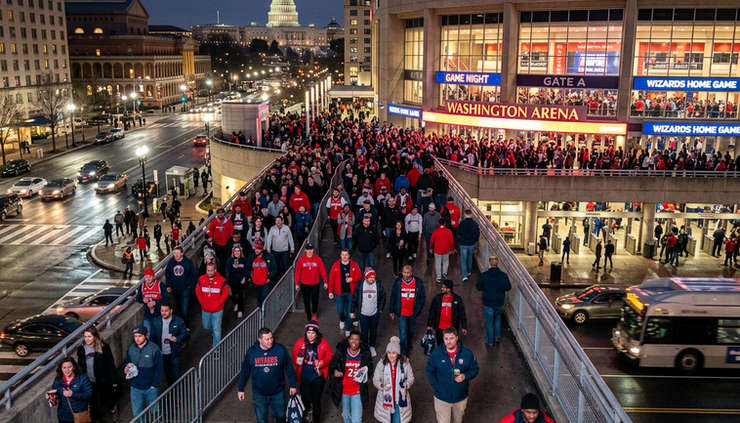
Home games at Capital One Arena also shape the rhythm of the season. The building sits in downtown Washington, close to restaurants, Metro stops, museums, and other major venues. For many fans, a Wizards game is part of a larger night in the city. That matters for a team trying to keep energy around a rebuild.
The franchise also carries tradition through alumni recognition. When past greats appear at games or receive honors, they connect younger fans to the Bullets and early Wizards eras. That link is especially valuable for a team whose best historical moment came under a previous name.
Then there is the local basketball culture around the team. Washington, D.C. has long been associated with strong high school, college, and playground basketball. The Wizards do not exist apart from that culture. They sit in the middle of it. A successful Wizards era would not just give the city a winning NBA team. It would give local basketball a stronger professional anchor.
The Capital City Go-Go, Washington’s NBA G League affiliate, should also be part of the 2026-27 conversation. Player development now extends beyond the main roster. The G League can give young players real minutes, help with injury returns, and let the organization test roles in live competition.
For a rebuilding or developing franchise, those details matter. Traditions are not only ceremonies and throwback nights. They also include the habits that help a team grow.
The main basketball questions for 2026-27
The Wizards’ 2026-27 season will likely be shaped by a handful of basketball questions. Some will be answered before opening night. Others will take months.
Can the defense become reliable enough to support young players?
Defense usually comes last for young teams. It requires strength, timing, trust, and experience. Washington’s progress will depend on whether the team can defend without constant scrambling.
Watch for these signs:
Guards fighting over screens instead of dying on them
Wings rotating early to protect the paint
Bigs communicating coverage clearly
Fewer second-chance points allowed
Better transition defense after missed shots
A team can survive offensive cold streaks if the defense holds. Without that base, every game becomes a shooting contest.
Does the offense create advantages before the final seconds?
A healthy offense creates motion before panic sets in. For Washington, that means getting two feet in the paint, moving the ball side to side, and generating open shots through design rather than desperation.
The most encouraging possessions are often simple. A good screen. A smart cut. A kickout pass. A second drive. A clean corner three. If the Wizards can stack those plays, they can build an offense that helps young players make faster reads.
Which players become part of the long-term core?
Every developing team faces the same hard question. Which players are keepers, and which players are placeholders?
The answer is rarely based on scoring alone. Teams need players who defend, pass, rebound, space the floor, and accept changing roles. The front office will be watching how players respond to coaching, mistakes, and competition for minutes.
By the second half of the season, the Wizards should have a better idea of which players fit together. That fit matters as much as individual talent.

Key external links for following the Wizards season
A good season preview needs reliable sources. Rosters, schedules, injuries, standings, and transactions change fast. These links are the best places to track the 2026-27 Wizards as details become official.
Resource | Best use |
Team news, tickets, schedule updates, roster pages, videos, and official announcements. | |
Game dates, opponents, start times, and broadcast details when released. | |
Current player list, jersey numbers, positions, heights, and official bios. | |
Eastern Conference race, division standings, and playoff positioning. | |
Team and player data, shot charts, advanced numbers, and lineup information. | |
Historical records, season-by-season results, player stats, and franchise history. | |
G League roster news, assignments, development updates, and schedule information. | |
Local coverage, broadcast information, interviews, and Wizards features. |
The official team site is the best starting point for confirmed news. NBA.com is best for leaguewide context. Basketball-Reference is the cleanest historical reference for comparing eras. The Go-Go site helps track player development beyond the main roster.
For fans who like to follow the season closely, a simple routine works well. Check the official schedule for game details, NBA stats after each game, standings once a week, and the Go-Go site when young players move between levels.
How the season could become a success
Success for the 2026-27 Wizards does not have to mean jumping straight into the top of the East. That would be welcome, but the more realistic goal is building proof.
Proof can look like a young player becoming a clear starter. It can look like a defense that climbs from poor to competitive. It can look like a bench unit with a real identity. It can look like a front office making disciplined decisions instead of chasing short-term noise.
A successful season would leave Washington with fewer questions than it had in October.
By spring 2027, the franchise should want clear answers to these points:
Which players fit the next good Wizards team?
What style of play gives the roster its best chance?
Which positions still need major upgrades?
Has the coaching staff built habits that can last?
Are fans seeing a team that competes with purpose?
The standings will matter, of course. They always do. But the deeper value is whether the Wizards look closer to a real foundation.
The takeaway for 2026-27
The 2026-27 Washington Wizards season should be watched with both patience and standards. Patience because the franchise is still shaping its future. Standards because Washington basketball has history, a championship legacy, and a fan base that knows the difference between empty promises and real progress.
The best version of this season gives the Wizards a clearer identity. It shows improved defense, smarter offense, stronger player development, and a roster that starts to make sense together. It also keeps the franchise connected to the traditions that give it weight, from the 1978 title team to downtown game nights and the next wave of players trying to earn a place in Washington basketball history.
The season will not be defined by one opening-night storyline. It will be defined by growth that lasts after the final buzzer.


Comments