2026 Stanford Cardinal Football Season Guide Schedule History Traditions and Fan Tips

Stanford football has always carried a different flavor. It blends elite academics, West Coast scenery, oddball humor, old rivalries, and a program history that runs through Rose Bowls, Heisman moments, and some of the sport’s most famous names.
The 2026 Stanford Cardinal football season lands in a newer era for the program. Stanford is no longer defined only by its old Pac-12 map. As an ACC member, the Cardinal now mixes traditional California and Notre Dame storylines with coast-to-coast conference travel. That makes planning the season more interesting for fans, alumni, students, and anyone curious about seeing a game at Stanford Stadium.
This guide covers the schedule storylines to watch, the history that shaped the program, the traditions that make game day feel like Stanford, and practical tips for attending a game in Palo Alto.

Schedule
The official 2026 schedule, kickoff times, and TV windows should always be checked through Stanford Athletics and the ACC before making travel plans. College football times often shift during the season based on broadcast selections, and late-season games can move into afternoon, evening, or primetime slots.
That said, the shape of Stanford’s schedule offers several reliable storylines.
The Big Game remains the emotional centerpiece
The rivalry against California is the first game many Stanford fans circle. Known simply as The Big Game, Stanford vs. Cal is one of college football’s oldest and most recognizable rivalries. It carries more than standings value. It is about the Stanford Axe, Bay Area pride, alumni bragging rights, and a century-plus of stories.
For new fans, this is the game to understand first. Even when one team enters with a stronger record, the rivalry has a way of ignoring predictions. The atmosphere has a sharper edge, the student sections are louder, and the pregame talk stretches across both sides of the Bay.
Notre Dame brings national attention
Stanford’s series with Notre Dame has become one of the program’s most visible nonconference fixtures when it appears on the schedule. The matchup connects two highly respected academic universities with national football brands. It also tends to draw viewers who may not follow Stanford every week.
When Stanford hosts Notre Dame, expect strong visiting fan turnout, higher ticket demand, and a more national media feel around the game. When the Cardinal travel to South Bend, it becomes one of the season’s marquee road atmospheres.
ACC games create new travel and style challenges
Stanford’s ACC era adds a unique twist. Conference play can mean long road trips across multiple time zones and matchups against programs with different regional styles, traditions, and climates.
That shift matters on the field. A West Coast team playing an early game in the Eastern Time Zone faces a different rhythm than a short regional road trip. Depth, routine, and preparation become part of the season story.
At home, ACC opponents give Stanford fans a chance to see teams that rarely visited Palo Alto in the old conference alignment. That novelty can make the home schedule feel fresh, especially for season-ticket holders.
Home games to watch closely
Stanford Stadium can be a comfortable place to watch football, but the best home games usually share a few traits:
Game type | Why it matters | Fan tip |
Rivalry games | They carry history beyond the standings | Buy tickets early and arrive well before kickoff |
ACC home openers | They set the tone for conference play | Watch how Stanford handles new matchups |
Night games | The stadium has a different energy under the lights | Bring layers, Palo Alto evenings can cool quickly |
Late-season games | Bowl hopes, roster growth, and rivalry stakes often sharpen | Check weather and kickoff updates before traveling |
Road games tell the bigger story
Stanford’s road slate is worth watching even for fans who never leave California. Long-distance ACC travel can reveal a team’s maturity. Games outside the Pacific Time Zone may test focus, depth, and coaching adjustments.
For fans who like destination trips, Stanford road games can be a fun way to explore college football regions beyond the West Coast. Just build in extra time. Cross-country football weekends work best when flights, hotels, and ground transportation are booked early.
Team History
Stanford football dates back to the late 19th century, and the program’s identity has shifted many times. It has been a national power, a Rose Bowl regular, a quarterback factory, a physical running team, and now a coast-to-coast ACC member.
The program began play in the 1890s and soon became part of the early fabric of West Coast football. One of the most important early figures was Pop Warner, the legendary coach who helped build Stanford into a national name. His teams helped establish the program’s place among the sport’s serious contenders.
Stanford claims national championships from the early and mid-20th century, including the 1926 and 1940 seasons. Those years remain key markers in the program’s record book, along with multiple conference titles and Rose Bowl appearances.
The Rose Bowl is central to Stanford’s football story. The Cardinal has appeared on that stage across different eras, from early classics to modern victories. The 1971 and 1972 Rose Bowl wins helped define one golden stretch. Decades later, Stanford returned to Pasadena as a power under David Shaw, winning the 2013 Rose Bowl after the 2012 season and the 2016 Rose Bowl after the 2015 season.
Stanford’s great players shaped football beyond campus
Stanford’s best-known football alumni include some of the sport’s most respected names.
Jim Plunkett won the 1970 Heisman Trophy and later became a Super Bowl-winning quarterback. John Elway became one of the most famous quarterbacks in football history. Andrew Luck helped lead Stanford’s modern rise and became one of the most celebrated college quarterbacks of his era.
The program has also produced elite players across positions, including Ernie Nevers, Christian McCaffrey, Richard Sherman, Zach Ertz, and many others who carried Stanford’s name into the NFL.
The modern rise changed expectations
The late 2000s and 2010s gave Stanford one of its strongest modern runs. Jim Harbaugh helped revive the program with toughness, recruiting momentum, and national relevance. David Shaw, a Stanford alumnus, then built on that foundation with conference titles, major bowl appearances, and a clear identity built around physical play.
That era matters because it reset what fans expect. Stanford was not just a smart underdog. It became a team that could win the line of scrimmage, produce NFL talent, and compete in high-stakes national games.
The move to the ACC adds another chapter. It asks Stanford to preserve its identity while adapting to a much different football map.
Traditions
Stanford traditions are not always traditional in the usual college football sense. Some are old. Some are strange. Some are proudly irreverent. Together, they make Stanford game day feel distinct.
The Stanford Tree stands alone
Stanford’s official nickname is the Cardinal, referring to the color, not a bird. The most famous sideline figure, though, is the Stanford Tree.
The Tree is the unofficial mascot of the Leland Stanford Junior University Marching Band. It is intentionally odd, homemade in spirit, and different every year. That is part of the charm. While many schools present polished mascots, Stanford leans into weirdness.
For first-time fans, seeing the Tree is almost a rite of passage. It perfectly captures the mix of seriousness and satire that runs through Stanford athletics.
The band is part music and part performance art
The Leland Stanford Junior University Marching Band, often called the LSJUMB, does not look or sound like a standard military-style marching band. It is a scatter band known for loose formations, humor, and unpredictable energy.
The band has sometimes been controversial, but it remains one of the most recognizable parts of the Stanford football experience. Its style fits Stanford’s personality: clever, chaotic, and hard to confuse with anyone else.
The Stanford Axe defines rivalry week
The Stanford Axe is the trophy awarded to the winner of The Big Game. Its history includes student pranks, thefts, recoveries, and carefully guarded appearances. The Axe is more than a trophy. It is the symbol of Stanford-Cal competition.
During rivalry week, the Axe becomes the focus of rallies, chants, and campus events. Winning it can brighten a difficult season. Losing it can sting even during a successful one.
“All Right Now” brings the stadium together
Stanford fans often associate “All Right Now” by Free with game-day celebrations. It is one of those songs that can turn a routine break in play into a shared stadium moment.
The traditions may not be as uniform as some programs in the South or Midwest, but that is the point. Stanford’s rituals are quirky, local, and very much its own.

Fan Guide
Stanford Stadium sits on campus in Stanford, California, beside the broader Palo Alto and Silicon Valley area. It is one of the more scenic and relaxed settings in major college football. The rebuilt stadium holds roughly 50,000 fans, which makes it large enough for big-game energy but more manageable than many massive college venues.
Getting to Stanford Stadium
Traffic can build near campus on game days, especially for rivalry games or high-profile opponents. Plan to arrive early and treat the pregame window as part of the experience.
Good options include:
Driving and parking on campus
Buy or review parking information in advance through Stanford Athletics. Lots and access routes can vary by game.
Caltrain to Palo Alto
Caltrain can be a useful option for fans coming from San Francisco, the Peninsula, or the South Bay. From the Palo Alto station, check game-day shuttle options or prepare for a walk or rideshare.
Biking or walking
Stanford is bike-friendly, and local fans often find biking easier than sitting in traffic. Bring a lock and check designated bike areas.
What to wear and bring
Palo Alto weather can shift from warm afternoon sun to cool evening air. Layers are the safest choice.
A simple game-day kit works well:
Cardinal red shirt, sweatshirt, or jacket
Sunglasses and sunscreen for day games
Light layer for night games
Mobile ticket ready before reaching the gate
Clear bag or small approved bag, based on the current stadium policy
Refillable water bottle only if stadium rules allow it
Always check the latest stadium policies before leaving home. Bag rules, entry procedures, and allowed items can change.
Where to sit
Stanford Stadium offers good sightlines in many sections because of its modern bowl design. The best seat depends on the desired experience.
Preference | Best fit |
Loud student energy | Sections near the student area |
Better tactical view | Higher rows near midfield |
Family-friendly comfort | Reserved seats away from the student section |
Shade potential | Check the kickoff time and sun angle before buying |
For rivalry games, expect more visiting fans and a louder atmosphere. For early-season nonconference games, the mood can feel more relaxed and family-friendly.
Pregame atmosphere
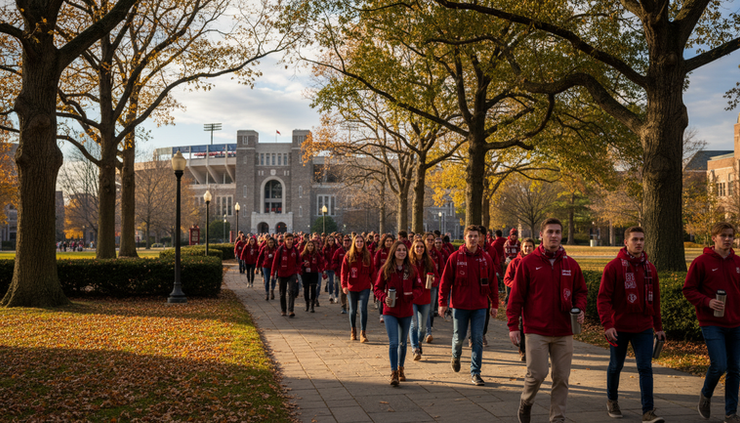
Stanford game days tend to feel less frantic than some college football destinations. That can be a strength. The campus is beautiful, the walking routes are pleasant, and the setting rewards fans who arrive early.
Explore the area around the stadium, look for official fan events, and give yourself time to enjoy the campus. If traveling from out of town, Palo Alto, Menlo Park, Mountain View, and nearby Peninsula cities offer plenty of food and lodging options.
Tips for first-time fans
A first Stanford game is easier to enjoy with a little planning.
Learn the difference between Cardinal and Cardinals. Stanford is the Cardinal.
Watch for the Tree and the band. They are central to the personality of the place.
If Cal is the opponent, read up on the Stanford Axe before kickoff.
Check kickoff time again during game week.
Bring layers, even if the afternoon forecast looks warm.
Arrive early enough to walk the campus instead of rushing straight to the gate.

Reasearch Links
Use official sources for final details on dates, tickets, policies, and broadcasts. These links are useful starting points for following Stanford football through the 2026 season.
Stanford Football official site
The main source for roster updates, schedules, game notes, news, and team information.
Check single-game tickets, season tickets, student information, and special ticket offers.
Review stadium details, seating, directions, parking guidance, and game-day policies.
Follow conference standings, weekly matchups, awards, and ACC-wide news.
Useful during Big Game week for rivalry context, opponent news, and event details.
Helpful when Stanford and Notre Dame meet, especially for travel and matchup coverage.
NCAA football scores and rankings
A broad source for national context during the season.
The 2026 season is a chance to watch Stanford keep building its ACC identity while holding onto the traditions that made the program distinct in the first place. Start with the rivalry games, keep an eye on the long road trips, and make time for the odd, funny, very Stanford details around the stadium. That mix is what turns a fall Saturday in Palo Alto into something worth planning around.


Comments