Anaheim Ducks Season Guide, Team History, Traditions, and Fan Experiences

The Anaheim Ducks are one of the NHL’s most recognizable modern franchises, born from a Hollywood idea and shaped into a championship club with a loyal Orange County fan base. Their story has movie roots, Hall of Fame talent, legendary playoff nights, and a game day culture that feels distinctly Southern California.
This season guide brings that full picture together. It covers how the Ducks grew from an expansion team into Stanley Cup champions, what traditions define the fan experience, and where to go for reliable team news, records, schedules, and fan conversation.
The Ducks began as a bold hockey experiment in Orange County
The Ducks entered the NHL in 1993 as the Mighty Ducks of Anaheim, an expansion team owned by The Walt Disney Company. The name tied directly to the 1992 film The Mighty Ducks, which gave the franchise instant pop-culture recognition before it had played a single regular-season game.
That origin made the club unusual from day one. Many NHL teams built their identities around local industry, geography, or decades of tradition. Anaheim built its first identity around a fictional youth hockey team, then had to prove it belonged in the real NHL.
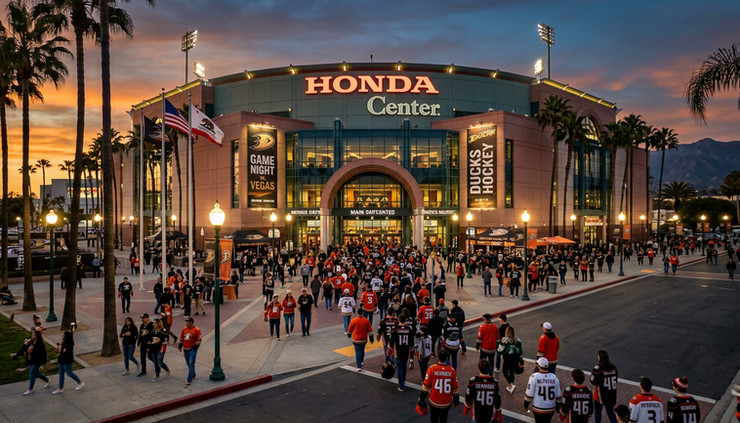
The early years were not easy, but they were never dull. The team played at what was then called the Anaheim Arena, later known as Arrowhead Pond of Anaheim, and now Honda Center. The original colors, jade, eggplant, silver, and white, stood out across the league. So did the goalie-mask logo, which remains one of the most beloved marks in franchise history.
The Ducks quickly found their first true superstar in Paul Kariya, a dynamic forward whose speed, skill, and creativity gave Anaheim credibility. When Teemu Selanne joined the club in 1996, the Ducks suddenly had one of the NHL’s most exciting scoring duos.
Kariya and Selanne helped lead Anaheim to its first playoff appearance in 1997. That season mattered because it turned the Ducks from a novelty into a competitive team. The franchise had arrived.
For official team history and current club information, the best place to start is the Anaheim Ducks official website. For season-by-season stats, records, and rosters, Hockey Reference’s Anaheim Ducks page is one of the most useful historical archives.
The franchise built its legacy through unforgettable playoff runs
The Ducks’ first great national spotlight came in 2003. Anaheim entered the playoffs as an underdog and went on a stunning run to the Stanley Cup Final. Goaltender Jean-Sebastien Giguere became the story of the postseason with a series of brilliant performances.
Anaheim swept the defending champion Detroit Red Wings in the first round, then pushed all the way to Game 7 of the Stanley Cup Final against the New Jersey Devils. The Ducks lost the series, but Giguere won the Conn Smythe Trophy as playoff MVP, a rare honor for a player on the losing finalist.
That run changed the franchise’s reputation. Anaheim was no longer just a fun expansion team with movie ties. It was a legitimate NHL threat.
A few years later, the Ducks changed both ownership and identity. Henry and Susan Samueli purchased the franchise in 2005. The team shortened its name to the Anaheim Ducks before the 2006-07 season and introduced a new color scheme built around black, gold, orange, and white.
Then came the defining season.
In 2007, Anaheim won the Stanley Cup, defeating the Ottawa Senators in five games. The Ducks became the first California team to win the Cup. That roster had star power and balance, led by Scott Niedermayer, Chris Pronger, Teemu Selanne, Andy McDonald, Ryan Getzlaf, Corey Perry, and Giguere.
Niedermayer won the Conn Smythe Trophy that spring, capping one of the finest defensive playoff performances of his era. For Ducks fans, 2007 remains the gold standard. It gave the franchise a permanent place in NHL history.
The post-Cup years brought more milestones. Perry won the Hart Trophy in 2011 as the NHL’s most valuable player after a 50-goal season. Selanne continued to build his legacy as one of the greatest Finnish players in league history. Getzlaf grew into the longtime captain and emotional center of the team.
From the early 2010s through 2017, the Ducks were one of the NHL’s most consistent regular-season teams. They won multiple Pacific Division titles and reached the Western Conference Final in 2015 and 2017. Those teams mixed veteran leadership with heavy, skilled forward play and strong defense.
The franchise has also honored its greatest figures by retiring three numbers:
Retired number | Player | Why it matters |
8 | Teemu Selanne | Franchise icon, elite scorer, and one of the most beloved Ducks ever |
9 | Paul Kariya | First face of the franchise and a defining star of the Mighty Ducks era |
27 | Scott Niedermayer | Stanley Cup captain and Conn Smythe winner in 2007 |
For broader hockey context, the Hockey Hall of Fame is a strong resource for player legacies and historical background.
The modern Ducks are building around a new young core
The current era is centered on development, patience, and the next wave of Ducks talent. Anaheim has moved away from the Getzlaf and Perry years and into a rebuild built around speed, creativity, and high draft picks.
Several young players have shaped the new identity. Trevor Zegras brings skill and flair. Mason McTavish adds strength and two-way promise. Leo Carlsson, one of the franchise’s key recent draft picks, gives the Ducks a high-upside center to build around. Pavel Mintyukov has shown the kind of offensive instincts from the blue line that modern teams need.
This season, the main story is not just wins and losses. It is progress.
A useful Ducks season guide should track a few things during the year:
How the young centers handle tougher matchups
Whether the power play becomes more consistent
Which defense pairs earn the coaching staff’s trust
How the goaltending holds up across long road trips
Which prospects push for bigger roles
The Ducks play in a demanding Pacific Division, where travel, rivalries, and playoff races can test a young roster. Games against the Los Angeles Kings and San Jose Sharks carry extra weight because of California bragging rights. Matchups with Vegas, Edmonton, and Vancouver often show how close Anaheim is to climbing the standings.
For current schedules, ticket information, and roster updates, use the official Ducks schedule page and the team roster page. For venue information, parking, bag policies, and event details, check Honda Center.

Ducks traditions make game day feel different
Anaheim’s traditions blend NHL culture with Southern California personality. The result is a game day experience that feels relaxed before puck drop, loud once the game starts, and deeply tied to the team’s unusual history.
The most famous symbol is Wild Wing, the Ducks’ mascot. A duck mascot in a goalie mask could have felt like a gimmick, but Wild Wing became part of the franchise’s identity. Kids love the character, longtime fans remember the original Mighty Ducks era, and the mascot keeps the team’s playful roots alive.
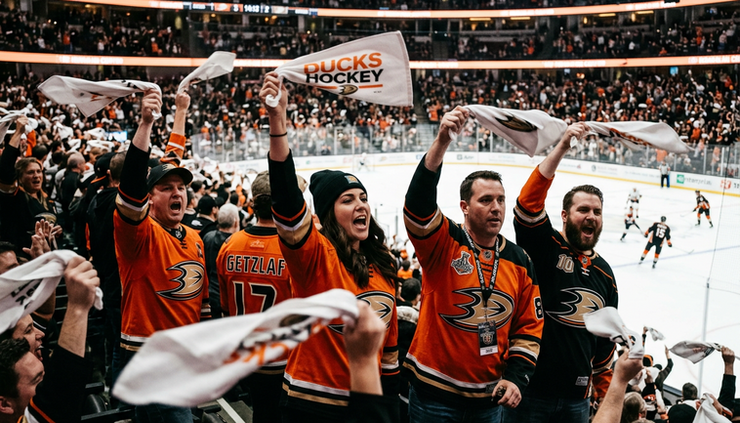
The crowd also has its own sound. Chants of “Let’s go Ducks” roll through Honda Center, especially after big saves, power-play chances, and late-game pushes. During playoff runs, rally towels turn the seating bowl into a moving wall of white and orange.
The team’s color history also matters. Some fans still have deep affection for the original eggplant and jade look. Others connect more with the orange-heavy identity that ties the club to Orange County. Throwback jerseys and retro nights often bring those eras together in one building.
Game day in Anaheim usually has a few familiar pieces:
Fans arrive early around Honda Center for food, photos, and warmups
Kids line the glass to watch players skate before the game
Wild Wing moves through the building for photos and crowd moments
The goal horn and celebration music turn scoring plays into full-arena releases
Fans linger after wins, especially against rivals
The Ducks also have a strong community presence through youth hockey, local events, and foundation programs. That local connection matters in a market where many residents did not grow up with NHL hockey. The team helped create hockey fans in Orange County, not just serve them.
For fans who want conversation beyond official channels, several independent communities follow the team closely. Anaheim Calling has long been a Ducks fan site with commentary and analysis. Crash The Pond offers Ducks-focused discussion and fan coverage. The Anaheim Ducks Reddit community is also active around games, roster moves, and prospects.
A simple guide for following the season
For new fans, the best way to follow the Ducks is to build a weekly rhythm. Watch the schedule, learn the main lines and pairings, and notice which players get trusted late in close games. Hockey moves fast, but patterns show up over time.
Start with these basics:
Follow the official team channels
Use the Ducks’ website for schedules, roster moves, game previews, and ticket links. Official sources are best for confirmed news.
Check historical context
When a broadcast mentions Selanne, Kariya, Getzlaf, Perry, Giguere, or Niedermayer, look up that player’s franchise role. The Ducks’ past helps explain why certain names mean so much in Anaheim.
Watch special teams
Power plays and penalty kills often decide close games. For a rebuilding team, special teams can show whether structure and confidence are improving.
Learn the rivalries
Ducks versus Kings is the main local rivalry. Ducks versus Sharks has long carried California history. Games against recent Pacific Division powers show how Anaheim compares to the teams it wants to catch.
Pay attention to prospects
For the modern Ducks, young-player development is one of the biggest storylines. A strong shift from a young defenseman or center can matter as much as the final score in a rebuilding year.
For deeper statistical browsing, HockeyDB’s Anaheim Ducks page is useful for roster history and player records. NHL.com’s official standings page helps track the division race throughout the season.

The Ducks’ identity keeps connecting past and future
The Anaheim Ducks have always lived between eras. They began with a movie name and a bold color palette. They became a serious contender behind Kariya, Selanne, and Giguere. They reached the top of the sport in 2007 with Niedermayer, Pronger, Getzlaf, Perry, and a roster built for playoff hockey. Now they are trying to grow again through a young core and a fan base that has seen both struggle and celebration.
That mix is what makes the Ducks worth following. The franchise has nostalgia, but it is not stuck there. It has a championship standard, but it is rebuilding toward the next version of itself. It has traditions that welcome new fans, while still rewarding those who remember the roar of the 2003 run or the final seconds of the 2007 Cup clincher.
A Ducks season is best enjoyed with one eye on the present and one on the larger story. Watch the young players grow. Learn the names in the rafters. Get to Honda Center if possible. Join the chants, follow the fan conversations, and keep the history close. Anaheim hockey has never followed the most traditional path, and that remains part of its charm.


Comments