George Balanchine The Nutcracker History Highlights and First Time Visitor Tips

A child receives a wooden toy, the room grows strange, mice march into battle, and snow begins to fall indoors. That simple holiday dream has become one of the most familiar stage experiences in American ballet.
George Balanchine’s The Nutcracker is more than a seasonal favorite. It helped turn a 19th-century Russian ballet into a North American holiday tradition, one that welcomes many people into a theater for the first time. Its mix of Tchaikovsky’s music, storybook design, and precise classical choreography still feels fresh because it balances wonder with discipline. The magic looks effortless, but every snowflake, soldier, mouse, and flower arrives on cue.
For anyone planning a first visit, or returning after years away, this guide covers the ballet’s history, what happens onstage, the scenes to watch for, and the simple etiquette that helps the evening feel easy.
The history behind Balanchine’s holiday classic
The Nutcracker began long before it became a December ritual in the United States. The original ballet premiered in St. Petersburg in 1892, with music by Pyotr Ilyich Tchaikovsky. The story came from E.T.A. Hoffmann’s darker tale, later adapted through Alexandre Dumas’s gentler version. Marius Petipa shaped the original scenario, and Lev Ivanov is closely associated with the choreography of the first production.
The ballet was not an instant international phenomenon. Tchaikovsky’s score became beloved, especially the suite of dances drawn from the full work, but the complete ballet took time to gain its modern status.
George Balanchine changed that story.
Balanchine had personal ties to the ballet from childhood in Imperial Russia. After co-founding New York City Ballet with Lincoln Kirstein, he created his full-length version for the company. It premiered in 1954 and became one of NYCB’s signature works. The production drew on Balanchine’s memories of the Russian ballet tradition, yet it felt clear, theatrical, and accessible to American audiences.
That 1954 staging helped establish the annual holiday Nutcracker as a central part of ballet culture in the United States. Many companies now perform some version of The Nutcracker each year, but Balanchine’s staging remains one of the most influential.
The version is closely associated with New York City Ballet’s official production, where it continues to draw families, ballet lovers, and first-time theatergoers. The George Balanchine Trust also provides useful background on Balanchine’s works and legacy.
Its significance comes from more than popularity. The ballet gives children real responsibilities onstage, from the party guests to the battle scene. It also reserves some of its most demanding classical dancing for Act II, where the Sugarplum Fairy, her Cavalier, Dewdrop, and the corps de ballet turn a fantasy world into a display of musical structure and control.
What audiences can expect from the performance
Balanchine’s The Nutcracker is built as a journey from a real holiday party into a dream world. Act I feels like a living storybook. Act II becomes a formal celebration of dance.
The experience usually lasts about two hours, including an intermission, though timing varies by company. The production is friendly to families, but it is not only for children. Adults often notice the craft more with each visit.
The choreography feels clear, musical, and alive
Balanchine was famous for making movement look inseparable from music. In The Nutcracker, that skill appears everywhere.
The party scene uses natural gestures, greetings, games, and little bursts of dancing to build a believable household. The children do not just decorate the stage. They create the atmosphere.
The battle scene shifts the mood with quick patterns and comic energy. The mice are playful but threatening enough to make the story move.
Then comes the snow scene, one of the ballet’s great images. The Snowflakes dance in changing formations as the stage fills with falling snow. It is beautiful because it is both delicate and exact. The dancers must move quickly, stay together, and make it all look weightless.
Act II is more formal. The divertissements, or specialty dances, introduce the sweets and guests of the kingdom. Each dance has a distinct rhythm and style. The famous “Waltz of the Flowers” brings sweeping patterns, led in Balanchine’s version by Dewdrop, one of the ballet’s most sparkling roles.
Tchaikovsky’s score carries the story
Even people who have never seen the ballet often know the music. The celesta in the “Dance of the Sugar Plum Fairy” sounds like ice, bells, and starlight all at once. The “Trepak” rushes forward with bright energy. The “Waltz of the Flowers” opens wide and generous.
Tchaikovsky gives the ballet emotional range. The score can be cozy, mysterious, funny, elegant, and grand, often within a few minutes. A live orchestra, when a company uses one, adds special warmth. The music breathes with the dancers, and small details in tempo can change the feel of a scene.
The set design creates the sense of scale
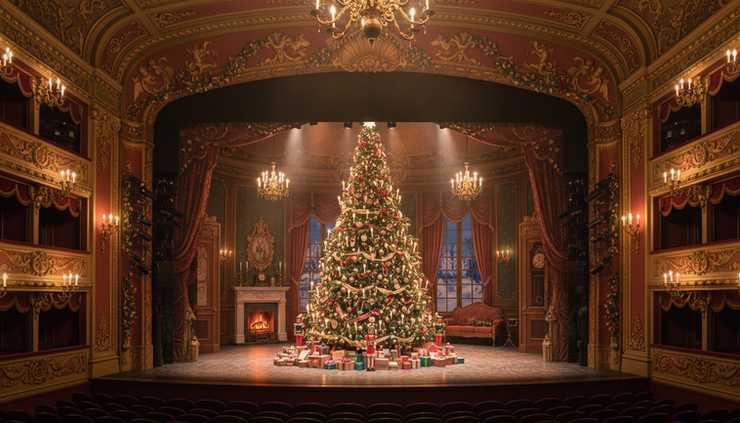
One of the most famous stage effects is the growing Christmas tree. In Balanchine’s version, the tree becomes enormous as Marie’s dream takes over. The room seems to transform around her. For many people, this is the moment when the ballet shifts from charming to unforgettable.
The scenic world usually contrasts the warm interior of Act I with the wintry brightness of the forest and the candy-colored grandeur of Act II. Costumes help tell the story at a glance. Party guests, toy soldiers, mice, snowflakes, flowers, and sweets each belong to a clear visual world.

Key characters and memorable scenes to watch for
Balanchine’s version uses the name Marie for the young heroine. In many other productions, the character is called Clara. The story may be simple, but each character helps create the shift from home to fantasy.
Marie
Marie receives the Nutcracker at the party and becomes the emotional center of the story. She is curious, kind, and brave. Her care for the broken toy makes the dream possible.
Herr Drosselmeier
Drosselmeier is Marie’s mysterious godfather. He brings gifts, tricks, and a hint of the uncanny. A good Drosselmeier does not need to overplay the mystery. A raised eyebrow, a careful gesture, or a sudden appearance can make the room feel enchanted.
The Nutcracker and the Mouse King
The Nutcracker begins as a toy and becomes a heroic figure in Marie’s dream. The Mouse King leads the opposing army in the battle scene. This sequence is often one of the most fun for children, with marching soldiers, scurrying mice, and theatrical chaos that stays tightly organized.
The Sugarplum Fairy and her Cavalier
The Sugarplum Fairy rules the second act with grace and ceremony. Her dance with the Cavalier is one of the evening’s classical highlights. The steps demand balance, control, and calm authority. It is the kind of dancing that can look simple until one imagines trying to do it.
Dewdrop and the Flowers
Dewdrop leads the “Waltz of the Flowers,” a role known for speed, clarity, and radiance. The corps of Flowers moves in patterns that bloom and fold as the music expands. This is one of Balanchine’s great examples of stage geometry made joyful.
Mother Ginger and the Polichinelles
Mother Ginger is a comic highlight. Her enormous skirt hides a group of children, often called Polichinelles, who spill out and dance. It is light, funny, and almost always a crowd favorite.
Scenes that tend to stay with people
A few moments define the experience:
The party scene
A warm introduction to the family, the children, and Drosselmeier’s magic.
The growing Christmas tree
The moment the ordinary world gives way to dream logic.
The battle with the mice
A lively mix of comedy, suspense, and stagecraft.
The snow scene
A wintry spectacle that combines music, movement, and falling snow.
The “Waltz of the Flowers”
A grand display of Balanchine’s patterns and musical sweep.
The Sugarplum pas de deux
A poised and elegant centerpiece of classical ballet.

Why this ballet still matters
George Balanchine The Nutcracker History Highlights and First Time Visitor Tips is a topic that matters because this ballet sits at the meeting point of art, memory, and seasonal ritual. Many people first encounter ballet through The Nutcracker. That first encounter can shape how they feel about live performance for years.
The work also supports ballet companies in practical ways. Holiday performances often bring large audiences, including people who may not attend mixed-repertory programs during the rest of the season. That helps companies introduce new viewers to the art form.
Balanchine’s version also matters because it respects children as performers and audience members. Children onstage are not treated as decoration. They have musical cues, spatial patterns, and dramatic tasks. Children in the audience can recognize the world of the first act, then follow Marie into fantasy.
For adults, the ballet offers another pleasure. It shows how classical structure can hold imagination. The second act has no complicated plot. Instead, it offers a sequence of dances that reward close watching. Patterns repeat and change. Music suggests texture. Costumes and steps tell us where we are before anyone says a word.
For reliable further reading, start with official company pages. Besides New York City Ballet, companies such as Pacific Northwest Ballet and Miami City Ballet also present Balanchine repertory and publish helpful production information when performances are scheduled. For criticism and context, check current dance coverage from outlets such as The New York Times Dance section and The Guardian’s stage reviews.
First-time visitor tips for dress code, timing, and etiquette
Seeing The Nutcracker for the first time should feel exciting, not intimidating. Ballet has traditions, but most of them are simple courtesy.
What to wear
There is usually no strict dress code unless the venue says so. People often dress a little nicer than they would for a movie, especially for evening performances.
Good choices include:
A dress, skirt, sweater, or blouse
Slacks, chinos, or dark jeans with a neat top
Comfortable shoes for walking through the venue
A light layer, since theaters can feel cool
Matinee performances tend to be more relaxed. Opening nights and holiday weekend evenings may feel dressier. Children do not need formal clothing, but comfortable outfits help them sit through the show.
When to arrive
Plan to arrive 30 to 45 minutes early. Parking, coat check, ticket scanning, restroom lines, and finding seats can take longer during holiday performances.
Late seating policies vary. Some theaters will not seat late arrivals until a pause, which may mean missing the opening party scene. Arriving early also gives time to read the program and explain the story to children before the lights go down.
How to handle phones and photos
Turn phones fully silent before the performance starts. Avoid checking screens during the show. Even a dim screen can distract nearby audience members and performers.
Photos and videos are usually not allowed during the performance. Many venues permit photos in the lobby or near decorations, but the rules differ. When in doubt, ask an usher.
When to clap
Applause is welcome. Audiences often clap after major dances, impressive solos, and the end of scenes. If unsure, follow the rest of the audience.
It is also fine to laugh during comic moments, especially Mother Ginger or the battle scene. Ballet is not meant to be watched in silence as if it were behind glass. The key is to respond without talking over the music or distracting others.
Bringing children
The Nutcracker is one of the best introductions to ballet for children, but preparation helps.
Before going, explain the basic story:
Marie receives a Nutcracker.
The Nutcracker comes to life.
Marie dreams of a battle, a snowy forest, and a kingdom of sweets.
Dancers tell the story through movement, not spoken dialogue.
Choose seats with sightlines in mind. An aisle seat can help if a child needs a quick break, but center sections often offer the best view of stage patterns. Snacks are usually not allowed inside the theater, so plan around intermission.

Final thoughts before the curtain rises
Balanchine’s The Nutcracker lasts because it gives audiences several pleasures at once. It has a clear story for children, refined choreography for ballet lovers, unforgettable music, and stage images that feel tied to the holiday season.
The best way to watch it is with attention and openness. Notice how the party guests create a real household. Listen for the celesta when the Sugarplum Fairy arrives. Watch the Snowflakes travel in patterns through the storm. Look at how the Flowers seem to breathe with the music.
For a first visit, keep the plan simple. Arrive early, dress comfortably, silence the phone, and let the performance work on its own terms. By the time the final curtain falls, the familiar story may feel newly alive.


Comments