Los Angeles Kings History, Traditions, and Fan Culture Through the Ages

The Los Angeles Kings were born in a city better known for movie premieres than frozen ponds, yet they helped turn Southern California into a serious hockey market. Their story runs from purple-and-gold beginnings at the Forum to Wayne Gretzky changing the sport’s map, then to the Stanley Cup parades that longtime fans once only imagined.
For new fans, the Kings offer one of the NHL’s most interesting timelines. For longtime supporters, the history still feels personal: heartbreaks, black-and-silver nights, “Go Kings Go” chants, playoff overtime goals, and a lion mascot with a deeper meaning than many realize.
The Kings began as part of the NHL’s 1967 expansion
The Kings entered the NHL in 1967, when the league doubled from six teams to twelve. Owner Jack Kent Cooke saw an opening in Los Angeles, even though many people doubted whether NHL hockey could work in a warm-weather city.
The team’s first home was the Los Angeles Memorial Sports Arena, but the Kings soon moved into the Forum in Inglewood. That building became central to the franchise’s identity. It hosted the team through its first major eras, from early expansion struggles to the arrival of superstars.
The original colors, often called Forum Blue and Gold, were bold and regal. “Forum Blue” was really a shade of purple, paired with gold to fit the royal theme of the Kings name. The look also connected naturally with Los Angeles sports culture, since the Lakers used purple and gold in the same building.
The early Kings had flashes of promise. Goaltender Rogie Vachon became one of the franchise’s first true stars after joining the team in the early 1970s. His quick style and consistency gave Los Angeles credibility in a league still dominated by older hockey markets. Vachon later became the first King to have his number retired.
The 1970s also brought one of the greatest offensive players in franchise history, Marcel Dionne. With Dave Taylor and Charlie Simmer, Dionne formed the famous Triple Crown Line, one of the most productive lines of its era. The name fit perfectly: three elite forwards, all playing under the Kings banner.
For fans who want a stats-first look at those seasons, Hockey Reference’s Los Angeles Kings page is one of the easiest historical archives to browse by year, player, and playoff result.
Wayne Gretzky changed the Kings and the NHL
No moment reshaped the franchise more than the 1988 trade that brought Wayne Gretzky from the Edmonton Oilers to Los Angeles. It was more than a hockey transaction. It was a cultural event.
Gretzky arrived as the greatest player in the sport and instantly made the Kings a national story. Celebrities came to games. Local media paid closer attention. Youth hockey in California grew. The NHL’s future in Sun Belt markets became easier to imagine.
The Kings also changed visually during this era. The team moved away from purple and gold and adopted black, silver, and white, a sharper look that matched late 1980s and early 1990s Los Angeles style. The crown remained, but the uniforms felt darker, cleaner, and more Hollywood.
Gretzky’s most famous Kings milestone came on March 23, 1994, when he scored his 802nd career regular-season goal and passed Gordie Howe as the NHL’s all-time goals leader. The record-breaking goal happened at the Forum, a fitting stage for a player who had turned the building into one of hockey’s must-watch venues.
The Gretzky years also produced the Kings’ first trip to the Stanley Cup Final. In 1993, Los Angeles defeated the Toronto Maple Leafs in a tense Campbell Conference Final. Gretzky’s Game 7 performance, including a hat trick, remains one of the defining games in team history. The Kings lost the Final to the Montreal Canadiens, but the run proved that Los Angeles could be a true hockey city.
The best official starting point for franchise milestones is the Los Angeles Kings official team site, which includes current news, rosters, schedules, and team features.

Memorable games gave the franchise its mythology
Every franchise has a record book. The Kings also have a set of games that fans retell like family stories.
The most famous early example is the Miracle on Manchester on April 10, 1982. In Game 3 of a playoff series against the Wayne Gretzky-led Edmonton Oilers, the Kings trailed 5-0 after two periods. They stormed back to tie the game, then won 6-5 in overtime on Daryl Evans’ goal.
That win still stands as one of the great playoff comebacks in NHL history. It happened at the Forum, on Manchester Boulevard, which gave the game its name.
Other games shaped different generations of fans:
Game | Why it matters |
1982 Miracle on Manchester | The Kings erased a 5-0 deficit against Edmonton and won in overtime. |
1993 Game 7 against Toronto | Gretzky’s hat trick sent Los Angeles to its first Stanley Cup Final. |
2012 Stanley Cup Final Game 6 | The Kings defeated the New Jersey Devils and won their first Cup. |
2014 Western Conference Final Game 7 | Alec Martinez scored in overtime against Chicago to send the Kings back to the Final. |
2014 Stanley Cup Final Game 5 | Martinez scored again in double overtime to win the second Cup in franchise history. |
The 2012 championship changed the emotional history of the team. The Kings entered the playoffs as the Western Conference’s No. 8 seed, then tore through the postseason with a heavy, disciplined style. Captain Dustin Brown set the tone. Anze Kopitar led at both ends of the ice. Drew Doughty played huge minutes. Jonathan Quick delivered one of the great modern goalie playoff runs.
Two years later, the 2014 team took a harder road. Los Angeles became one of the rare teams to overcome a 3-0 series deficit, doing it against the San Jose Sharks in the first round. The Kings then went through Anaheim and Chicago before beating the New York Rangers in the Final.
Those two Cups gave the franchise a new identity. The Kings were no longer just the team that brought Gretzky west. They were champions built on defense, depth, goaltending, and nerve.
For historical context beyond the team’s own archive, the Hockey Hall of Fame is a strong resource for player careers, honored members, and broader NHL history.
The colors, mascot, and symbols tell the team’s story
The Kings’ visual history reflects each major chapter of the franchise.
The original purple and gold years felt royal, bright, and tied to the Forum. That look still shows up in throwback uniforms and fan gear because it connects to Dionne, Vachon, Taylor, Simmer, and the franchise’s first identity.
The black-and-silver era belongs to Gretzky and the 1993 Final team, then later to the championship teams of 2012 and 2014. The colors suggest a tougher image. They also fit Los Angeles in a different way, with a sleek look that feels at home under arena lights.
The crown has changed over time, but the core idea has stayed the same. The Kings name carries a simple promise: compete with presence, confidence, and a little flash.
Then there is Bailey, the Kings’ lion mascot. Bailey is named in honor of Garnet “Ace” Bailey, a former player and Kings scout who died in the September 11 attacks. That connection gives the mascot more weight than a typical arena character. Bailey is playful during games, but the name carries memory and respect.
Kings traditions also include retired numbers and honored figures. Rogie Vachon, Marcel Dionne, Dave Taylor, Luc Robitaille, Rob Blake, Wayne Gretzky, and Dustin Brown all hold major places in team history. Broadcaster Bob Miller, the voice of the Kings for decades, also became part of the franchise’s emotional core. His calls helped generations of fans understand the rhythm of the game.

Kings fan culture grew from patience into pride
Kings fans know what waiting feels like. Before 2012, the franchise had decades of memorable players but no Stanley Cup. That long wait shaped the fan base. Supporters learned to value effort, gritty playoff wins, and players who stayed connected to the city.
The signature chant, “Go Kings Go,” is simple and loud enough to carry through any arena. At home games, it can rise after a big penalty kill, a clean hit, a Quick-style save, or a Kopitar shift that quietly controls the puck for half a minute.
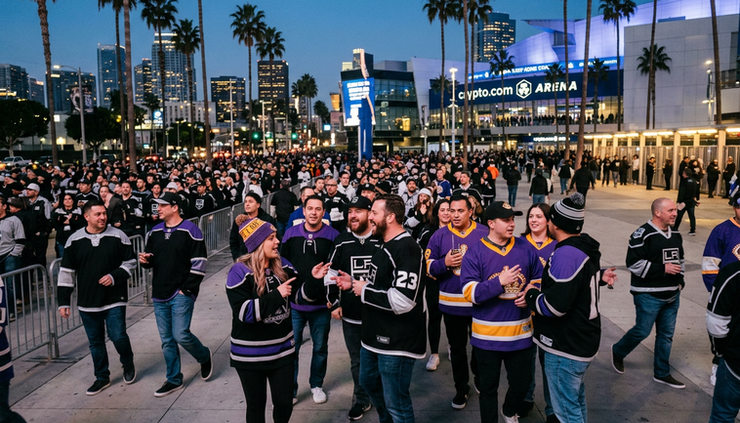
The team’s geography also matters. Los Angeles is not a single-sport town, and the Kings have always competed for attention. That made their culture more distinct. Fans who chose hockey in Southern California often did so with intention. Many became lifers through family traditions, youth hockey, or a first trip to the Forum, Staples Center, or today’s Crypto.com Arena.
The Kings also helped fuel the growth of hockey across the region. The success of Gretzky’s arrival and the championship-era teams gave Southern California players visible proof that hockey belonged there. The sport’s local growth cannot be credited to one team alone, but the Kings played a major role.
Fan-run coverage has become part of the modern experience too. Sites like LA Kings Insider and Mayor’s Manor have long given supporters more reporting, prospect notes, interviews, and commentary than a box score can offer. They are useful companions to official team coverage, especially for fans who follow the roster year-round.
This is where Los Angeles Kings history traditions and fan culture through the ages becomes more than a phrase. It describes how the franchise turned scattered moments into shared identity: purple and gold nostalgia, Gretzky memories, black-and-silver playoff scars, championship banners, and a fan base that knows both suffering and celebration.

The Kings’ legacy keeps adding new chapters
The Kings’ history is not a straight climb. It is a long Los Angeles story filled with reinvention.
They began as an expansion team trying to sell hockey in a city with little NHL tradition. They found stars in Vachon and Dionne. They became a global story with Gretzky. They endured lean years. They rose again with Brown, Kopitar, Doughty, Quick, and a championship core that delivered two Stanley Cups in three seasons.
The traditions remain because each era left something behind. The colors still matter. The crown still matters. Bailey’s name still matters. So do the chants, the old Forum memories, the black-and-silver jerseys, and the playoff goals that fans can describe years later without checking a replay.
For further reading, start with these resources:
The Kings’ past has room for every kind of fan: the one who remembers the Forum, the one who started with Gretzky highlights, the one who cried in 2012, and the one just learning why a 5-0 comeback in 1982 still gets mentioned. That mix is the real tradition. The story keeps moving, but the crown carries every era with it.


Comments