MJ The Musical Storyline, Characters, Songs, and Stage Magic Explained

MJ the Musical does not try to cover every chapter of Michael Jackson’s life. Instead, it chooses one charged moment: the rehearsal period for the 1992 Dangerous World Tour. That choice gives the show its shape. Rather than telling a cradle-to-grave biography, it turns a rehearsal room into a pressure cooker where memory, music, ambition, family, fame, and perfection all collide.
The result is part jukebox musical, part backstage drama, and part dance spectacle. With a book by two-time Pulitzer Prize winner Lynn Nottage and direction and choreography by Christopher Wheeldon, the show uses Jackson’s catalog to explore how a performer builds a concert that has to feel larger than life.

The storyline centers on the making of a legend
The main action takes place in Los Angeles as Michael Jackson and his creative team rehearse for the Dangerous World Tour. The show begins with a familiar tension. The concert is ambitious, expensive, and technically complex. Michael wants every lighting cue, dance move, costume change, and musical transition to feel exact. The people around him worry about deadlines, budgets, and whether the production can meet his demands.
This rehearsal frame gives MJ the Musical a clear engine. A documentary crew arrives to capture the process, and their questions push Michael into memories. Those flashbacks lead the audience through key periods of his life and career.
The musical does not move in a straight line. It flows between the present rehearsal room and the past, using songs as portals into memory.
Key plot points include:
The Jackson 5 years
The show looks back at Michael as a child performer alongside his brothers. These scenes show the thrill of early success, but they also reveal the cost of growing up under relentless discipline.
The influence of Joseph and Katherine Jackson
Joseph appears as a tough, demanding father and manager who pushes his children toward greatness. Katherine offers warmth, faith, and emotional steadiness. Their different forms of influence stay with Michael into adulthood.
The Motown breakthrough
The young Jacksons enter a music world that celebrates their talent while also placing them under intense public pressure. These scenes help explain Michael’s polish, work ethic, and early understanding of show business.
Michael’s move into solo stardom
The story shows the artist separating himself from the family group and shaping a sound, look, and performance style of his own. The musical treats this as both liberation and burden.
The rehearsal room crisis
Back in 1992, the tour grows more demanding. Michael keeps adding ideas. The team worries that his vision may outgrow what can be built, funded, or safely performed.
The final push toward the concert
The show builds toward a sense of launch. The audience does not watch a full recreation of the Dangerous World Tour. Instead, it sees the creative fire behind it.
One of the smartest things about the structure is that the rehearsal room becomes a mirror. Every time Michael asks for something bigger, sharper, or more magical, the show asks why. The answer is rarely simple. He is chasing excellence, but he is also trying to outrun fear, memory, pain, and the public gaze.
The characters reveal the pressure behind the icon
MJ the Musical depends on the performer playing Michael, but it is not a one-person character study. The supporting roles matter because they show the forces that shaped him.
Michael Jackson
Adult Michael is written as a brilliant artist under pressure. He is soft-spoken in many scenes, but his artistic standards are fierce. He hears tiny details in the music. He notices when a move lacks precision. He imagines lighting, sound, pacing, and dance as one complete experience.
The musical also presents Michael as guarded. He can charm the room, then pull away when questions become personal. That contrast gives the role its tension. Onstage, he is in control. Offstage, memories keep breaking through.
A strong performance in the role has to capture three things at once:
The physical vocabulary, including the isolations, spins, glides, and sharp accents
The vocal style, from rhythmic breath to falsetto
The emotional distance of someone who has lived most of life in public
The role is not only an impersonation challenge. It is an acting challenge built around control. The audience watches a person who knows how to create wonder, even when his own inner life is unsettled.
Little Michael and teenage Michael
The younger versions of Michael carry much of the show’s emotional weight. Little Michael brings brightness, innocence, and startling talent. His scenes with the Jackson 5 are often joyful, but they also show how early the demands began.
Teenage Michael marks a transition. He is no longer just the dazzling child star. He is becoming aware of image, identity, and artistic independence. These younger Michaels help the audience see adult Michael not as a sudden phenomenon, but as the result of years of training, praise, pressure, and sacrifice.
Joseph Jackson
Joseph is one of the most difficult figures in the show. He is portrayed as demanding and often harsh, a father who sees success as survival. His scenes can be uncomfortable because the discipline he imposes produces results while leaving emotional damage.
The musical does not need to reduce him to a simple villain. His presence shows how ambition can become fear, and how protection can turn into control. For Michael, Joseph becomes both a source of professional discipline and a wound that never fully closes.
Katherine Jackson
Katherine brings gentleness into the family scenes. She represents faith, care, and moral grounding. In a story filled with directors, managers, journalists, and producers, Katherine’s role is more intimate. She reminds Michael of home and of the child behind the performer.
Her scenes often work as emotional counterpoints to Joseph’s. Where Joseph pushes, Katherine steadies. Where the business demands output, she offers comfort.
Rachel and the documentary crew
The documentary crew gives the musical an outside perspective. Rachel, often staged as a journalist or interviewer, asks the questions that others avoid. She wants the real story, not just the polished public version.
This device helps the musical handle exposition without stopping the show cold. It also creates friction. Michael understands media attention better than almost anyone, and he knows how quickly curiosity can become intrusion. Rachel’s questions open doors, but they also test his boundaries.
The creative team and ensemble
The rehearsal team, musicians, dancers, assistants, and tour personnel are essential. They show what it takes to build a pop spectacle. Their job is not only to support Michael, but to react to him. When he changes a cue, they absorb the shock. When he finds the right groove, they lift the room.
The ensemble is also the show’s engine. In MJ the Musical, dancers are not background decoration. They become memory, momentum, and spectacle.
The songs work as biography, memory, and release
The music is the main reason many people buy a ticket, and the show knows it. It includes many of Jackson’s most recognizable songs, but it does not treat them all the same way. Some numbers recreate the feeling of performance. Others reveal character. A few do both at once.
Expect songs associated with different phases of Jackson’s career, including the Jackson 5 era, the Off the Wall period, Thriller, Bad, and Dangerous. The exact emotional function matters more than the playlist.
“ABC” and other Jackson 5 numbers bring early joy and speed. They show the brothers as a polished unit and remind the audience how young Michael was when his public life began.
“I’ll Be There” often lands as a moment of tenderness. In the context of the show, a love song can also become a family song, a memory song, or a promise that fame complicates.
“Don’t Stop ’Til You Get Enough” and “Wanna Be Startin’ Somethin’” capture the adult artist finding rhythmic force. These songs are built for motion, and the choreography often turns them into demonstrations of stamina and control.
“Billie Jean” carries special weight because it is tied to one of Jackson’s defining performance identities. The bassline alone can change the temperature in the theater. Onstage, it becomes a study in restraint, precision, and star power.
“Beat It” brings conflict and theatricality. Its guitar-driven energy gives choreographers room for sharp group movement, tension, and release.
“Thriller” is more than a hit song. It represents Jackson’s gift for turning pop music into visual event. In a stage musical, that legacy matters. The number invites lighting, shadows, formation work, and a sense of playful menace.
“Smooth Criminal” highlights style. It is crisp, angular, and cinematic. The choreography has to honor the famous vocabulary without making the scene feel like a museum piece.
“Man in the Mirror” can work as the show’s emotional summation. Its message of self-examination gives the musical a way to close on reflection rather than spectacle alone.
The best numbers in the show do not ask the audience only to recognize the song. They ask the audience to understand why that song belongs at that moment.
The stagecraft turns a rehearsal room into a concert machine
The stage design usually begins with practicality: rehearsal space, lighting rigs, rolling equipment, scaffolding, instruments, and backstage traffic. That choice keeps the story grounded. The audience sees the labor behind the shine.
Then the design expands. A simple rehearsal setup can become a memory of Motown, a family home, a studio, a television performance, or a full concert environment. The transitions need to feel quick because Michael’s mind moves quickly. A beat, a question, or a musical cue can pull the show into another decade.
Audiences can expect:
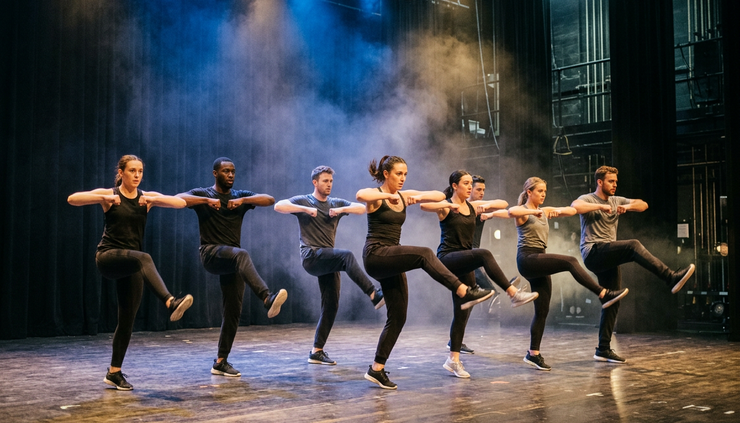
High-energy choreography
The movement style draws from Jackson’s vocabulary, including isolations, footwork, spins, poses, and group formations. It also has to serve musical theater storytelling, so the dancing reveals mood and memory.
A concert-like sound
This is not a quiet chamber musical. The band, vocals, and arrangements aim for impact. Fans of the original recordings will hear familiar hooks, but the live setting gives the songs fresh heat.
Fast visual shifts
Lighting does a lot of storytelling. Color, shadow, strobes, and tight spotlights can move the audience from rehearsal realism to pop spectacle in seconds.
Costume changes that track eras
Costumes help mark time. The Jackson 5 scenes, solo career moments, and Dangerous Tour rehearsals each carry a different visual language.
A demanding lead performance
The actor playing Michael rarely gets an easy night. The role needs singing, dancing, acting, and the ability to suggest a globally known figure without disappearing into imitation.
The show’s style is also shaped by what it chooses not to be. It does not offer a full legal or tabloid history. It focuses on artistry, family origins, career pressure, and the creation of a major tour. That focus has drawn conversation, and it is part of why reviews and audience reactions often discuss both the thrill of the staging and the limits of the frame.
Reviews, interviews, and official resources for further reading
For readers who want more context before or after seeing the show, these resources are useful starting points:
Official MJ the Musical website
Best for current tour dates, Broadway information, cast updates, ticket links, and official production details.
Broadway.com’s MJ the Musical page
A helpful overview with production information, photos, news, and visitor-friendly details.
The New York Times review of MJ the Musical
A major critical response that discusses the show’s staging, performances, and narrative choices.
Variety’s review of MJ the Musical
Useful for another critical view on how the musical balances entertainment with biography.
Playbill features and interviews on MJ the Musical
A good place to find cast interviews, rehearsal features, opening night coverage, and awards-season conversations.
BroadwayWorld coverage of MJ the Musical
Good for production news, reviews, interviews, and regional tour updates.
These links also help place the show in the larger Broadway conversation. MJ is both a crowd-pleaser and a biography with boundaries, and the strongest writing about it tends to address both sides.

The takeaway is that MJ is built around process, not just fame
MJ the Musical works best when viewed as a story about creation. The show is not simply asking, “How did Michael Jackson become famous?” It is asking how a person with extraordinary gifts built performances that seemed effortless, and what that effort cost.
The storyline gives audiences a rehearsal-room frame. The characters give that frame emotional pressure. The songs supply recognition, memory, and release. The staging turns craft into spectacle.
For longtime fans, the pleasure comes from hearing the catalog live and seeing iconic movement reimagined for the stage. For musical theater fans, the interest lies in how the show uses a pop concert vocabulary inside a Broadway structure. Either way, the stage magic comes from watching perfection being chased in real time, one beat, one step, and one spotlight at a time.


Comments