Name Change on Tickets: What Venues Allow and How to Ask


You can usually fix a misspelled or legally changed name on an event ticket, and you can usually move a ticket to another person, but those are two different requests handled in two different ways. A correction goes to the venue or the ticketing company’s customer service. A transfer happens inside the ticket app or account, and it is free at many venues. Which one you need decides what to do next, and getting that wrong is how people end up stuck at the gate.
We cover concerts, sports and theater here, not airline tickets, which follow separate rules. If you are researching a flight, the airline is the only place to ask.
TL;DR
A correction fixes a typo or a legal name change on your own ticket. A transfer hands the ticket to someone else. Venues treat them differently.
Mobile tickets are normally moved by an in-app transfer to the new person’s email or phone, which often costs nothing.
Will-call tickets are tied to the purchaser’s name and photo ID. Changes usually go through the box office or the ticketing company, not at the door.
Some events block transfers until shortly before the show, and extras like VIP elements may not move at all.
Read the checkout language before you pay: “non-transferable,” “name on ticket” and “ID required” tell you how flexible the ticket will be.
Table of Contents
Correction or transfer: the distinction that decides everything
People search for a “name change” and mean one of three things.
Fixing a typo. You typed “Jon” instead of “John,” or your name on the order does not match your ID.
Updating a legal name. You married, divorced or changed your name, and the ticket still shows the old one.
Giving the ticket to someone else. A friend is going in your place.
The first two are corrections to your own ticket. The third is a transfer. Most venues and ticketing systems do not treat a transfer as a “name change” at all. Instead of editing the name on your ticket, they cancel your access and issue a new ticket in the other person’s account.
That is why a box office will often tell you “we cannot change names” when what they mean is “we cannot edit this ticket, but you can send it.” Ask for the right thing and the answer changes.
For a plain-language definition of what a transfer does and does not move, see our guide on what ticket transfer means.
How to transfer a mobile ticket to someone else
Most tickets now live in an app or account, and for those, a transfer is the cleanest way to put a different name on the seat. The mechanics are consistent across platforms. According to Quartz’s guide to telling official sellers from resale sites, the ticket holder enters the recipient’s email address or phone number, the recipient accepts, and the ticket then appears in an account under the recipient’s own name on the same platform the venue or promoter uses.
Here is the routine, with the places it tends to go wrong.
Open the order in the account you bought with. Transfers only work from the account holding the ticket. If you bought through a friend or a different email, start there.
Pick the seats you are sending. At many venues you can send individual seats rather than the whole order. Broadway at The National’s help center confirms that transfers are free, that the recipient gets their own mobile tickets after accepting, and that you can split an order seat by seat.
Enter the email or phone number the recipient actually uses for their account. A transfer to an address they never check will sit unaccepted. Ask them to confirm which one is tied to their ticketing account.
Have them accept right away. Until they accept, the ticket is still yours. The same venue help page notes you can cancel a pending transfer at any time before the recipient accepts, which is useful if you typed the wrong address.
Confirm the ticket is in their account. Ask for a screenshot of the ticket inside their app. For mobile-entry events, a screenshot of a barcode is not a ticket, so the transfer inside the app is the only version that counts.
If you want the longer walk-through when a transfer stalls, our piece on delayed ticket delivery explains what to check before you escalate.
Transfer delays and what does not move
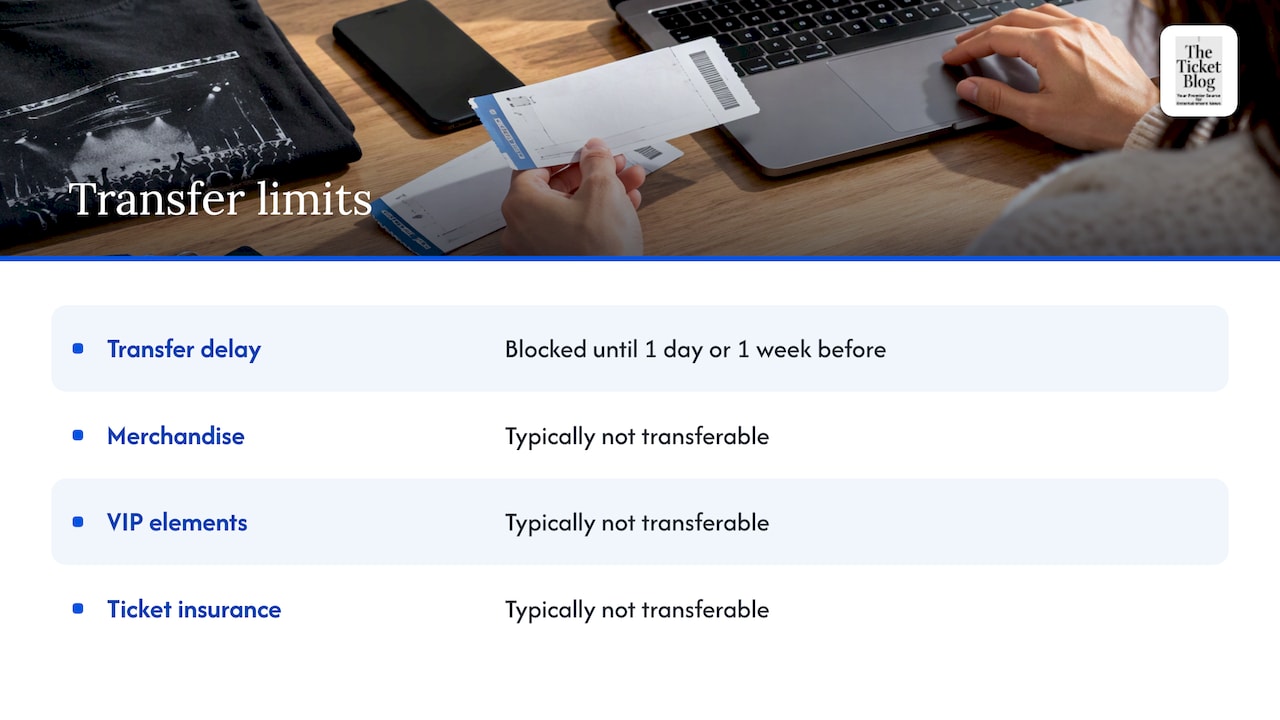
Two limits catch people out. The first is timing. The Pabst Theater Group’s FAQ explains that seat transfers through the AXS mobile app are free and unlimited, but some events carry an artist-requested Transfer Delay that blocks transfers until one day or one week before the show.
The second is scope. The same FAQ says merchandise, VIP package elements and ticket insurance are typically not transferable. If your seat came with a bundle, ask the box office what the new holder will actually receive before you promise anything.
If a transfer is blocked entirely, our checklist on transfer-restricted tickets in the U.S. shows the three places to look first.
Will-call tickets: the name and the ID have to match
Will call is where the question “can I change the name?” bites hardest, because the ticket is held in the purchaser’s name and handed over at the window. Policies vary by venue, and the exact rule is on each venue’s FAQ page.
Three real examples show the range:
Strict. Peabody Auditorium requires the named account holder to show photo ID to pick up will-call tickets, and its box office will not release tickets to anyone else or make name changes by telephone.
Strict, with a time window. The Pabst Theater Group requires photo ID, offers pickup during box office hours or from two hours before showtime, and does not allow third-party name changes. Only the original purchaser may collect.
Flexible with verification. LA Phil’s ticket FAQ says someone else can pick up your will-call tickets if you contact Audience Services at (323) 850 2000 and provide the pickup person’s name, address and phone number for box-office verification. For a spelling error or a legal name change, it points to an online change-of-information form on its site, and it notes the account itself cannot be handed to another individual.
The lesson is not that one policy is right. It is that the person on the order, the person holding the ID and the person at the window need to line up, and that the fix has to happen before the day of the show.
Our guide to will-call tickets covers what to bring and how pickup lines usually work.
When the venue sends you to the ticketing company
At many amphitheaters and arenas, the venue does not hold the order. Toyota Pavilion at Concord states that will-call pickup is day-of-show only, starting 90 minutes before the show, with photo ID matching the purchaser’s name, and that any name changes go through the ticketing company’s customer service line at 800-653-8000. If a box office tells you the same, call that number with your order number ready rather than arguing at the window.
Fixing a typo or a legal name change
A correction is the easiest of the three requests, as long as you make it early. A practical order of operations:
Check what the ticket needs. Many mobile tickets never display your name at the gate. The barcode is what gets scanned. If the event does not require ID, a typo may be harmless.
If ID is required, fix it now. Look at the event page and your confirmation email for phrases such as “ID required” or “name on ticket.”
Contact the right party. Use the venue’s change-of-information form if it has one. Otherwise contact the ticketing company named on your confirmation email. Resale purchases go through the marketplace you bought from.
Have documents ready. For a legal name change, expect to be asked for something like a marriage certificate or court order, and for a plain typo, a photo ID showing the correct spelling. Requirements differ by venue, so ask what they accept.
Get the confirmation in writing. Save the reply email or the chat transcript. If the gate scan or ID check goes sideways, you have something to show.
Do not wait for show day. Phone and counter staff at several venues, as the examples above show, cannot or will not edit names at the door.
Read the ticket rules before you pay
The cheapest name change is the one you never need. The Traveler’s guide to common ticketing mistakes advises scanning checkout language for “non-transferable,” “name on ticket” or “ID required,” and noting when barcodes release, which it says is often 24 to 72 hours before the show. It also reports that exchanges are often limited to certain events, run on strict time windows, and typically require that you bought from the primary seller rather than through resale or a transfer.
For resale tickets, a short pre-purchase list keeps you out of trouble. Drawing on Verold’s mobile-only resale checklist, confirm:
Transfer is enabled for the event.
The ticket will land in your own ticketing account, not arrive as a screenshot.
When the barcode becomes visible.
The listing is an official resale with a buyer guarantee.
Entry does not require the original buyer to be present.
If a seller refuses an official transfer or pushes some other arrangement, Quartz’s guide treats that as a warning sign. Walk away.
Two of our own guides help here: how to verify officially guaranteed AXS resale tickets and how mobile-only venues handle entry. If you are weighing resale prices, check resale ticket coupon codes before you check out, so a discount is applied at purchase rather than missed.
A worked example
Say you bought two concert tickets as a gift for a friend, and the show is eight weeks away.
Scenario A: the friend wants to take your place. Open your account, select one seat, enter their email, and ask them to accept. Done, unless the event has a transfer delay. If it does, the ticket stays yours until the delay lifts, so confirm the date on the event page.
Scenario B: your name is misspelled and the show requires ID. Find the venue’s change-of-information form or the ticketing company’s customer service number, send a photo of your ID, and save the confirmation.
Scenario C: you will not make it, and the seats are will call. Ask the box office whether a designated pickup person is allowed. Some venues verify a name, address and phone number. Others release tickets only to the purchaser.
In each case, the request that works is the one that matches how the ticket was issued.
Perspective: why we treat this as a buying decision
Most name-change headaches begin at checkout, not at the gate. When we write about ticket buying, we keep coming back to the same habit: read how the ticket is issued before you pay. Is it a mobile ticket that can be sent? A will-call order that needs ID? A resale listing with a guarantee? That is why our guides pair every platform explanation with the practical question of what happens if plans change. A ticket you can transfer is worth more to you than one you cannot, and knowing the difference ahead of time is part of finding a good deal. Our approach is to give you the checklist, the venue-level examples and the promo codes together, so a lower price never comes at the cost of a ticket you cannot use or pass on. The Ticket Blog
Find tickets you can actually transfer
If you are still shopping, start with deals where the transfer rules are clear. Our guide to buying event tickets for less walks through the platforms, the promo codes and the checkout details that matter, and the Summer Concert Ticket Buying Checklist for 2026 is a quick pre-purchase run-through.

Browse the latest guides and promo postings on The Ticket Blog, where we cover concerts, sports and theater from first-time buyers’ questions to resale details.
FAQ
Can I change the name on a concert ticket?
Usually you can correct a typo or a legal name change on your own ticket by contacting the venue or the ticketing company. Moving the ticket to a different person is a transfer, not a name edit. For mobile tickets that is done in the app, and at some venues it is free.
Does it cost money to transfer a ticket to a friend?
At many venues it does not. Broadway at The National and The Pabst Theater Group both describe their mobile transfers as free. Fees can still apply on some resale orders, and VIP extras or insurance may not transfer, so check the event’s own rules.
Can someone else pick up my will-call tickets?
It depends on the venue. Some, like Peabody Auditorium and The Pabst Theater Group, release tickets only to the purchaser with photo ID. Others, like LA Phil, let you name a pickup person through the box office ahead of time. Contact the venue before the show.
Why is my ticket marked non-transferable?
Some events are set up that way, and some artists request a transfer delay that blocks sending until one day or one week before the show. Look at the event page and your confirmation email for the exact terms and release dates.
Sources
Recommended


Comments