Primary vs Secondary Ticket Sites Compared: How to Decide

Buy primary when face-value inventory is still available and the all-in total is within roughly 10% of verified resale prices. Buy secondary when the event is sold out or resale comes in 15% or more below the primary checkout total for the same section. This covers most ticket-buying scenarios.
Before you commit to either market, run this quick check:
Is primary inventory still available? If yes, note the all-in checkout total (face value + service fee + facility fee + delivery).
Is verified resale available for the same section and row range? If yes, note that all-in total too.
Are the totals within 10%? Buy primary for stronger fraud protection and venue support.
Is resale 15% or more cheaper? A verified resale platform with a buyer guarantee is worth the switch.
Table of Contents
What is the primary ticket market and how does it work?
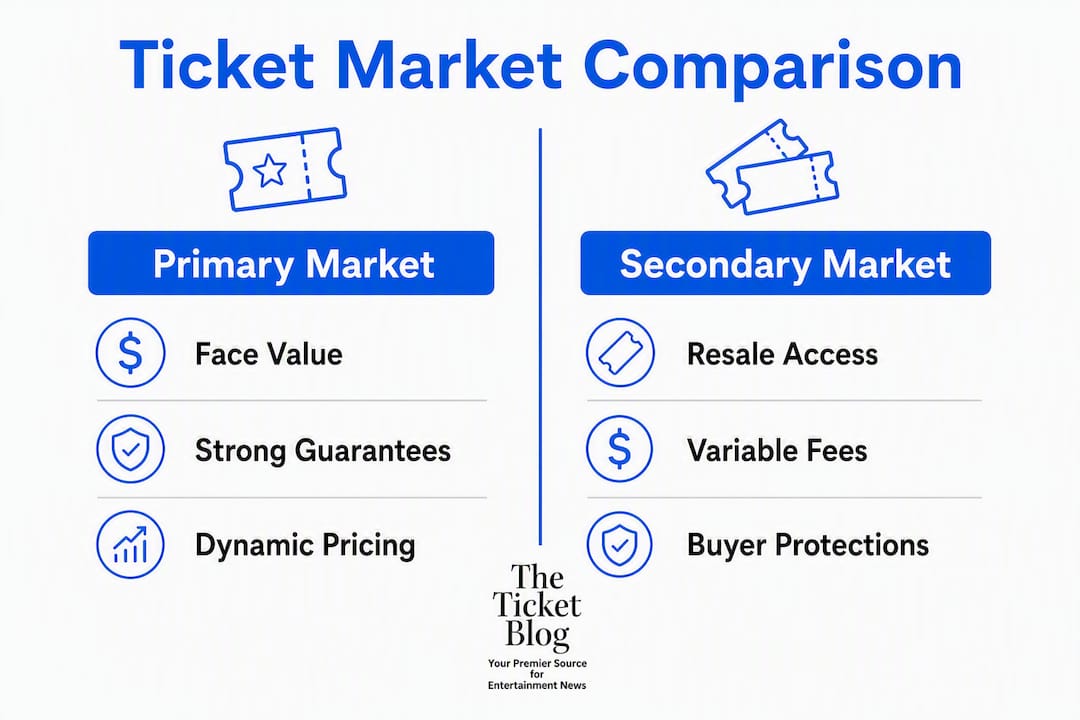
The primary ticket market is the first point of sale: the rights-holder (a promoter, venue, sports team, or artist) sets a face value and authorizes specific outlets to sell that initial inventory. Primary ticket outlets include venue box offices, official on-sale platforms, and verified presale channels such as fan club or credit card presales.
Because the rights-holder controls the inventory, primary tickets carry the strongest guarantee of validity at the door. The venue or producer stands behind the ticket, which means a scan failure is almost always resolved on-site. Fee structures on primary sales typically include a service fee, a facility fee, and an optional delivery charge, all set by the platform and the venue together.
One important nuance: “face value” does not always mean “lowest price.” Many primary platforms now use dynamic pricing (prices that rise with demand) and platinum pricing (a tiered premium category the rights-holder sets above standard face value). On high-demand tours, a platinum primary ticket can cost more than a resale listing from a fan who bought early at a fixed price. Knowing this distinction is what separates a savvy buyer from one who assumes primary is always cheaper.
What is the secondary ticket market and who sells on it?
The secondary market is where tickets change hands after the initial sale. Sellers range from casual fans who can no longer attend, to professional brokers who buy in bulk at on-sale and list at a markup, to individual resellers who speculate on demand. Price is set by supply and demand, not by the rights-holder, so the same seat can trade at a fraction of face value or at several times face value depending on how the event is selling.

Secondary marketplaces facilitate these exchanges and typically add platform service fees on top of the seller’s listed price. Delivery methods vary: mobile transfer, PDF, or barcode delivery are common, but some platforms hold delivery until close to showtime, which matters if you are traveling. Buyer guarantees also differ by platform, a point covered in detail below.
The secondary market exists for two structural reasons. First, rights-holders sometimes underprice tickets relative to actual demand, leaving money on the table that resellers capture. Second, primary inventory sells out, and fans who missed the on-sale need another route to attend. Both dynamics are normal, and understanding them helps you decide when resale is a reasonable option rather than a last resort.
How do pricing, fees, and timing affect your all-in cost?
Sticker price comparisons between primary and secondary are almost always misleading. The number that matters is the final checkout total for the same section and row range on both platforms.
Breaking down what you actually pay
Cost component | Primary market | Secondary market |
Base ticket price | Face value (or dynamic/platinum rate) | Seller’s listed price (market-driven) |
Service fee | Set by platform + venue | Buyer fee charged by marketplace |
Facility fee | Common on primary | Rare or absent |
Delivery fee | Varies; often waived for mobile | Varies; sometimes included |
Typical buyer fee range | Included in face-value structure | Roughly 10% depending on platform |
Buyer fees on secondary platforms vary significantly. TickPick charges no buyer fee, shifting its commission to the seller side instead, which often produces a lower all-in price at checkout. Some platforms add a moderate buyer fee, which can influence the final total enough to flip which market is cheaper for a given seat. Those ranges shift the final total enough to flip which market is cheaper for a given seat.
Since May 2025, U.S. platforms are required to display fee-inclusive totals upfront, which makes side-by-side comparisons far more reliable than they were even a year ago. You no longer need to click all the way to checkout to see the real number.
Timing matters as much as fees. On-sale day prices on primary can spike with dynamic pricing, then stabilize. Resale prices on high-demand events tend to peak in the days after on-sale and again in the week before the show. The most reliable window for resale savings is the final 72 hours before the event, when sellers who need to offload unwanted tickets list at a discount rather than eat the cost.
Pro Tip: Always open both a primary page and a verified resale page in separate tabs, filter both to the same section and row range, and compare the final checkout totals side by side. Comparing sticker prices across platforms is the single most common buyer mistake.
What are the real risks and buyer protections in each market?
Primary market risks and protections
Primary tickets carry the lowest fraud risk. Because the rights-holder issues the ticket directly, it is valid by definition. Refund policies vary by event (most primary sales are non-refundable unless the event is canceled or rescheduled), but the ticket itself will scan. Venue support is also on your side: if something goes wrong at the door, the box office has a record of your purchase.
Secondary market risks and protections
The risks on secondary are real but manageable when you stay on verified platforms. The main threats are counterfeit or duplicated tickets, off-platform scams (someone selling via social media or Craigslist with no recourse), delayed delivery, and surprise fees that appear only at checkout.
Verified resale marketplaces reduce fraud risk substantially compared with informal peer-to-peer sales. Platforms like StubHub offer FanProtect, which promises a replacement or refund if your ticket fails to scan. SeatGeek has a buyer guarantee with similar terms. TickPick guarantees ticket validity. Lyte, which operates as a fan-to-fan exchange tied to official event channels, offers one of the stronger validity assurances in the resale space because it works directly with event organizers.
One important caveat: buyer guarantees typically cover a refund or replacement for tickets that fail to scan, but they do not cover travel costs, hotel bookings, or other personal losses if the ticket turns out to be invalid. If you are flying across the country for a show, the stakes of buying from an unverified seller are considerably higher than the potential savings.
When risk outweighs savings: If a resale listing has no verified guarantee, the seller cannot confirm the transfer method, or the price seems unusually low for a high-demand event, walk away. The savings are not worth attending a show only to be turned away at the door.
How do you choose between primary and secondary for a specific purchase?
Follow this checklist in order before completing any ticket purchase.
Open both markets in parallel. Pull up the official primary page (venue box office or authorized platform) and a verified resale page simultaneously.
Filter to the same section and row range. Comparing floor seats on one platform to upper-deck seats on another tells you nothing useful.
Compare final checkout totals only. Ignore sticker prices. Add both to cart (without completing purchase) to see the true all-in number.
Check the buyer guarantee. Confirm the resale platform offers a verified guarantee covering invalid tickets. If it does not, treat it as unverified.
Check delivery timing. Some resale platforms hold mobile transfer until 24–48 hours before the event. If you need tickets sooner (for travel planning, for example), confirm the delivery window before buying.
Apply the threshold rule. Within 10% of each other? Buy primary for stronger fraud protection. Resale is 15% or more cheaper with a verified guarantee? Resale is worth it.
Check for red flags. Unverified seller, no stated transfer method, a price that seems implausibly low, or pressure to complete the transaction off-platform are all reasons to stop.
For last-minute buyers (within 72 hours of the show)
Check resale first: prices often drop as sellers offload unwanted tickets.
Prioritize platforms with instant mobile transfer so you have the ticket before you leave home.
Confirm the guarantee covers same-day delivery failures, not just pre-event issues.
If primary still has inventory at this stage, compare the all-in total one more time — late resale discounts sometimes bring prices below primary, but not always.
For a broader pre-purchase checklist, the Summer Concert Ticket Buying Checklist covers timing, price alerts, and presale code strategies in detail.
Which platforms are primary, secondary, or both?
Knowing where each platform sits in the market helps you set the right expectations before you search.
Ticketmaster operates primarily as a primary market platform, selling rights-holder inventory at face value (including dynamic and platinum tiers). It also hosts a verified resale section, making it a hybrid. Fees are bundled into the checkout total under all-in pricing rules.
SeatGeek functions mainly as a secondary marketplace aggregating listings from brokers and fans, though it also holds official primary inventory partnerships with some venues and teams. Buyer fees typically run around 10–30%, and its Deal Score feature helps identify relative value.
StubHub is one of the largest secondary marketplaces in the U.S., connecting buyers with individual sellers and brokers. Its FanProtect guarantee covers invalid tickets with a refund or replacement. Buyer fees generally fall in the 15–30% range.
Lyte operates as a fan-to-fan exchange that works directly with event organizers, which gives it a closer relationship to the primary market than most resale platforms. It focuses on returning unwanted tickets to fans at or near face value, reducing the markup typical of broker-heavy marketplaces.
TickPick is a secondary marketplace that charges no buyer fee, shifting its commission to the seller. That structure frequently produces lower all-in prices compared with buyer-fee platforms for the same seat. TickPick also holds official partnerships with teams and organizations, adding some primary inventory.
Hybrid platforms (those selling both primary and resale inventory) can be convenient, but always confirm which type of listing you are buying. A resale listing on a primary platform still carries resale-level risks and protections, not primary-level ones.
Reminder: always compare all-in totals for the same section across platforms before deciding. Platform reputation matters, but the final number is what you actually pay.
When does resale actually beat primary on price?
The clearest scenario is a major tour where the artist or promoter uses aggressive dynamic or platinum pricing. On megatours, primary dynamic pricing can push face-value totals above resale prices because resellers who bought early at a fixed price can list profitably below the current inflated primary rate. In those cases, a verified resale listing is not just more affordable — it is the rational choice.
The second scenario is the late-window drop. Sellers who cannot attend and need to recover any portion of their cost will list below market in the final 72 hours. For flexible buyers, this is the most reliable window for below-face-value resale.
The practical rule of thumb: Open primary and a verified resale site side by side, filter to the same section and row range, and compare final checkout totals. If resale is 15% or more cheaper and backed by a verified guarantee, resale is usually worth the switch. If the gap is under 10%, buy primary for stronger fraud protection and venue support.
The all-in pricing requirement that took effect in May 2025 makes this comparison faster than it used to be. You no longer need to reverse-engineer fees from a sticker price — the total is displayed upfront on compliant platforms.
For a deeper look at fee structures and how to reduce what you pay, the guide on how to avoid concert ticket fees breaks down platform-by-platform tactics.
Key Takeaways
Primary markets offer face-value pricing and the strongest fraud protection; secondary markets offer access when primary is sold out and can beat primary on price when resale is 15% or more cheaper after fees.
Point | Details |
Default decision rule | Buy primary when all-in totals are within 10%; switch to verified resale when resale is 15% or more cheaper. |
Always compare all-in totals | Sticker prices mislead — compare final checkout totals for the same section and row range on both markets. |
Buyer guarantees have limits | Platform guarantees cover invalid tickets (refund or replacement) but not travel costs or personal losses. |
Late-window resale opportunity | Resale prices often drop in the final 72 hours as sellers offload unwanted tickets at a discount. |
The Ticket Blog resource | The Ticket Blog’s guides, fee comparisons, and promo codes help you apply these rules to specific events and platforms. |
Why this comparison matters more now than it did two years ago
The ticket market in 2025–2026 is more transparent than it has ever been, and that transparency shifts the decision calculus in the buyer’s favor. The all-in pricing rules that took effect in May 2025 removed the most common source of sticker-shock at checkout. Regulatory attention from the FTC and ongoing Congressional scrutiny of ticketing practices have pushed platforms to compete more visibly on total price rather than hiding fees until the final screen.
Dynamic pricing is not going away. If anything, more rights-holders are adopting it as a way to capture demand that previously flowed entirely to resellers. That means the assumption that primary is always the cheaper, safer option is increasingly outdated. On a sold-out arena tour with platinum pricing, a verified resale listing can genuinely be the better deal, not just a fallback.
What this means for buyers is straightforward: the comparison between primary and secondary ticket markets is now a calculation you can actually make in real time, with real numbers, before you commit. The tools are there. The guarantees on reputable resale platforms are real, if limited. The risk is manageable when you stay on verified platforms and check delivery timing. The one thing that still trips buyers up is skipping the side-by-side checkout comparison and making a decision based on sticker price alone.
Be deliberate about guarantees and venue support when buying resale, especially for high-stakes events where travel is involved. The savings are real in the right scenarios. So is the downside when something goes wrong with an unverified listing.
The Ticket Blog helps you compare markets before you buy
Knowing the rules is one thing. Applying them to a specific show, venue, or platform in real time is where most buyers lose money or miss out on savings. The Ticket Blog publishes detailed fee comparisons, platform-specific guides, and curated promo codes that let you act on the decision framework above without starting from scratch every time you buy tickets.
Whether you are navigating a sold-out stadium tour or trying to figure out whether a resale listing on SeatGeek is actually cheaper than what Ticketmaster still has available, the guides at The Ticket Blog give you the context to decide quickly and confidently. The secondary ticket market guide covers resale platforms, fee structures, and buyer protections in depth. For timing strategy, the best time to buy concert tickets guide maps out when prices peak and when they drop across both markets.
Head to The Ticket Blog to find the latest deal roundups, promo codes, and event-specific buying guides updated for 2026.
Useful sources and further reading
Primary ticket outlet (Wikipedia) — foundational definition of primary market mechanics and face-value guarantees.
What is the Difference Between the Primary and Secondary Ticket Markets? (Lyte via Medium) — practitioner explanation of market structure, the 10% rule of thumb, and how resale acts as a market correction.
Resale vs Primary: Is Ticketmaster Always the Cheapest? (About Your Seats) — practical comparison of primary and resale pricing, including dynamic pricing scenarios and the 72-hour late-window effect.
Best Ticket Sites Compared (Tixplorer) — fee range data by platform, all-in pricing context, and the May 2025 regulatory change requiring upfront fee display.
Scalping the System: The Ticket Resale Market (Michigan Journal of Economics) — academic analysis of resale market dynamics, pricing behavior, and policy implications.
An Analysis of Ticket Pricing in the Primary and Secondary Concert Marketplace (Princeton PSRC) — research-backed examination of how primary and secondary prices interact across concert events.
TickPick — secondary marketplace with no buyer fee; useful reference for understanding seller-side commission models.
The Ticket Blog — hub for ongoing guides, fee comparisons, promo codes, and curated deals across primary and secondary markets.
Recommended


Comments