Touring Show Ticket Prices: What Buyers Should Expect

Most U.S. touring production tickets carry a typical face value in a moderate range, though premium seats at high-demand shows in major markets can command significantly higher prices. That number alone won’t tell you what you’ll actually pay at checkout. Service fees, dynamic pricing, and market size routinely add $15–$50 or more to the advertised price, so the real question is always the out-the-door cost, not the face value.
Here’s what this guide covers, drawing on guidance from Broadway, TDF’s TKTS program, and primary-market platforms like Ticketmaster:
Typical face-value ranges by production tier and seat class
Where to buy and how each channel affects your final price
When to buy for the best combination of price and seat quality
Proven saving tactics you can apply before your next checkout
The single most reliable rule: compare final out-the-door prices across channels before committing, not just the headline number.
Key Takeaways
Buying at the box office or official theatre link, then using TKTS as a same-day fallback, consistently produces the lowest out-the-door cost for U.S. touring production tickets.
Point | Details |
Face value vs. final cost | Service fees add $15–$50+ per ticket; always compare out-the-door prices across channels. |
TKTS same-day discount | TDF’s TKTS offers up to 50% off face value with a fixed $8 per-ticket service charge. |
Buy early for seat certainty | Presales and subscriptions lock in specific seat classes before general on-sale inventory moves. |
Mystery will-call programs | $20 ID-verified allocations offer genuine savings but require will-call pickup and can’t be resold. |
The Ticket Blog | Tracks touring deal alerts, promo codes, and discount windows so buyers can act on the best price. |
Table of Contents
What does a touring production ticket price guide actually show you?
Why do two seats for the same show cost so much differently?
Where should you buy touring tickets, and what fees should you expect?
Proven tactics to lower your out-the-door touring ticket cost
What are the real risks of buying touring tickets on the resale market?
The Ticket Blog’s take on what actually matters when buying touring tickets
The Ticket Blog helps you find verified touring ticket deals
What does a touring production ticket price guide actually show you?
Touring productions and Broadway (NYC) run on separate pricing systems, and even within touring, prices vary sharply by market size. A national touring musical stopping in Chicago or Los Angeles will price differently from the same show playing a mid-sized regional market. The table below shows typical face-value ranges and estimated out-the-door costs after standard service fees.
Broadway.org’s Buying Broadway Tickets guidance puts regular Broadway price tiers at $20–$145, which gives a useful baseline: touring productions often start lower than Broadway runs, but premium touring markets can approach Broadway-level pricing for the best seats. For blockbuster titles, the gap narrows fast. Reported presale face-value ranges for major 2026 concert tours illustrate how wide these bands can stretch, with premium packages reaching close to $800 depending on seat and market, a signal that the ceiling for touring productions is genuinely high when demand is strong.
A few things to keep in mind:
Face value is what the venue or promoter sets; it does not include service fees, facility charges, or order processing fees.
Weekend and holiday performances typically carry higher face values than Tuesday or Wednesday shows.
Major-market stops (New York, Los Angeles, Chicago, San Francisco) tend to price 20–40% above smaller-market stops for the same production.
Why do two seats for the same show cost so much differently?
Several factors can push a ticket’s price up or down, sometimes dramatically, even within the same production.
Market and venue size is the biggest structural driver. A national touring musical in a 3,000-seat house in a major metro will price its orchestra seats higher than the same show in a 1,500-seat regional theater. Larger markets draw higher demand, and promoters price accordingly.
Seat location is the second-biggest lever. Front-center orchestra seats can cost three to four times what an upper-level side seat costs for the same performance. The gap between “standard orchestra” and “premium” is not just a few rows; it often represents a completely different pricing tier set by the venue.
Day and time matter more than many buyers realize. Weekend evening performances, holiday weeks, and closing-night shows consistently command higher face values. A Thursday matinee of the same production can run $30–$50 less than a Saturday night.
Dynamic pricing is now standard practice across primary-market platforms, including Ticketmaster. Prices adjust in real time based on remaining inventory and demand signals, so a ticket priced at $110 on Monday may be $145 by Friday. Understanding how theater ticket pricing works helps you recognize when a price spike is demand-driven versus a fee artifact.
Production scale and demand set the ceiling. A touring production of Hamilton or The Lion King operates in a different pricing universe than a smaller national tour with less brand recognition. Goldman Sachs data cited by Forbes found the average ticket for a top-100 global concert tour reached $136 in 2024, up from $91 in 2019, a roughly 50% increase that reflects the same inflationary pressure hitting touring theater.
Resale pressure compounds all of the above. When a show sells out at face value, secondary-market listings can multiply the price two to five times, with additional buyer fees on top.
Pro Tip: When you see a ticket price jump significantly within a few days of going on sale, that’s a dynamic-pricing signal, not a fee error. Check the venue’s official site directly to compare; primary-market prices sometimes reset lower as the performance date approaches and unsold inventory needs to move.
Where should you buy touring tickets, and what fees should you expect?
The channel you choose affects both the price you see and the price you pay.
Channel | Typical face value | Best for | Fees & final cost |
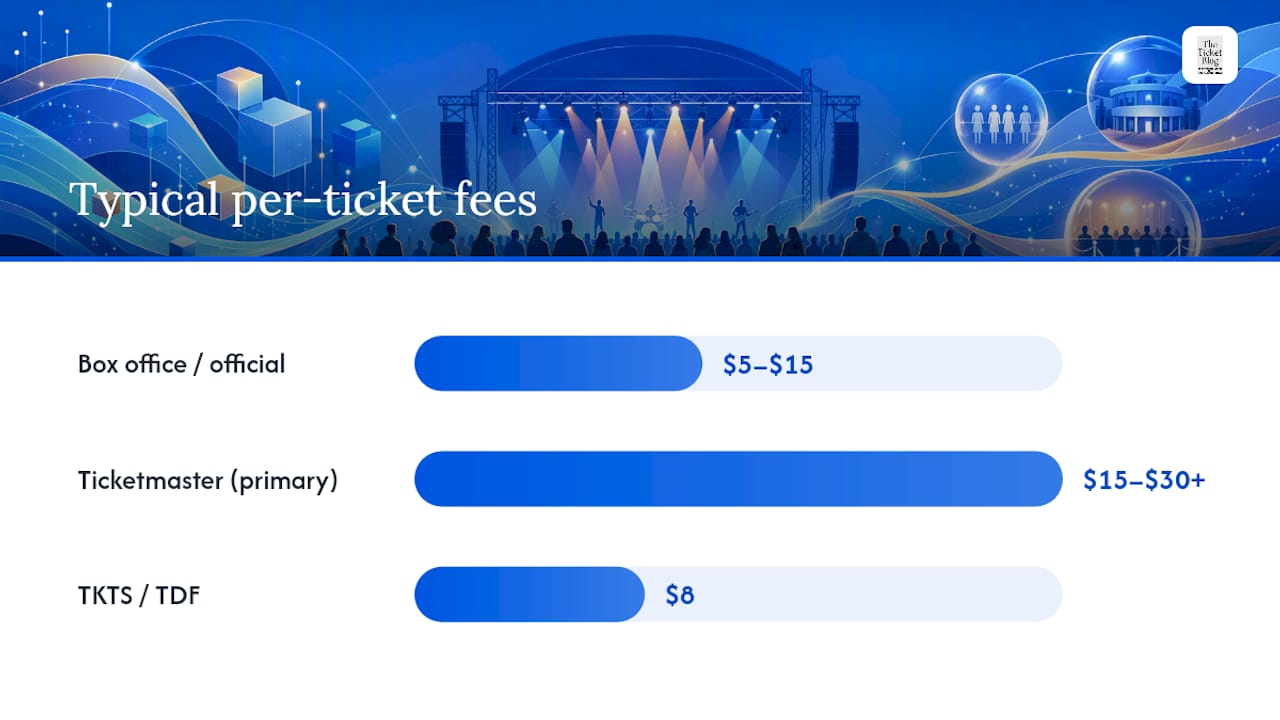
Box office / official theatre site | Full face value | Seat certainty, no markup | Lowest fees; often $5–$15 per ticket |
Ticketmaster (primary market) | Full face value | Wide inventory, presale access | Service + facility fees; $15–$30+ per ticket common |
TKTS / TDF (same-day discount) | 30–50% off face value | Last-minute, flexible buyers | $8 per-ticket service charge (TDF-set) |
Resale marketplace | Above face value (variable) | Sold-out shows, specific seats | Buyer fees 20–30%+ on top of listing price |
Broadway.org’s Touring Broadway Ticket Guide recommends buying directly from the theatre box office or official ticketing links as the most reliable way to avoid extra charges and confirm accurate seat information. That advice holds for touring productions as much as it does for Broadway.
TDF’s TKTS program offers same-day discounts up to 50% off face value, with a fixed $8 per-ticket service charge on all discounted purchases (some tickets may carry additional non-TDF charges). That $8 fee is notably lower than the service fees most online platforms charge, so when the face-value discount is large enough, TKTS produces a genuinely lower out-the-door cost than buying at full price online.
Industry context: Average concert tour ticket prices hit $136 in 2024, up roughly 50% from 2019 levels. Touring theater has tracked the same upward trend, making fee-aware buying more consequential than it was five years ago.
Use resale as a last resort, not a first stop. For a full breakdown of types of ticket discounts and how they compare on out-the-door cost, The Ticket Blog’s discount guide covers the mechanics in detail.
When should you buy to get the best touring ticket price?
Timing is one of the most controllable variables in what you pay. The buying window for a touring production typically moves through four phases:
Presale (weeks to months before on-sale): Credit card presales, fan club presales, and venue member presales open before the general public. Prices are at face value, but inventory is limited. This is the best window for specific seat classes at standard pricing.
General on-sale: Full inventory opens to the public. Dynamic pricing kicks in immediately for high-demand shows, so prices can rise within hours of the on-sale opening.
Subscription allocations: Many touring venues sell subscription packages that lock in access to specific price tiers across multiple productions. Broadway.org confirms that subscriptions can guarantee access to certain allocations that sell out quickly in general on-sale.
Last-minute / same-day window: Rush tickets, student discounts (valid ID required), and TKTS same-day listings become available as the performance date approaches. Inventory is unpredictable, but the savings can be significant.
An emerging option worth watching: mystery will-call ticket programs that offer allocations at prices as low as $20, with seat assignments withheld until will-call pickup and ID verification required. Because these tickets are tied to the buyer’s ID, they can’t be resold, which keeps them out of the secondary market and in the hands of actual fans.
Practical rule: If you need a specific seat class or performance date, buy early in the presale or general on-sale window. If you can be flexible on date and seat location, the last-minute TKTS window and rush programs often deliver the lowest out-the-door cost.
Proven tactics to lower your out-the-door touring ticket cost
These are the highest-impact moves, ranked by reliability:
Buy at the box office or official theatre link first. Fees are lowest here, and you’re dealing directly with the venue. No third-party markup, no inflated service charges.
Use TKTS for same-day flexibility. The $8 per-ticket service charge plus a 30–50% face-value discount frequently beats full-price online purchases, even after fees. Check the TKTS Live listings on the day of the performance.
Join presale lists before the on-sale date. Credit card presales (American Express, Citi) and venue member presales often open 48–72 hours before the general public. Signing up costs nothing and gives you first access at face value.
Watch for rush and student programs. Many touring productions release a limited number of rush tickets on the day of the show, often at $25–$40. Student discounts with valid ID can bring orchestra seats down to similar levels. The Ticket Blog’s guide to Broadway rush tickets covers the mechanics for both Broadway and touring stops.
Look for mystery/will-call allocations. When available, these $20 programs offer genuine savings with no resale risk. The trade-off is that you won’t know your seat until you arrive.
Always compare final out-the-door costs, not face values. A $90 face-value ticket with $35 in fees costs more than a $100 face-value ticket with $8 in fees.
Pro Tip: Combine a presale signup with a TKTS backup plan. Lock in your presale access for the specific performance you want, but if the presale sells out before you get a seat you like, set a TKTS alert for the same show closer to the date. You may land a better seat at a lower out-the-door price than the presale offered.
What are the real risks of buying touring tickets on the resale market?
Resale can be useful when a show is sold out and you need a specific date. It can also be expensive and occasionally risky. Knowing the difference between a legitimate resale listing and a problematic one saves both money and frustration.
A $120 face-value ticket can easily become a $200+ purchase on resale.
Safety checks before buying resale:
Confirm the platform offers a buyer guarantee that covers canceled shows and invalid tickets.
Match the listed seat section and row against the venue’s official seating chart before purchasing.
Verify that the ticket delivery method (mobile transfer, PDF, will-call) is accepted by the venue. Some venues have restrictions on transferred tickets.
Avoid listings that offer prices far below market rate. Tickets priced suspiciously low are a common fraud signal.
Check whether the show has will-call-only or ID-verified ticket policies, which make resale tickets functionally unusable.
Warning: The highest-risk resale behaviors are buying from unverified individual sellers on social media, paying via wire transfer or gift card, and purchasing tickets for a show that has announced ID-verification or will-call-only policies. None of these situations offer meaningful buyer protection, and recovery after a scam is rare.
For standing-room and last-minute budget options that sidestep resale entirely, official venue programs are almost always the safer and cheaper route.
The Ticket Blog’s take on what actually matters when buying touring tickets
The conventional wisdom says “buy early and you’ll get the best deal.” That’s true for seat selection, but not always for price. Dynamic pricing means early buyers sometimes pay more than last-minute TKTS buyers for comparable seats. The real skill is knowing which variable matters most to you: certainty, price, or seat quality. Those three goals rarely align perfectly, and pretending they do leads to overpaying or disappointment.
The most overlooked move in this space is the presale-plus-backup strategy. Most buyers either commit early at full price or wait and hope. Doing both, signing up for every presale while keeping a TKTS or rush option open, costs nothing extra and gives you a genuine fallback. The Ticket Blog tracks deal windows, promo codes, and discount program updates across touring productions so you don’t have to monitor every channel manually.
The Ticket Blog helps you find verified touring ticket deals
Sorting through face values, service fees, presale windows, and resale listings takes time most buyers don’t have. The Ticket Blog cuts through that by tracking verified deals, discount program updates, and promo codes for touring productions, concerts, and sports events across the U.S.
Whether you’re looking for the lowest out-the-door price on a national touring musical or trying to figure out whether a resale listing is worth the premium, The Ticket Blog’s guides and deal alerts give you the context to decide quickly and confidently. Visit The Ticket Blog to browse current touring deals, promo codes, and buying guides updated for the current season.
Sources
These official and industry references back the guidance in this article and are worth bookmarking for your own research:
Recommended
Comments