What Does E-Ticket Mean? Your Complete Guide


An e-ticket is defined as a digital record that replaces a physical paper ticket, stored securely in an airline’s or event provider’s reservation system rather than printed on paper. If you’ve ever booked a flight on Delta, bought concert tickets through Ticketmaster, or reserved seats at a Broadway show, you’ve already used one. Understanding what does e-ticket mean goes beyond knowing it’s “just digital.” The e-ticket is the official proof of your purchase and reservation, and it works very differently from the boarding pass or email confirmation you receive afterward. Since june 1, 2008, 100% of commercial airline tickets are issued electronically, making e-tickets the global standard for travel.
What does e-ticket mean and how is it defined?
An e-ticket, short for electronic ticket, is the industry term for a reservation record stored in a secure database rather than issued as a physical document. The International Air Transport Association (IATA) defines it as the official contract of carriage between a passenger and a carrier. In entertainment, the same concept applies: your purchase is logged in the ticketing platform’s system, not handed to you as a paper stub.
The e-ticket definition covers more than just airlines. Platforms like Ticketmaster, AXS, and SeatGeek all issue electronic tickets for concerts, sports events, and theater productions. Each ticket is tied to a unique identifier in the provider’s system, which is what actually grants you entry. The email or PDF you receive is a receipt, not the ticket itself.

This distinction matters more than most buyers realize. If you lose your confirmation email, your ticket still exists in the system. The provider can retrieve it using your name, order number, or payment details. The record never disappears just because you deleted an email.
How does an e-ticket work in practice?
An e-ticket functions as a database entry with a unique identifier, not as a file you download or a document you carry. For airline tickets, that identifier is a 13-digit ticket number assigned by IATA standards. The number encodes the airline code in the first three digits, followed by a form code, a serial number, and a check digit.
Here is how the process works from purchase to entry:
Purchase: You buy a ticket through an airline website, a travel agency, or a platform like Expedia. The transaction creates a record in the reservation system.
Confirmation: You receive an email with your booking reference and a PDF receipt. This is not the ticket. It is proof of purchase for your convenience.
Check-in (travel): You check in online or at the airport. The airline issues a boarding pass, which is the separate document that grants you access to the gate.
Entry (events): At a concert or sports venue, you present a QR code from your phone or a printout. The scanner reads the code and verifies it against the ticketing database in real time.
Boarding or admission: The system confirms your record is valid, and you are admitted.
The 13-digit ticket number remains the definitive reference even when flight details change. If your flight is rescheduled or you upgrade your seat, the same ticket number is updated in the system. No new physical document is needed.
Pro Tip: Save your booking reference number separately from your email. Airlines and event platforms can retrieve your full record using just that number plus your name, even if you lose access to your original confirmation.
Multi-leg itineraries and interline agreements also rely on e-ticket records. When you fly from New York to Tokyo with a connection in Los Angeles on two different carriers, each leg has its own ticket number, and the systems communicate through global distribution platforms like Amadeus or Sabre.
E-ticket vs paper ticket: what are the key differences?
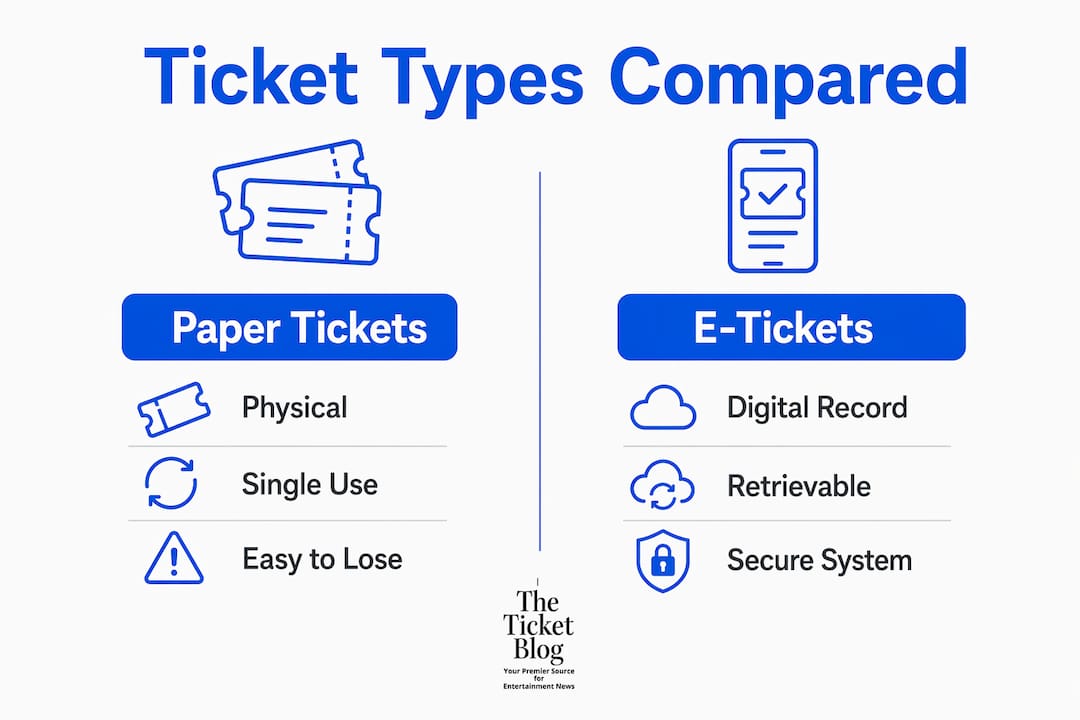
Paper tickets were physical coupons issued by airlines or box offices, each representing one leg of a journey or one event admission. E-tickets replaced that physical coupon with a centralized database record. The shift was driven by the need to reduce administrative complexity and printing costs while enabling real-time data synchronization across global flight databases.
Feature | Paper ticket | E-ticket |
Storage | Physical document | Secure airline or venue database |
Risk of loss | High | Very low (retrievable by name or ID) |
Forgery risk | Moderate to high | Very low (unique encrypted identifier) |
Change process | Requires reissue of physical ticket | Updated instantly in the system |
Environmental impact | Paper and printing waste | No physical materials needed |
Access method | Present physical ticket | QR code, mobile pass, or ID verification |
The advantages of e-tickets over paper tickets are clear in everyday use. You cannot accidentally leave a database record in your other jacket. You can manage refunds, seat upgrades, and itinerary changes entirely online without visiting a ticket counter or box office.
Common myths about e-tickets still circulate among less frequent travelers:
“I need to print my e-ticket to use it.” You do not. A QR code on your phone works at most venues and airports.
“If I lose the email, I lose the ticket.” The ticket lives in the provider’s system, not in your inbox.
“An e-ticket and a boarding pass are the same thing.” They are not. More on this below.
Pro Tip: When buying tickets through secondary markets, always verify that the seller transfers the ticket to your account on the original platform (Ticketmaster, AXS, etc.) rather than just forwarding a screenshot or PDF. A transferred ticket updates the database record to your name, which is the only secure form of transfer.
Understanding concert venue ticket fees also helps you read your e-ticket receipt accurately, since the face value and service fees are itemized separately in most confirmation emails.
What practical benefits do e-tickets offer travelers and event attendees?
E-tickets deliver concrete advantages at every stage of the experience, from purchase to entry. Over 4 billion passenger journeys were processed electronically in 2024, reflecting how thoroughly the industry has moved away from paper. That scale is only possible because e-ticketing systems handle changes, cancellations, and verifications instantly across thousands of simultaneous transactions.
The practical benefits include:
Faster check-in and entry. Airports using mobile boarding passes and biometric verification move passengers through security significantly faster than paper-based systems. Event venues with QR code scanners process crowds more efficiently than manual ticket checks.
Online booking management. You can change seats, request refunds, or upgrade your ticket entirely online. No physical document needs to be reissued.
No need to carry physical documents. Modern e-ticket systems integrate with biometric verification and mobile check-ins, allowing travelers to board without carrying any physical documentation at all.
Reduced fraud risk. Each ticket has a unique encrypted identifier. Counterfeit paper tickets were a real problem at major events; counterfeit e-tickets are far harder to produce because the database record is the source of truth.
Instant delivery. You receive your ticket confirmation within seconds of purchase, regardless of where you are in the world.
For event attendees specifically, platforms like Ticketmaster and AXS allow you to transfer tickets to friends, sell them on the secondary market, or add them to Apple Wallet or Google Wallet with one tap. That level of flexibility did not exist with paper tickets.
Common confusions: e-ticket, boarding pass, and ticket receipt explained
Three documents cause the most confusion for travelers, and mixing them up can create real problems at the airport or venue gate.
The e-ticket is the official record of your purchase and reservation. It is stored in the airline’s or event provider’s system. It represents the legal contract between you and the carrier or venue. You do not physically carry it.
The boarding pass is a separate document issued at check-in that grants you access to the airport security area and the gate. You cannot board a flight using only your e-ticket. The boarding pass is what TSA and gate agents scan.
The ticket receipt or email confirmation is a convenience document. It contains your booking reference and itinerary details, but it is not the ticket and it is not the boarding pass. Presenting only an email confirmation at a gate will not get you on the plane.
Here is what to do if you lose your confirmation email or printout:
Go to the airline’s or platform’s website and log into your account.
Look up your booking using your reservation code or order number.
Re-download or resend the confirmation email to yourself.
If you cannot access your account, contact customer support with your name and payment details. The ticket is retrievable from the system using that information.
At the airport, airline staff can pull up your record at the check-in counter using your passport or government ID.
At event venues, the process is similar. Ticketmaster and AXS both allow you to log in and display your ticket QR code directly from the app, even without a prior email.
Key takeaways
An e-ticket is a secure database record, not a file or document, and it serves as the official contract of carriage or admission for travel and events worldwide.
Point | Details |
E-ticket definition | A digital reservation record stored in a provider’s system, not a file you carry. |
Boarding pass is separate | The boarding pass grants gate access; the e-ticket is only the purchase contract. |
Email receipt is not the ticket | Your confirmation email is a convenience copy; the real ticket lives in the database. |
Lost email does not mean lost ticket | Airlines and platforms retrieve tickets using your name, ID, or booking reference. |
E-tickets replaced paper globally | IATA mandated 100% electronic airline ticketing as of june 1, 2008. |
The Ticket Blog’s take on e-tickets and what most buyers still get wrong
After years of covering ticketing markets for both travel and live events, the single most persistent mistake buyers make is treating their confirmation email as the ticket itself. That misunderstanding creates real panic when an inbox gets wiped or a phone dies before an event. The actual ticket is safer than most buyers realize. It sits in a secure system and can be retrieved with basic identifying information.
What concerns me more is the boarding pass confusion. Travelers who understand e-tickets well still sometimes show up at a gate with only their booking confirmation, expecting to board. The boarding pass is a separate step, and skipping it costs time and sometimes causes missed flights.
The rise of biometric check-in at airports like Hartsfield-Jackson Atlanta International and John F. Kennedy International is making this even more interesting. In those systems, your face becomes the boarding pass. The e-ticket record is still there in the background, but the physical verification step disappears entirely. That is where ticketing is heading, and it is worth understanding the foundation before the technology makes it invisible.
For live events, the secondary market adds another layer. Buying a transferred ticket through Ticketmaster or AXS is genuinely secure because the database record updates to your name. Buying a screenshot or PDF from a stranger on social media is not. The format looks the same to the untrained eye, but only one of them is a real ticket.
— The Ticket Blog
Stay current on ticketing with The Ticket Blog
Knowing what an e-ticket means is the foundation, but the ticketing world moves fast.

The Ticket Blog covers everything from how electronic ticketing platforms work to finding the best deals on concerts, sports, and theater. Whether you want to understand online ticketing platforms before your next purchase or stay updated on industry changes, The Ticket Blog is the resource built for buyers who want to spend less and stress less. Visit The Ticket Blog for guides, promo codes, and expert advice updated regularly for 2026 and beyond.
FAQ
What is an e-ticket exactly?
An e-ticket is an electronic reservation record stored in an airline’s or event provider’s secure database. It serves as the official proof of purchase and contract of carriage, replacing the physical paper ticket entirely.
Is an e-ticket the same as a boarding pass?
No. An e-ticket is your purchase record stored in the system, while a boarding pass is a separate document issued at check-in that grants you access to airport security and the gate.
What happens if I lose my e-ticket confirmation email?
Your ticket still exists in the provider’s database. Airlines and platforms like Ticketmaster can retrieve your booking using your name, government ID, or booking reference number.
Are e-tickets safe from fraud?
E-tickets are significantly safer than paper tickets. Each ticket carries a unique encrypted identifier verified against a live database at entry, making counterfeiting far harder than with physical tickets.
Where can I find my e-ticket for a flight or event?
Log into your airline account or the ticketing platform where you made the purchase. Your ticket QR code or booking reference is accessible directly from the app or website, even without the original confirmation email.
Recommended


Comments