What Is a Pit Ticket? The Fan's Guide to Front-of-Stage Access


A pit ticket gives you standing access in the area closest to the stage, ahead of the general floor or seated sections. You’re trading comfort for proximity: no seat, no guaranteed personal space, but the best sightline in the building.
Best for: superfans who want to see every facial expression and don’t mind standing for hours in a packed crowd
Think twice if: you need to sit, get overwhelmed in tight crowds, or want a guaranteed spot without arriving early
The trade-off in one line: proximity and energy versus comfort and predictability
Key Takeaways
A pit ticket puts you closest to the stage in a standing-only area, and the right choice depends on whether you value proximity over comfort and certainty.
Point | Details |
Pit means proximity | It’s the standing zone closest to the stage, ahead of general floor or seated sections. |
Arrival time often decides position | Most GA pits are first-come, first-served, so early arrival directly affects your spot. |
Scarcity drives price | Smaller pit capacity compared to full floor sections pushes up both primary and resale prices. |
Prep beats luck | Sturdy shoes, hydration, and earplugs matter more than any last-minute strategy. |
Read the label closely | “VIP,” “front pit,” and “early entry” don’t always mean the same thing across listings. |
Table of Contents
What Is a Pit Ticket and Where Does It Sit at a Venue?
The pit sits directly in front of the stage, closer than any other ticketed section in the house. Ticketmaster’s own help documentation defines the “Pit sector” as the area positioned nearer to the stage than general admission, which tells you how central this zone is to the whole layout. At an arena show, the pit typically occupies the space where the first few rows of floor seating would normally go. At an outdoor festival, it’s the fenced-off zone right at the barricade, separated from the rest of the field by rails and security staff.
Pit configurations vary more than most fans expect. A few common setups:
Standard floor pit: an open standing area directly below the stage, often the entire front section of the floor
Front rail or barricade pit: a narrower strip right against the stage barrier, sometimes sold as its own premium tier
Raised or lowered orchestra-style pit: occasionally used at theater or hybrid venues, where the front section sits slightly below or above floor level
Festival pit area: a designated, fenced zone at outdoor events, usually requiring a wristband exchange near the stage entrance
Venue seating charts and ticketing diagrams usually mark the pit with its own shaded block, often labeled “GA Pit,” “Floor Pit,” or simply “Pit.” If a diagram shows numbered rows near the stage, you’re likely looking at a reserved pit rather than a standing one. Always zoom into the map before buying. A pit label on a general seating chart doesn’t always mean the same physical footprint from venue to venue, and promoters occasionally shrink or expand it based on stage design.
How Do Pit Tickets Differ From Floor, GA, and Seated Tickets?
The core difference comes down to assignment and distance. A pit ticket is almost always a subset of general admission, but it’s not identical to a floor ticket, and it’s a completely different animal than reserved seating.
GA pit vs. GA floor: both are standing, unassigned areas, but the pit sits inside or in front of the larger floor section, closer to the stage. Floor tickets get you standing room somewhere in the main area; pit tickets get you standing room up front.
Assigned vs. unassigned: most GA pits work on a first-come, first-served basis, meaning your physical spot depends on when you arrive, not what’s printed on your ticket. Some events sell reserved pit access, where you’re guaranteed a section but still stand rather than sit.
Crowd density: pit sections pack people tighter than the general floor, which spreads out as it moves away from the stage. Expect shoulder-to-shoulder contact in a strong pit, especially near the barricade.
Sightlines: seated tickets guarantee a fixed view, sometimes elevated and far from the stage. Pit tickets give you the closest possible view but require you to hold your ground to keep it.
Arrival behavior: reserved seating lets you walk in minutes before doors close. A first-come pit rewards people who queue hours early, sometimes camping outside the venue since morning.
If you want certainty, comfort, and the ability to show up late, seated tickets make more sense. If proximity to the artist matters more than personal space, and you’re willing to commit to an early arrival, the pit is the better call. GA pit is a standing-only area directly in front of the stage where position is usually determined by arrival time, and that single fact should drive most of your planning.
What Should You Expect Once You’re in the Pit?
Standing is the baseline, but the real story is crowd behavior, which shifts a lot depending on the artist. A pop or acoustic show tends to stay calm and social. A rock or EDM set can turn into shoving, crowd surges, and occasional moshing near the front. Neither is wrong, but you should know which one you’re walking into before you commit to a front-rail spot.
Front-rail dynamics deserve their own mention. Security staff typically patrol the barricade line, pulling people out if they’re in distress or breaking rules. Phones and cameras are common, but some artists and venues restrict recording near the stage, and staff will enforce that inconsistently depending on the show. Most pits also ban bags, chairs, and large personal items, partly for crowd safety and partly to keep the area from becoming a tripping hazard.
Hearing protection matters more than most first-timers assume. Standing directly in front of a concert-grade sound system for two or three hours puts you closer to speaker stacks than almost any other ticket type allows, and the volume at that range adds up over a full set.
A few practical fixes go a long way:
Bring foam or reusable earplugs rated for concerts, not the disposable kind meant for sleeping
Hydrate before entry since drinks are rarely allowed inside the barricade
Plan restroom trips around opener sets, not the headliner, because leaving the pit usually means losing your spot
Pro Tip: Scope out fan-recorded footage from the tour’s earlier stops before the show. Crowd behavior at a pit varies enormously by artist, so watching how the last city’s pit handled the setlist gives you a realistic preview of what to expect.
Multiple concert guides describe GA pit conditions as physically demanding by design, since the closest view comes with the tightest space and the least room to retreat. That trade-off is the entire reason pit tickets exist as a separate tier in the first place.

Why Are Pit Tickets Scarcer and Pricier Than Other Sections?
Pit capacity is small by design. A typical arena floor might hold thousands of standing fans, but the pit carved out of that floor often fits a few hundred at most. That physical limit is the real driver behind the premium you see on both primary and resale listings.
Smaller inventory against high demand pushes prices up fast. Pit sections are smaller than general floor areas, and that scarcity carries straight through to the secondary market, where pit listings routinely command some of the steepest markups of any ticket type on a given show.
Sales flows for pit access typically follow one of a few patterns:
General on-sale: pit tickets released alongside every other tier, usually the first to sell out
Fan pre-sales: early access windows through artist mailing lists or credit card partnerships, often the only realistic shot at face value
Lottery or armband systems: common at festivals, where fans register for a random draw or exchange a wristband for pit access on show day
VIP packages: pit access bundled with merchandise, early entry, or meet-and-greets at a significantly higher price point
Industry explainers note that pit tickets are among the most in-demand ticket types and frequently show up bundled into premium packages rather than sold as a standalone line item. Before buying resale, check the exact label on the listing, whether it specifies entry rules, and whether “early entry” language actually applies to your seat category or just to VIP add-ons. A mislabeled listing is the single most common way fans overpay for a pit spot that turns out to be something else entirely. For more on how ticket tiers get priced apart from each other, The Ticket Blog’s breakdown of price floors is worth a look before you commit.
How Do You Prepare for a Safe, Comfortable Pit Experience?
Getting the most out of a pit ticket comes down to timing and gear, not luck. Here’s a simple sequence to follow:
Check the event page for entry logistics. Some shows use numbered armbands distributed hours before doors, others run strict first-come lines, and some fold pit access into VIP check-in. Event listings commonly spell out these steps in advance, including armband exchange requirements for pit holders.
Arrive earlier than you think you need to. For a first-come pit, being in line two or three hours before doors is common practice for a hotly anticipated show.
Dress for standing, not comfort. Closed-toe, sturdy shoes matter more than anything else you pack. Breathable layers help since body heat builds fast in a packed pit.
Leave valuables at home. Bags are frequently restricted, and pockets get jostled constantly in a crowd.
Watch out for the people around you. If someone looks distressed, alert security immediately. Pit etiquette runs on this kind of mutual awareness, especially near the barricade.
Accessibility is worth planning for directly. If you’re bringing a friend or family member who needs extra space, contact the venue ahead of time. Many venues offer accommodated viewing platforms as an alternative to standing pits, and asking early avoids a scramble at the door.
Pro Tip: If you’re arriving solo for an early-entry line, tell venue staff at check-in if you have any medical concerns. Most pit security teams are trained to spot and respond to distress quickly, but flagging it in advance speeds up their response.
For a broader prep checklist beyond the pit specifically, The Ticket Blog’s summer concert buying guide covers gear and timing for general admission shows as a whole.
What Are the Different Types of Pit Tickets and VIP Options?
Not every “pit” ticket means the same thing, and listings use the word loosely. A few common variants:
VIP pit: usually includes early entry, a smaller and less crowded standing zone, and sometimes extras like merchandise or a dedicated entrance
Assigned or reserved pit: a numbered ticket for a standing spot in the front zone, guaranteeing a section without requiring an early arrival
Festival pit pass: a wristband-based system exchanged at a designated booth, often tied to a lottery or presale window rather than direct purchase
Forward barricade or “front of stage”: language that usually signals the innermost strip of a pit, sometimes sold as its own premium add-on above standard pit pricing
Read the fine print before assuming “VIP” or “early entry” guarantees a front-rail spot. Some VIP packages grant early access to the venue but still place you behind a general pit crowd that formed hours earlier. If a listing description doesn’t spell out the exact area, treat “front of stage” as marketing language until the venue’s own event page confirms it.
The Ticket Blog’s Buyer-Tested Tips for Pit Tickets
Buying a pit ticket well starts before the show, not at the door. The Ticket Blog tracks on-sale calendars closely because pit inventory is usually the first tier to disappear, sometimes within minutes of a general on-sale opening.
A few habits separate a smooth pit purchase from a frustrating one:
Set alerts for on-sale times and log in to your ticketing account early, since pit sections often sell out before the homepage even refreshes
Verify the listing wording on resale marketplaces; “pit” and “front pit” aren’t always the same product, and sellers sometimes blur the distinction
Never assume early entry means front rail. Early entry gets you into the building sooner, but your final position still depends on how fast you move once inside
Look for promo codes tied to the venue, presale partner, or credit card program before paying full resale markup
Common Mistake | Better Approach |
Assuming all pit listings are identical | Read the exact section label and entry rules before buying |
Skipping the presale window | Register for artist or venue presales the moment they’re announced |
Buying resale without checking price history | Compare against face value and recent sales before paying a premium |
The Ticket Blog publishes event-specific breakdowns and promo code roundups regularly, which is often the fastest way to catch a pit deal before it disappears.
Where to Verify Official Pit Rules and Ticket Types
Always confirm pit-specific rules on the event’s official ticketing page, since bag policies, age limits, and armband procedures vary by show. Ticketmaster’s Pit sector explainer and event listings like The Dead South’s tour page show how promoters typically present these details.
Our Take on Pit Tickets
Most explainers treat pit tickets like a simple upgrade: pay more, stand closer, done. That framing undersells how much the actual experience depends on logistics most fans never think about until they’re standing in line at 3 p.m. for an 8 p.m. show. Armband systems, lottery pickups, and VIP early-entry rules vary so much by promoter that the ticket type on your confirmation email tells you less than the event page’s fine print does.
The advice that consistently falls short is “get there early and you’ll be fine.” Early matters, but knowing the specific entry workflow, whether it’s a wristband exchange or a straight queue, matters more. Festival crowd dynamics at the barricade shift by artist and genre, and no amount of arriving early fixes a mismatch between your expectations and the actual crowd you’re standing in.
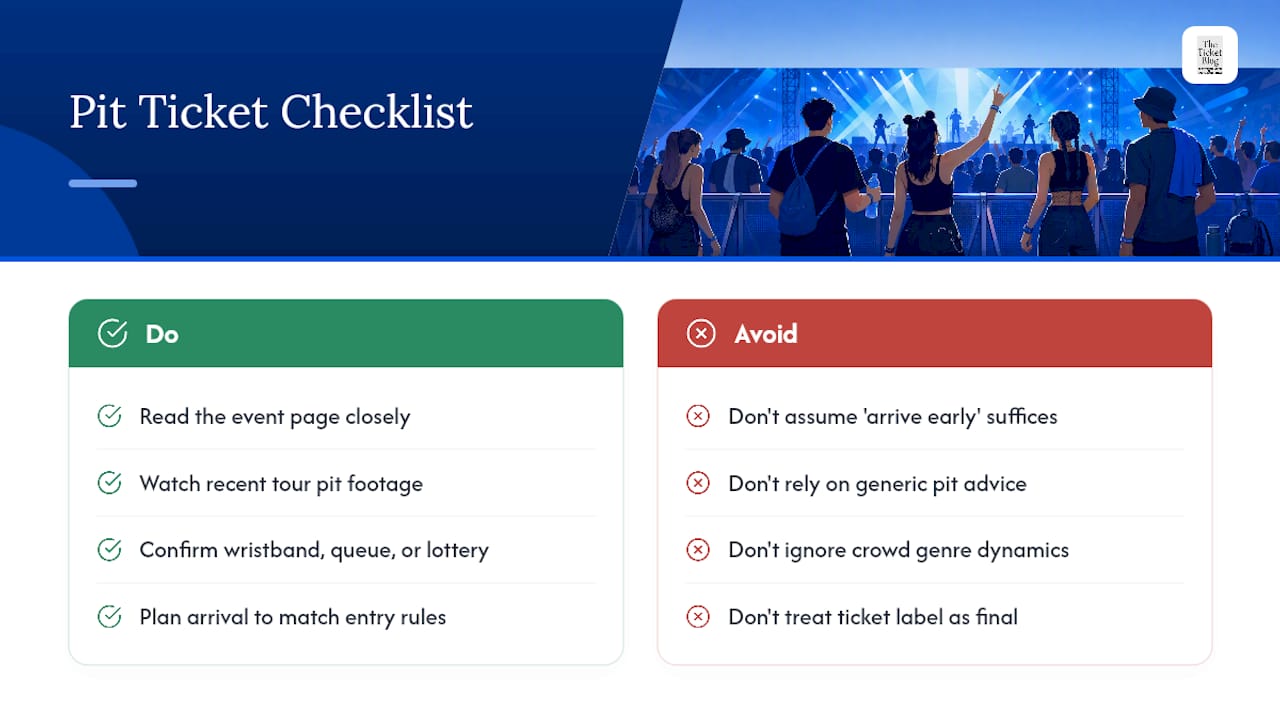
Prioritize research on the specific show over generic pit advice. Watch recent tour footage, read the event page twice, and treat the ticket label as a starting point, not the full picture.
Sources
Recommended


Comments