2026 Mississippi Rebels Football History Traditions and Key Players Guide

Ole Miss football has never been just a Saturday scoreboard. It is a walk through the Grove, a chant that rolls across Vaught-Hemingway Stadium, a powder blue helmet under the lights, and a long memory of stars who shaped the program.
The 2026 Mississippi Rebels season will arrive with expectations built by more than a century of football in Oxford. Rosters change. Schedules shift. New names become Saturday favorites. Yet the best way to understand where the Rebels are going is to understand what has carried them this far: history, traditions, community, and players who made Ole Miss matter well beyond Mississippi.
Ole Miss football began with regional pride and grew into a national brand
The University of Mississippi first fielded football teams in the late 1800s, and the program grew alongside the rise of Southern college football. For much of its history, Ole Miss has carried a strong regional identity. That identity comes from Oxford, from the Southeastern Conference, and from the way the school’s football culture blends pageantry with pressure.
The Rebels’ greatest early era came under Johnny Vaught, the coach most closely tied to the program’s rise. Vaught led Ole Miss from the late 1940s into the early 1970s, building teams known for defense, toughness, and national relevance. Ole Miss claims national championships from 1959, 1960, and 1962, with the 1962 team still standing as one of the program’s defining groups.
For season-by-season records, historical rankings, and bowl results, these resources are useful starting points:
The modern SEC has made life harder for every program. Weekly schedules often include future NFL players, packed stadiums, and national TV pressure. Ole Miss has still found ways to stay visible. The Rebels have won major bowl games, produced high draft picks, and built offenses that attract attention across the country.
For 2026, the bigger story is continuity of identity. Whatever the roster looks like by kickoff, Ole Miss will be judged against a standard shaped by Vaught’s title teams, Manning family memories, SEC West battles, and the energy Lane Kiffin’s era brought back to Oxford.
Traditions turn Ole Miss games into a shared experience
Many programs have loud stadiums. Ole Miss has something more layered. The school’s football traditions begin hours before kickoff and stretch far beyond the final whistle.
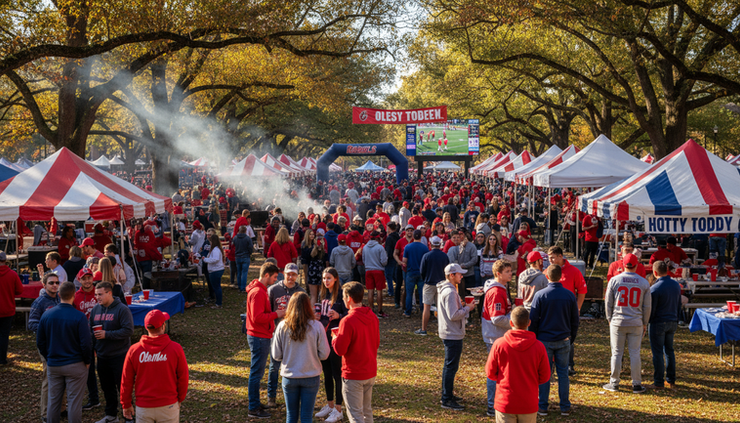
The best known is the Grove, a 10-acre green space at the center of campus. On game days, it becomes one of college football’s most famous gathering places. Fans set up tents, dress for the occasion, share food, and welcome generations of family and friends. The Grove matters because it makes football feel communal. A new fan can understand the culture before seeing a single snap.
The team’s Walk of Champions brings players through the Grove on the way to the stadium. It gives fans a close look at the team and gives players a physical reminder of who they represent. The tradition links the crowd to the roster in a direct way. Players are not just running out of a tunnel. They are moving through a community.
Then there is “Hotty Toddy,” the chant that serves as greeting, celebration, and rally cry. It can sound strange to outsiders at first. After one game weekend, it starts making sense. It works because it is easy to share. Alumni, students, kids, and first-time visitors can all join in.
Other pieces of the game-day feel include:
Vaught-Hemingway Stadium
The home venue gives Ole Miss its main stage and has grown through renovations as the program’s ambitions have grown.
Powder blue uniforms
The shade has become one of the most recognizable looks in college football, especially when paired with a home crowd under the lights.
The Pride of the South band
The band connects generations of fans through songs, rhythms, and pregame routines.
The student section
At its best, it gives Ole Miss a true home-field edge, especially in SEC games where momentum can swing fast.
Traditions also carry responsibility. Ole Miss has worked through public debates around symbols tied to its past, including the retirement of Colonel Reb as an on-field mascot and later changes to game-day symbols. That history is part of the full story. The strongest traditions are the ones that can welcome more people while still giving long-time fans a sense of belonging.

Key moments still shape the 2026 Rebels
Ole Miss history is full of moments that fans return to because they explain something about the program’s personality.
The 1959, 1960, and 1962 seasons sit near the top. Those teams made Ole Miss a national power. The 1962 team went unbeaten and won the SEC, creating a standard that still appears in conversations about the program’s ceiling.
The Manning years gave Ole Miss national visibility in two different generations. Archie Manning was a brilliant quarterback in the late 1960s and early 1970s, known for carrying heavy responsibility on dynamic, often dramatic teams. Decades later, Eli Manning brought another wave of attention, leading the Rebels to a memorable era before becoming a two-time Super Bowl champion in the NFL.
Chucky Mullins’ story remains one of the most meaningful in Ole Miss history. Mullins suffered a paralyzing injury during a 1989 game and became a symbol of courage and connection within the program. The Chucky Mullins Courage Award continues to honor a defensive player who represents leadership, toughness, and character.
In more recent years, Ole Miss has built its image around explosive offense and recruiting ambition. The Rebels’ wins over ranked opponents, New Year’s Six bowl appearances, and NFL receivers have helped position Oxford as a place where skill players can shine.
The official schedule and current team updates are best tracked through:
For the 2026 Mississippi Rebels Football History Traditions and Key Players Guide, the safest way to think about “key moments” is not as a museum list. They are reference points. They tell new players what the jersey means. They remind fans that a season can become part of a much longer story.
Influential players define what Ole Miss football can be
A program’s history becomes easier to understand through names. Ole Miss has produced stars at quarterback, receiver, running back, linebacker, and along the line. Some became NFL icons. Others became college legends whose names still matter in Oxford.
Player | Era | Why the name still matters |
Charlie Conerly | 1940s | A standout quarterback who later became an NFL champion with the New York Giants. |
Jake Gibbs | 1950s and 1960s | A two-sport star and one of the great athletes in school history. |
Archie Manning | 1960s and 1970s | One of college football’s most beloved quarterbacks and a lasting face of the program. |
Ben Williams | 1970s | The first Ole Miss football player to earn first-team All-America honors more than once. |
Deuce McAllister | 1990s | A powerful, versatile running back who became a fan favorite in college and the NFL. |
Eli Manning | 2000s | A record-setting Ole Miss quarterback and two-time Super Bowl MVP. |
Patrick Willis | 2000s | One of the greatest linebackers in school history and a Pro Football Hall of Famer. |
Michael Oher | 2000s | A standout offensive lineman who helped raise the program’s national profile. |
A.J. Brown | 2010s | A dominant receiver whose NFL success keeps Ole Miss in wide receiver conversations. |
DK Metcalf | 2010s | A rare physical talent who became one of the NFL’s most recognizable receivers. |
These players reflect different versions of Ole Miss success. Manning represents quarterback lore. Willis represents defensive force. McAllister represents reliability and power. Brown and Metcalf represent the modern receiver pipeline.
The next influential Rebel may already be on campus by 2026, or may arrive through recruiting or the transfer portal. Modern roster building moves fast. That makes official sources vital for tracking who will shape the season.
Good places to follow player movement and performance include:

What to watch as the 2026 team takes shape
Because college football rosters now change through high school recruiting, the transfer portal, NFL draft decisions, and coaching movement, any 2026 preview needs room for change. The better approach is to watch the traits that usually decide Ole Miss seasons.
Quarterback play will always come first. Ole Miss history raises expectations at the position, and modern SEC football demands quick decisions, accuracy, and leadership under pressure.
Offensive tempo and spacing are also central. Recent Ole Miss teams have leaned into speed, wide formations, and aggressive play-calling. When that style works, it stresses defenses and turns home crowds into a real factor.
Defensive depth may decide the ceiling. The Rebels have often had star defenders, but SEC contention requires enough depth to survive physical games in October and November.
Line play matters as much as the highlight positions. The best Ole Miss teams have protected quarterbacks, run the ball when needed, and created pressure without relying on constant blitzing.
Special teams and field position can swing tight league games. In the SEC, one hidden-yardage mistake can change a season’s biggest Saturday.
Fans following the 2026 team should pay close attention to spring practice reports, fall camp depth charts, and early nonconference games. Those windows usually reveal which young players have earned trust and which position groups still need time.
Traditions build more than noise
College football traditions can look like decoration from the outside. At Ole Miss, they do practical work.
They help players feel part of something larger than a single season. A freshman who walks through the Grove before a packed home game understands the program in a way no meeting room can teach. A senior who hears “Hotty Toddy” after a hard win feels the reward of representing a place that cares deeply.
Traditions also build community support. Local businesses fill with fans. Alumni return to Oxford. Families plan weekends around kickoff. Students form memories that keep them connected to the university long after graduation. That cycle helps recruiting, fundraising, attendance, and the overall health of the athletic department.
A strong game-day tradition gives fans a role. They are not only watching the team. They are helping create the setting the team plays in.
That does not mean every tradition stays frozen. The best ones adapt. They keep the parts that bring people together and leave behind the parts that no longer fit. Ole Miss has had to face that balance more directly than many schools. The result is a football culture that still feels distinct while continuing to evolve.
For fan travel, tickets, and game-day planning, these resources help:

The 2026 Rebels will add another chapter to a long Oxford story
The 2026 Ole Miss season will bring new starters, new pressure, and new memories. Some players will become leaders. Some games will define the year. A few moments may last far longer than anyone expects when the ball is kicked off.
The deeper appeal of Ole Miss football comes from how those moments connect to everything around them. The Grove before the game. The Walk of Champions. The sound of “Hotty Toddy.” The Manning legacy. The memory of Chucky Mullins. The pride of seeing former Rebels make it on Sundays.
That combination is why Ole Miss can attract new fans while still rewarding those who have followed the program for decades. The 2026 team will be measured in wins and losses, as every team is. It will also be measured by how well it carries the spirit of Oxford into another fall.


Comments