2026 San Francisco 49ers History Traditions Legends and Fan Culture

The 49ers are one of the rare NFL teams whose past still feels close enough to touch. A chant at Levi’s Stadium, a red No. 16 jersey in the stands, a clip of Dwight Clark rising over the goal line, or a Jerry Rice highlight on the big screen can pull decades into one moment.
For fans following the 2026 San Francisco 49ers, that history is more than nostalgia. It is part of the team’s identity. The franchise has rebuilt, reinvented, and returned to contention across generations, but the symbols stay familiar: red and gold, “The Faithful,” the West Coast offense, and the constant chase for the next championship.
This guide walks through the milestones, legends, games, rituals, and fan culture that shaped the franchise, with links to official resources and trusted archives for anyone who wants to explore further.
The 49ers began with Bay Area ambition
The San Francisco 49ers were founded in 1946 as part of the All-America Football Conference before joining the NFL in 1950. The name honored the prospectors of the California Gold Rush of 1849, giving the team an identity rooted in Northern California from the start.
Early 49ers football had a different feel from the dynasty years that came later. The franchise played at Kezar Stadium, then Candlestick Park, building a fan base long before the Super Bowl trophies arrived. Those early teams gave San Francisco some of its first football heroes.
The “Million Dollar Backfield” remains one of the great early chapters. It featured four future Hall of Famers:
Y.A. Tittle
Joe Perry
Hugh McElhenny
John Henry Johnson
That group made the 49ers exciting before the modern passing era. Perry, in particular, became one of the NFL’s great runners and a key figure in franchise history.
Fans who want the official version of the timeline can start with the San Francisco 49ers official website and the team’s history pages. For box scores, season records, coaching lists, and year-by-year results, Pro Football Reference’s 49ers archive is one of the best resources available.
Bill Walsh turned San Francisco into a football standard
The biggest shift in franchise history came when Bill Walsh became head coach in 1979. The team had struggled through much of the 1970s, but Walsh changed its direction with a precise passing system that came to define modern offense.
That approach became known as the West Coast offense. It favored timing, spacing, route detail, and quick decisions. Joe Montana turned it into art. Jerry Rice later took it to another level. The system did not rely only on arm strength or deep throws. It forced defenses to defend every blade of grass.
The 1981 season changed everything. San Francisco went from promising to elite, and the NFC Championship Game against the Dallas Cowboys gave the franchise its defining image.
Dwight Clark’s catch from Joe Montana on January 10, 1982, remains one of the most famous plays in NFL history. The play is known simply as The Catch. It sent the 49ers to their first Super Bowl, where they defeated the Cincinnati Bengals.
That win began a run that few franchises can match.
The five Super Bowl championships shaped the franchise
The 49ers’ championship seasons form the spine of the team’s modern identity:
Season | Super Bowl | Result |
1981 | Super Bowl XVI | 49ers defeated the Bengals |
1984 | Super Bowl XIX | 49ers defeated the Dolphins |
1988 | Super Bowl XXIII | 49ers defeated the Bengals |
1989 | Super Bowl XXIV | 49ers defeated the Broncos |
1994 | Super Bowl XXIX | 49ers defeated the Chargers |
Each title had its own personality.
The 1984 team was dominant and balanced. The 1988 team had Montana’s late drive against Cincinnati. The 1989 team crushed Denver in one of the most complete Super Bowl performances ever. The 1994 team, led by Steve Young, finally broke through after years of battling the Dallas Cowboys for NFC control.
The Pro Football Hall of Fame’s 49ers team page is a useful place to connect those championship teams to the players and coaches who reached Canton.

The legends give the franchise its voice
Every historic team has stars. The 49ers have a full cast of figures who shaped how the game is remembered.
Joe Montana remains the calm face of the dynasty. His nickname, “Joe Cool,” fit his style. He played with touch, patience, and command. His game-winning drive in Super Bowl XXIII against the Bengals is still a model of late-game poise.
Jerry Rice stands as the standard for NFL wide receivers. His work ethic became part of the team’s mythology, from hill workouts to relentless route running. Rice did not just produce great numbers. He made precision feel explosive.
Ronnie Lott gave the defense its edge. He played safety with rare force and intelligence, and his toughness still comes up whenever fans discuss what 49ers football should feel like.
Steve Young carried the pressure of following Montana, then built his own Hall of Fame career. His six-touchdown performance in Super Bowl XXIX gave the 49ers their fifth Lombardi Trophy and removed any doubt about his place in team history.
Other names belong in the conversation too:
Bill Walsh
The coach who changed the franchise and helped reshape NFL offense.
Dwight Clark
Forever linked to The Catch and to the emotional heart of the dynasty years.
Roger Craig
A versatile running back who helped define what backs could do in the passing game.
Fred Dean and Charles Haley
Pass rushers who changed games and tilted playoff runs.
Bryant Young
A respected defensive lineman and leader through changing eras.
Patrick Willis
A modern defensive icon whose speed and force made him one of the great linebackers of his time.
Frank Gore
A beloved runner known for patience, toughness, and remarkable consistency.
No single era owns the franchise. The early stars built credibility. The Walsh years built greatness. The 1990s protected the standard. The 2010s and 2020s brought the team back to the NFL’s biggest stages.
The games fans still talk about tell the story best
History becomes real through games, and few teams have a highlight reel like San Francisco’s.
The Catch is the obvious starting point, but it is far from the only game that shaped the team’s identity.
Super Bowl XXIII against Cincinnati had one of Montana’s most famous drives. With the 49ers trailing late, Montana led the offense down the field and found John Taylor for the winning touchdown. It was not just a win. It became part of Montana’s legend.
Super Bowl XXIV showed the dynasty at full speed. The 49ers overwhelmed the Denver Broncos, with Montana and Rice starring in a performance that still ranks among the most lopsided Super Bowls.
The 1994 NFC Championship Game against Dallas felt like a release. The Cowboys had blocked San Francisco’s road in prior seasons, and the 49ers’ win at Candlestick Park sent them to the Super Bowl. Steve Young’s run in Super Bowl XXIX, with the monkey-off-the-back gesture, captured what that season meant.
More recent fans have their own memories.
The 2011 NFC Divisional Playoff Game against the New Orleans Saints produced “Vernon Post,” Alex Smith’s late touchdown pass to Vernon Davis. Candlestick shook, Davis cried, and a new generation felt the old energy return.
The 2012 season brought Colin Kaepernick’s playoff breakout and a Super Bowl appearance. The 2019 season under Kyle Shanahan and John Lynch put the franchise back in the Super Bowl. The 2023 season brought another Super Bowl trip and another chapter in the team’s modern rivalry with Kansas City.
One of the most dramatic recent playoff moments came in the 2023 NFC Championship Game, played in January 2024, when San Francisco rallied from a large halftime deficit to beat Detroit. It showed a familiar trait across eras: the 49ers rarely feel out of a game when their best players start to roll.
For deeper game logs and playoff history, the 49ers page at Pro Football Reference is especially helpful.

Traditions connect Candlestick memories to Levi’s Stadium
The 49ers have moved through different homes, but fan rituals travel well.
Candlestick Park still holds a special place in team memory. It was windy, cold, awkward, loud, and beloved. Baseball and football history overlapped there, and 49ers fans turned its quirks into pride. Many of the franchise’s greatest moments happened at Candlestick, from The Catch to the 1994 NFC Championship win.
Levi’s Stadium, which opened in Santa Clara in 2014, brought a new era. It also gave the franchise space to preserve its past. The 49ers Museum at Levi’s Stadium is one of the best stops for fans who want to see team history through artifacts, exhibits, and stories.
Some rituals are formal. Others come from the stands.
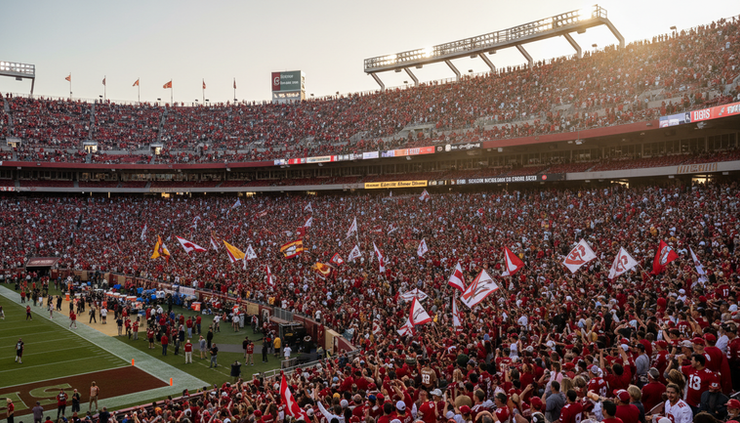
“The Faithful” is the team’s most enduring fan identity. It signals loyalty through quarterback changes, rebuilds, playoff pain, and championship hopes. It appears on signs, shirts, chants, and conversations across the Bay Area and beyond.
“Bang Bang Niner Gang,” popularized by Bay Area rapper E-40, became a modern rallying cry. It fits tailgates, highlight videos, and road games where 49ers fans seem to take over large sections of opposing stadiums.
“Who’s got it better than us? Nobody” came from the Jim Harbaugh era, but it stayed in the fan vocabulary because it had the feel of a family call-and-response.
The team’s red and gold colors carry their own weight. On game days, jerseys tell the franchise story:
Montana No. 16
Rice No. 80
Young No. 8
Lott No. 42
Gore No. 21
Willis No. 52
Kittle No. 85
Samuel No. 19
Bosa No. 97
Warner No. 54
Those jerseys are not just names. They mark entry points into 49ers fandom.
Fan culture stretches far beyond the Bay Area
The 49ers may be a Northern California team, but their fan base is national. Decades of winning, iconic players, and prime-time games turned the team into a coast-to-coast brand of fandom in the plainest sense: people grew up watching them, moved elsewhere, and kept the colors.
Road games often show that reach. In many NFL cities, pockets of red appear behind the visiting bench, in upper decks, and at local sports bars. Some fans trace their connection to the 1980s. Others came in through Steve Young, Terrell Owens, Frank Gore, Patrick Willis, Colin Kaepernick, George Kittle, Deebo Samuel, Christian McCaffrey, Nick Bosa, or Fred Warner.
Online fan culture keeps the conversation alive every day. For news, opinion, and community debate, fan-run sites like Niners Nation and 49ers Webzone offer a window into how people talk about the team between games. For official news, schedules, tickets, and roster updates, the safest starting point is still 49ers.com.
The best 49ers culture mixes old and new. A long-time fan might compare Brock Purdy’s rhythm passing to older West Coast ideas. A newer fan might start with Kyle Shanahan’s motion-heavy offense and work backward to Walsh. Both paths lead to the same place: a franchise that values timing, toughness, stars, and high expectations.

What the 2026 49ers inherit
The 2026 49ers inherit a standard that can be both inspiring and heavy. Few franchises measure themselves against so many ghosts. Montana, Rice, Walsh, Lott, Young, Clark, and the five Lombardi Trophies are always in the room.
That pressure is part of the deal.
The modern team also inherits a fan base that expects creativity on offense, violence and speed on defense, and a real chance to contend when the roster is healthy. Recent seasons restored the feeling that San Francisco belongs near the top of the NFC. The next step, as always, is turning contention into another championship.
For new fans, the path in is simple. Watch the highlights, learn the names, visit the archives, and follow the current team week by week. For long-time supporters, 2026 is another chapter in a story that began at Kezar, rose at Candlestick, and now lives at Levi’s Stadium.
The 49ers’ history is not frozen. It gets carried into every season by the people wearing red and gold, yelling from the stands, saving old ticket stubs, arguing over quarterbacks, and believing that the sixth Lombardi Trophy is still out there.


Comments