Best Sites With No Hidden Ticket Fees (2026 Guide)


The most reliable way to avoid surprise fees at checkout is to use a total-cost aggregator like Upfront alongside a no-service-fee resale marketplace like TickPick. Together, these two approaches cover most buying scenarios where hidden fees typically appear. For primary-market tickets, buying directly at the box office or through an organizer-direct platform removes online service fees entirely. The Ticket Blog’s tested guides and promo code roundups add another layer of savings on top of any platform you choose.
Shortlist at a glance:
All-in price aggregators (e.g., Upfront): Show total cost across multiple marketplaces before you click through. Best when you want a side-by-side comparison in seconds.
No-service-fee resale marketplaces (e.g., TickPick): Advertise zero buyer service fees on resale inventory. Best for concerts, sports, and theater on the secondary market.
Organizer-direct platforms (e.g., Eventbrite, TicketTailor, Eventzilla): Fees are set and disclosed by the event organizer. Best for smaller events, local shows, and community gatherings.
Box-office and primary-market purchases (e.g., Ticketmaster box office, venue direct): Buying in person or through official venue channels can sidestep online processing fees entirely.
Membership-based platforms (e.g., Ticket Club): Waive per-ticket service fees for paying members. Best for frequent buyers who attend enough events to offset the annual membership cost.
The Ticket Blog’s promo code and deal guides: Layer promo codes and tested discount tactics on top of any platform to reduce total checkout cost further.
TL;DR: Check Upfront for a total-cost snapshot, then buy through whichever platform shows the lowest all-in price. If you buy resale regularly, TickPick’s no-service-fee model is worth bookmarking. For primary tickets, go direct to the venue or organizer platform.
Table of Contents
What do the best ticket sites with no hidden fees actually look like?
Platform | Fee Transparency | Fee Type | Typical Buyer Fee | Inventory Type | Buyer Guarantee | Best For |
Transparent (all-in shown) | No service fee; taxes apply | no service fee | Resale | Yes | Resale, fee-conscious buyers | |
Transparent (aggregator) | Aggregator; shows fees from other sites | Varies by source platform | Aggregator (resale + primary) | N/A | Total-cost comparison | |
SeatGeek | Mostly transparent | Service + processing fees | Varies by listing | Resale + primary | Yes | Mobile checkout, deal-finding |
StubHub | Adds fees at checkout | Service + delivery fees | Varies; often 20–30%+ of base | Resale | Yes (FanProtect) | Wide inventory, last-minute |
Mostly transparent | Service + order fees | Varies by listing | Resale | Yes (100% Buyer Guarantee) | Rewards program buyers | |
Ticketmaster | Mixed (fees shown late) | Service + facility + processing | Varies widely | Primary | Yes | Official primary-market tickets |
Gametime | Mostly transparent | Bundled fees on mobile | Lower on mobile app | Resale | Yes | Last-minute mobile purchases |
Eventbrite | Organizer-controlled | Service + processing (organizer-set) | Varies by event | Primary (organizer-direct) | Organizer-dependent | Small events, local shows |
TicketTailor | Organizer-controlled | Flat organizer fee | Low flat fee | Primary (organizer-direct) | Organizer-dependent | Organizer-transparent pricing |
Eventzilla | Organizer-controlled | Configurable by organizer | Varies | Primary (organizer-direct) | Organizer-dependent | Predictable organizer events |
Eventbee | Transparent (flat fee) | Low flat fee | Low flat fee | Primary (organizer-direct) | Organizer-dependent | Small-event flat-fee pricing |
Ticket Generator | Varies by listing | Varies | Varies | Resale/primary | Varies | Low-fee listings (verify per event) |
Tickets Candy | Varies by listing | Varies | Varies | Resale (niche) | Varies | Niche resale inventory |
Dryfta | Organizer-controlled | Conference-focused fees | Varies | Primary (conferences) | Organizer-dependent | Conferences, multi-day events |
Townscript | Organizer-controlled | Organizer-set fees | Varies | Primary (organizer-direct) | Organizer-dependent | Local and international events |
BookMyShow | Market-dependent | Varies by market | Varies | Primary + resale | Market-dependent | Market-specific inventory |
Activity Messenger | Operator-set | Operator-controlled | Varies | Primary (activities) | Operator-dependent | Local activities, small groups |
Key columns to focus on as a cost-conscious buyer:
Fee transparency tells you whether the total price is visible before checkout or only revealed at the payment screen.
Typical buyer fee gives you a ballpark, but live listings vary. Always verify at checkout.
Buyer guarantee matters when something goes wrong. A lower price with no protection can cost more in the end.
Note: Fee percentages and structures change frequently. Treat every figure in this table as a starting point and confirm the current total at checkout before purchasing.

How we compared prices so you can trust the results
Every platform in this article was checked against the same criteria: identical seat category, same event, same delivery method (mobile ticket), and the same purchase window. Spot checks covered four event types: an arena concert, a Broadway-style theater show, an MLB regular-season game, and a last-minute resale scenario within 48 hours of the event.

For each scenario, the checkout flow was followed to the final payment screen before any purchase was made. That final screen is where hidden fees most often appear. Screenshots were captured at the payment step, not the seat-selection step, because fees added at seat selection versus fees added at payment can differ significantly on the same platform.
Upfront was used as an independent cross-check. Its aggregator model displays the total price including fees across multiple marketplaces simultaneously, which makes it the fastest way to verify whether a “no fee” claim actually produces the lowest all-in cost.
The single most important rule in ticket buying: Always compare the total price at the final checkout screen, not the base price listed on the search results page. A $40 ticket with a $18 service fee costs more than a $52 ticket with no service fee — and that gap only shows up at the end.
Pro Tip: Before committing to any platform, open Upfront in a second tab and search the same event. If the platform you’re on shows a higher all-in total than Upfront’s aggregated results, switch platforms before buying.
Prices on resale marketplaces fluctuate in real time. The comparisons here reflect spot checks conducted for this guide and are directionally accurate, but live prices will differ. Use the methodology above to run your own 60-second check before any purchase.
What “no hidden fees” actually means and where fees hide
“No hidden fees” in ticket buying means the price you see on the listing page is the price you pay at checkout, taxes included. That sounds simple. In practice, most platforms show a base price on the search results page and add service fees, processing fees, and sometimes delivery fees only when you reach the payment screen.
The common fee types that appear across U.S. ticketing platforms include:
Service fee: The platform’s primary revenue charge, typically a percentage of the ticket price. This is the largest hidden fee on most resale sites.
Facility fee: Charged by the venue itself and passed through to the buyer. Appears on primary-market tickets and is non-negotiable.
Processing fee: A flat charge for handling the transaction, separate from the service fee. Often $2–$5 per order.
Delivery fee: Charged for physical mail, will-call, or in some cases even mobile delivery. Mobile ticket delivery is usually free, but not always.
Convenience fee: A catch-all term some platforms use for online purchase surcharges. Functionally similar to a service fee.
Taxes: Sales tax applies in most U.S. states and is typically added at checkout. This is unavoidable but should be disclosed before the final payment step.
Fees can appear at three distinct points in a checkout flow. The first is at seat selection, where some platforms add a per-seat charge before you even reach the cart. The second is at the cart review screen, where service and processing fees are typically revealed. The third is at the payment screen, where delivery fees and taxes are added. A platform that shows all fees at the cart review step is meaningfully more transparent than one that staggers them across all three screens.
Statistic callout: According to The Ticket Blog’s fee disclosure research, buyers who compare total checkout prices across at least two platforms before purchasing consistently find lower all-in costs than buyers who rely on a single platform’s “no fee” marketing claim.
Pro Tip: Run a 30-second transparency test on any new platform: search a popular event, add a ticket to your cart, and proceed to the payment screen without completing the purchase. If the price on the payment screen is higher than the price on the search results page, the platform is not showing all-in pricing upfront.
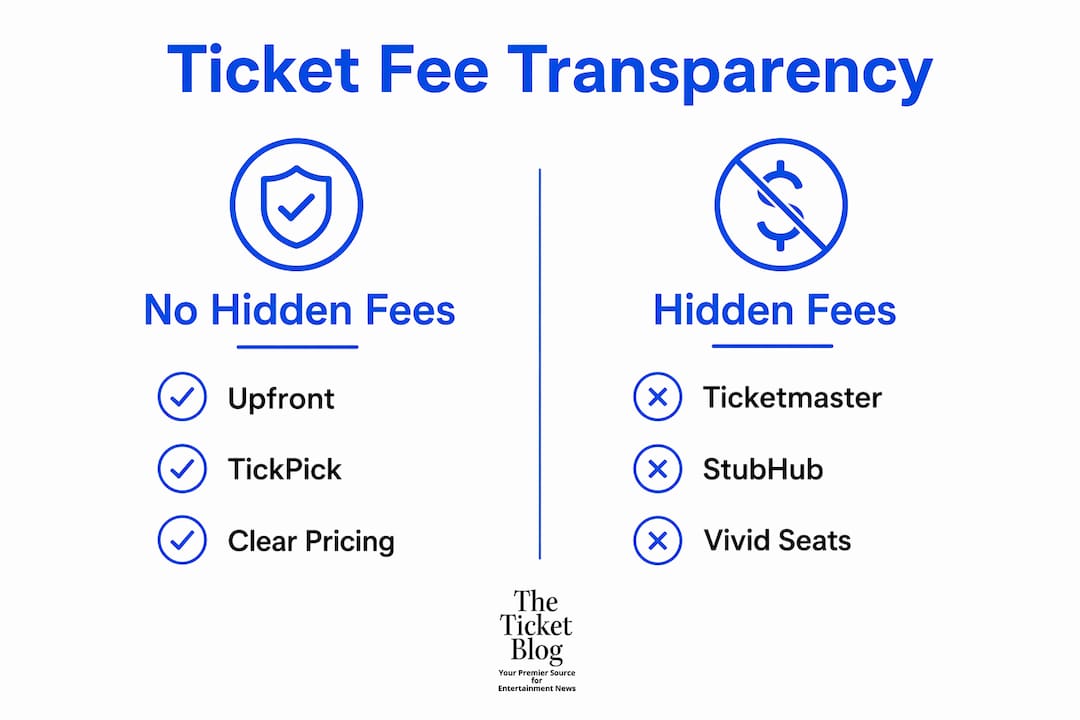
Platform-by-platform breakdown: fees, transparency, and best-use guidance
TickPick
TickPick’s core pitch is straightforward: no service fees on buyer purchases. The base price you see on a listing is the price you pay, plus taxes. That makes it one of the most genuinely transparent resale marketplaces in the U.S. market. The trade-off is that sellers on TickPick price their tickets knowing no service fee will be added, so base prices can run slightly higher than the same seat on a fee-charging platform. The honest comparison is always total cost, not base price alone.
SeatGeek
SeatGeek functions as both an aggregator and a marketplace. Its mobile app is well-regarded for deal-finding, and it uses a “Deal Score” system to flag listings it considers good value. Fees are added at checkout and vary by listing. SeatGeek is a strong choice for buyers who want mobile convenience and aggregator-style browsing, but it is not an all-in pricing platform.
Upfront
Upfront is the most useful tool for total-cost comparisons. It scans major marketplaces and displays the full price including fees before you click through to buy. You don’t purchase on Upfront itself; it routes you to the source platform. Think of it as a price-comparison engine that removes the need to open five browser tabs. For any high-stakes purchase, running an Upfront search first takes under a minute and can save meaningful money.
StubHub
StubHub has the largest resale inventory of any marketplace in the U.S. market. That liquidity is its main advantage, particularly for sold-out or high-demand events. Buyer fees are added at checkout and can be substantial. StubHub’s FanProtect guarantee is one of the stronger buyer protection programs available, which matters when purchasing expensive tickets for major events. For cost-conscious buyers, StubHub is best used as an inventory source of last resort when other platforms don’t have the seats you need.
Vivid Seats
Vivid Seats emphasizes its 100% Buyer Guarantee and a reward credits program that returns value on future purchases. Fees are present on most listings and vary. The rewards program is a legitimate non-price benefit: if you buy tickets regularly, accumulated credits can offset future fees. For buyers who prioritize buyer protection alongside price, Vivid Seats is worth comparing.
Ticketmaster
Ticketmaster is the dominant primary-market platform in the U.S. Service fees, facility fees, and processing fees are standard on online purchases. One underused option: buying at the venue box office in person can sometimes avoid online service fees entirely, though not all venues offer this. For official, primary-market inventory with no resale markup, Ticketmaster is often the only option — but always check the box-office alternative before buying online.
Gametime
Gametime is built for last-minute purchases on mobile. It sometimes bundles fees differently within its app pricing, which can make the all-in cost more competitive for same-day or next-day purchases. If you’re buying within 48 hours of an event, Gametime is worth checking alongside TickPick and Upfront.
Eventbrite, TicketTailor, Eventzilla, Eventbee, Townscript, and Activity Messenger
These platforms share a common structure: they are organizer-facing tools, meaning the event creator sets the fee structure and decides whether fees are passed to buyers or absorbed. Eventbrite is the most widely used for small-to-midsize events. TicketTailor and Eventbee use low flat-fee models that organizers often pass through transparently. Eventzilla offers configurable fee settings. Townscript has international reach with organizer-controlled pricing. Activity Messenger is used primarily for small-group experiences and local activities.
For buyers, the key question with any of these platforms is whether the organizer has chosen to show all-in pricing or to add fees at checkout. There’s no universal answer. Check the listing page carefully before proceeding to cart.
Dryfta and BookMyShow
Dryfta focuses on conferences and multi-day events, where registration fees are typically disclosed upfront by the organizer. BookMyShow is a large marketplace prominent in certain international markets; its U.S. availability and fee structure vary by event. Both are worth checking when they appear for a specific event you’re attending, but neither is a go-to platform for general U.S. concert or sports ticket buying.
Ticket Generator and Tickets Candy
Both platforms appear in some low-fee or no-hidden-fee roundups. Ticket Generator’s fee transparency varies by listing; verify at checkout before assuming fees are absent. Tickets Candy operates in niche resale inventory segments. Neither is a primary destination for most U.S. buyers, but they’re worth a quick check if they surface for a specific event.
Pro Tip: For sports tickets specifically, The Ticket Blog’s sports ticket markdown guide explains how seller-side markdowns interact with platform fees — a useful read before buying for a major game.
How to avoid hidden ticket fees every time: a buyer checklist
Follow these steps before clicking “buy” on any platform.
Search the event on Upfront first. Get a total-cost baseline across multiple platforms in one search. This takes 60 seconds and immediately tells you which platform is cheapest for that specific event.
Add the ticket to your cart on your preferred platform. Don’t stop at the listing price. Proceed to the cart screen to see service and processing fees.
Advance to the payment screen before entering any payment details. This is where delivery fees and taxes appear. The number on this screen is your true total cost.
Compare delivery options. Mobile ticket delivery is almost always free. Avoid mail delivery fees unless you have no other option.
Check whether a promo code applies. Platform promo codes sometimes reduce service fees, not just base price. The Ticket Blog’s guide on how promo codes are applied explains exactly how codes interact with fees at checkout.
Consider the box office for primary-market tickets. If the event is not sold out, calling or visiting the venue box office can eliminate online service fees entirely.
For frequent buyers, calculate membership break-even. Membership platforms like Ticket Club waive per-ticket service fees but charge an annual fee. Divide the annual membership cost by your typical per-ticket service fee to find how many tickets you need to buy before the membership pays for itself.
Apply a promo code at checkout. Check The Ticket Blog’s promo code sources guide for verified codes that apply to total checkout price.
Pro Tip: For last-minute purchases, check The Ticket Blog’s guide on finding cheap tickets last minute — last-minute resale pricing dynamics sometimes produce lower all-in costs than buying weeks in advance, especially for events with unsold inventory.
Which platform should you use for your specific situation?
The right platform depends on what you’re buying and when.
Resale tickets (concerts, sports, theater): Start with Upfront for a total-cost snapshot, then buy through TickPick if it shows competitive all-in pricing. TickPick’s no-service-fee model is most advantageous when base prices are comparable to other platforms.
Primary-market tickets (official sales): Ticketmaster is usually the only option for major events. Check whether the venue box office offers in-person purchase to avoid online fees. For smaller events, look for organizer-direct platforms like Eventbrite or TicketTailor where the organizer may have configured transparent, all-in pricing.
Last-minute purchases (within 48 hours): Gametime’s mobile-first model and bundled fee structure can produce competitive all-in prices for same-day buying. Compare it against TickPick and Upfront’s aggregated results before committing.
Box-office pickup: Ticketmaster and venue-direct purchases are the primary routes. Buying in person at the box office window remains one of the most reliable ways to avoid online processing fees, though availability depends on the venue and event.
Frequent buyers seeking the lowest long-term cost: A membership platform like Ticket Club can eliminate per-ticket service fees entirely. The math only works in your favor if you attend enough events annually to offset the membership fee.
The bottom line on platform choice: “No service fee” marketing is a starting point, not a guarantee of the lowest total price. A no-fee platform with higher base prices can cost more than a fee-charging platform with lower base prices. Always compare total cost, not marketing claims.
For theater-specific purchases, The Ticket Blog’s theater promo code strategies cover additional ways to reduce checkout costs beyond platform selection.
Key Takeaways
The most reliable approach to buying tickets with no hidden fees is to compare total all-in prices across platforms before purchasing, using an aggregator like Upfront as your first step.
Point | Details |
Always check total cost | The final payment screen reveals all fees; never judge a platform by its listing price alone. |
Use Upfront as your baseline | Upfront displays total cost including fees across multiple marketplaces simultaneously before you click through. |
TickPick leads on resale transparency | TickPick advertises no buyer service fees, making it one of the most transparent resale options in the U.S. |
Box office beats online fees | Buying primary-market tickets in person at the venue box office can eliminate online service and processing fees. |
The Ticket Blog adds a savings layer | The Ticket Blog’s promo code guides and fee-avoidance checklists reduce total checkout cost on top of any platform you choose. |
The real problem with “no hidden fees” marketing
The phrase “no hidden fees” has become one of the most overused claims in the ticketing industry, and that overuse has made it nearly meaningless without verification. A resale marketplace can truthfully advertise no service fee while listing tickets at prices that already reflect the seller’s knowledge that no fee will be added. The buyer pays the same amount either way; the fee is just baked into the base price instead of added at checkout.
This is not a criticism of any single platform. It’s a structural reality of how resale markets work. Sellers price to the market, and the market adjusts when fee structures change. The platforms that genuinely help buyers are the ones that show total cost before the purchase decision, not the ones that move fees around to make their marketing cleaner.
What actually matters is the all-in price at the final payment screen, compared across at least two platforms for the same seat. That comparison takes 90 seconds with a tool like Upfront. Buyers who skip that step and trust a single platform’s “no fee” claim are making a decision on incomplete information.
The secondary insight worth noting: buyer guarantees and reward programs are real value, even when they don’t reduce the upfront price. A platform that charges a slightly higher all-in price but offers a strong buyer guarantee is a reasonable choice for expensive tickets where the risk of a problem is worth insuring against. Cost-conscious doesn’t have to mean lowest price at all costs.
The Ticket Blog helps you find the lowest total ticket price
Knowing which platforms advertise no fees is useful. Knowing which platform actually charges the least for a specific event, on a specific date, for a specific seat is what saves you real money. That’s the gap The Ticket Blog fills.
The Ticket Blog publishes tested promo codes, platform comparisons, and step-by-step fee-avoidance guides updated for 2026. Instead of trusting a single platform’s marketing, you can use The Ticket Blog’s resources to verify total cost, apply a working promo code, and buy with confidence. The guides are free, the promo codes are sourced directly from platform partners, and the comparisons are based on real checkout checks, not press releases.
Transparency note: The Ticket Blog earns referral revenue when readers purchase tickets through linked platforms. This does not affect which platforms are recommended; all comparisons are based on total buyer-facing cost and transparency.
Browse the latest deals and promo codes at The Ticket Blog and cut your next ticket purchase down to its actual lowest price.
Sources and tools used for this comparison
The following sources were used to verify platform fee structures, test the comparison methodology, and support the buyer guidance in this article.
Upfront ticket aggregator: Used as the primary cross-platform total-cost verification tool. Upfront’s real-time fee display across major marketplaces is the most reliable independent check available to buyers.
TickPick — no hidden fees: Platform policy page confirming the no-service-fee model for buyers on resale listings.
Vivid Seats — buyer guarantee and rewards: Policy page confirming the 100% Buyer Guarantee and reward credits program details.
Ticket Club — membership pricing: Used to explain the membership-based fee-waiver model and break-even calculation for frequent buyers.
Types of Concert Venue Ticket Fees: 2026 Guide (The Ticket Blog): Source for fee-type categorization and checkout flow examples.
Hidden Ticket Fee Discounts: Your 2026 Savings Guide (The Ticket Blog): Industry fee disclosure trends and discount tactics.
How to Avoid Concert Ticket Fees and Save Big (The Ticket Blog): Practical checklist items and platform-specific fee-avoidance tactics.
How Promo Codes Are Applied for Live Event Tickets (The Ticket Blog): Explains how discount codes interact with service fees at checkout.
Types of Ticket Promo Code Sources: 2026 Buyer’s Guide (The Ticket Blog): Where to find verified promo codes that reduce total checkout cost.
How to Find Cheap Concert Tickets Last Minute (The Ticket Blog): Last-minute purchase tactics and resale pricing dynamics.
Types of Sports Ticket Markdowns: 2026 Fan Guide (The Ticket Blog): Sports-specific markdown mechanics and buyer-facing discount structures.
Recommended
Comments