What Is a Flash Ticket Sale? How to Score Big Deals


A flash ticket sale is a short, time-limited promotion offering steeply discounted event tickets, typically running anywhere from a few hours to a few days, with limited quantities available. According to Salesforce, flash sales create urgency and value by compressing the decision window, which pushes buyers to act fast. If you’re flexible on plans, comfortable with final-sale terms, and ready to check out quickly, they’re genuinely worth chasing.
Quick takeaways:
A flash ticket sale = steep discount + hard time limit + limited quantity
Main risk: tickets are usually final sale and non-refundable
Top prep tip: save your payment info and log into your account before the sale starts
Table of Contents
What is a flash ticket sale and how does it work?
A flash ticket sale combines a time limit, a capped inventory, and a steep discount to create a short buying window where hesitation costs you the deal. The mechanics are straightforward, but the pace is fast.
Where flash sales typically appear in the US:
Venue box offices (arenas, amphitheaters, stadiums)
Promoter email lists and official event websites
Ticketing platform presale windows
Sponsor or bank card partner promotions
Social media announcements from artists or teams
Organizers protect their margins with a few standard rules: first-N redemptions only, members-only or subscriber-first access, unique promo codes, and per-customer purchase caps. Once the limit is hit or the clock expires, the sale ends.
Here’s the typical flow from announcement to ticket in hand:
Announcement — venue, promoter, or platform sends an alert (email, social post, or app notification)
Traffic surge — thousands of fans hit the page simultaneously; site slowdowns are common
Checkout — you enter the promo code (if required), select seats, and complete payment
Ticket delivery — mobile or PDF delivery, usually within minutes; paper tickets are rare for flash deals
Pro Tip: Set up your account and save your payment method before any sale goes live. Logging in during a traffic surge wastes precious seconds.
Why do venues and promoters run flash sales?
The short answer: organizers run flash sales to move inventory fast, reward loyal fans, and generate a quick revenue spike during slow periods. BigCommerce notes that flash sales are most effective during quiet trading periods or seasonal shifts when venues need to increase volume.
“Flash sales tap into the fear of missing out so that customers act fast without overthinking their decision. The goal is to create urgency, encourage impulse purchases, and generate a quick spike in sales.” — Salesforce
Beyond filling seats, promoters use flash sales to grow their email lists, gain social followers, test price sensitivity on slower days, and boost midweek or shoulder-day attendance. A Tuesday night game with 30% of seats unsold is a prime candidate. For more on the business logic behind discounted tickets, The Ticket Blog’s guide on why unsold tickets get discounted breaks it down clearly.
Common guardrails organizers use:
Hard end times (no rolling extensions)
Per-customer purchase caps (often 2–4 tickets)
Members-only or subscriber-first windows
No stacking with other promo codes
Are flash ticket sales worth it for buyers?
They can be, but only if you value savings over flexibility. If you need the option to get a refund or swap dates, a flash sale ticket is usually the wrong buy.
Pros | Cons |
Deep discounts, sometimes half price | Almost always final sale, no refunds |
Fast access to last-minute or hard-to-find seats | Site crashes during high-demand windows |
Rewards fans who stay engaged and prepared | Service fees often added at checkout |
Can unlock seats in sections normally out of budget | Seat quality or location may be limited |
Quick decision checklist — ask yourself before buying:
Are you flexible if the event date changes or you can’t attend?
Do you accept final-sale, non-refundable terms?
Is your checkout ready (saved card, logged in, autofill on)?
Have you checked the service fees so the final price still feels like a deal?
Do you know the transfer or resale rules if plans change?
Pro Tip: Before you commit, look up the ticket’s resale and transfer policy. Some flash-sale tickets are locked to the buyer’s name and can’t be transferred, which means you’re out the full amount if something comes up.
Real U.S. examples of flash ticket sales
Flash sales show up across nearly every event category in the US. State fairs, pro sports teams, arenas, and independent promoters all use them. The South Carolina State Fair, for example, runs a dedicated flash sale offering discounted admission for a single day. The Denver Broncos have offered half-price tickets on a limited-window Tuesday sale, a classic midweek inventory push. These aren’t outliers; they’re a standard playbook.
Common event types and venues that run flash sales:
Pro sports teams — midweek or low-demand games, often promoted via team email lists
State and county fairs — single-day admission flash deals, usually tied to a sponsor or opening week
Arenas and amphitheaters — last-minute seat releases for shows with unsold inventory
Independent promoters — unadvertised deals sent only to email subscribers or social followers
Venue box offices — direct-to-fan sales that bypass secondary market fees
Common triggers for a flash sale include countdown promotions tied to a sponsor (bank card offers are popular), milestone celebrations like an anniversary or season opener, and end-of-presale inventory clearance. The Ticket Blog’s sports ticket flash sale examples covers real cases with specific savings breakdowns.
How to find flash ticket sales and prepare to buy fast
The best approach is proactive alerts combined with checkout readiness. Flash sales often reward already-engaged fans because unadvertised deals go to email subscribers and social followers first, not the general public.
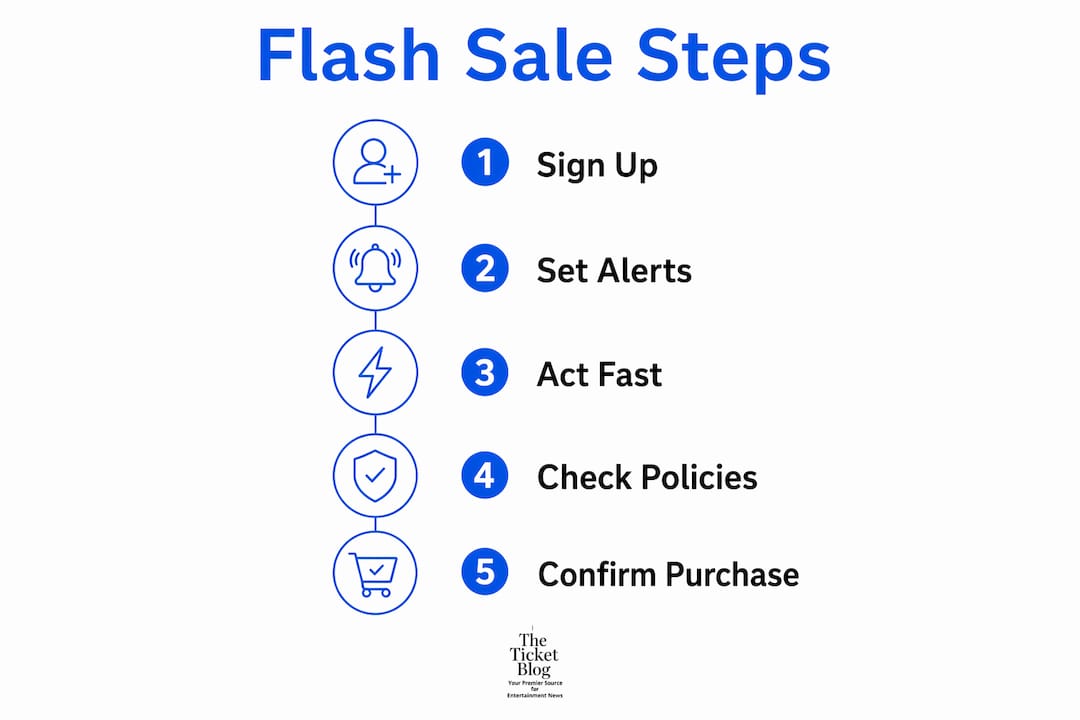
Step-by-step prep checklist:
Sign up for venue, team, and promoter email newsletters
Follow official social accounts for artists, teams, and venues you care about
Bookmark The Ticket Blog for curated flash-sale alerts and verified deals
Create accounts on official ticketing platforms in advance
Save your payment card and enable autofill in your browser or app
Test your login credentials before a known sale window opens
Read the final-sale and transfer terms for any event you’re targeting
Speed tips for checkout day:
Use one device only (switching mid-checkout can drop your session)
Have your billing address and card CVV ready to type if autofill fails
Avoid holding tickets in your cart without completing payment; many platforms have short hold timers
A fast, stable internet connection matters more than it sounds during a traffic surge
Pro Tip: Signing up for private sale access through venue fan clubs or credit card presale programs often gets you into flash windows before the general public even sees the announcement.

What to expect on price, timing, and fees
Most flash ticket sales run from a few hours up to 72 hours, with shorter windows creating the most urgency. Discounts vary widely, but half-price offers are common for sports and fair admissions, while concert flash deals may be smaller percentage cuts on specific seat sections.

Dimension | Typical range | Checkout caveat |
Sale duration | A few hours to 72 hours | Shorter windows = higher traffic surge risk |
Discount depth | 20%–50% off face value | Service fees can reduce net savings |
Ticket delivery | Mobile or PDF, same day | Paper tickets rarely available for flash deals |
Service fees are the most common surprise. A ticket listed at $30 can land at $42 after fees, so always click through to the final checkout screen before deciding the deal is worth it. The Ticket Blog’s guide on hidden ticket fees explains exactly where those charges come from and how to reduce them.
Flash sales tied to sponsor promotions (like bank card discounts) sometimes stack on top of an already-reduced price, which is where the deepest deals appear. Watch for those specifically.
What to check in the fine print before you buy
Check the refund policy, transfer rules, and delivery method before you complete any flash-sale purchase. Shopify’s enterprise research flags that flash sales amplify operational risks, including overselling, which makes clear terms even more important for buyers.
Terms to verify before checkout:
Refund policy (most flash-sale tickets are explicitly non-refundable)
Exchange policy (date changes or cancellations may not qualify for a swap)
Transferability (some tickets are name-locked and cannot be resold or gifted)
Ticket delivery method (mobile-only tickets require a working smartphone at the gate)
Identity restrictions (some venues require ID matching the buyer’s name)
Final-sale language (look for “all sales final” in the purchase confirmation)
Security checklist to avoid scams:
Verify the sale was announced on the official venue or team website
Check that the URL uses HTTPS and matches the official domain exactly
Avoid clicking links from unsolicited DMs or third-party social accounts
Never pay via wire transfer or gift card for event tickets
Voucherify’s research notes that legitimate flash sales have hard constraints: a real end time and a real quantity limit. If a sale keeps resetting or never seems to expire, the urgency is probably artificial.
How The Ticket Blog verifies and posts flash-sale alerts
The Ticket Blog vets every flash-sale alert by confirming the official event or venue announcement, documenting the ticket terms, and testing link integrity before publishing. The goal is simple: you should never click a deal on this site and land somewhere unexpected.
The verification process:
Source confirmation: every alert traces back to an official venue, team, or promoter page
Terms documentation: refund policy, final-sale status, and transfer rules are noted before posting
Link testing: every URL is checked to confirm it routes to the correct official page
Status updates: sold-out or expired sales are removed or marked promptly
The Ticket Blog also publishes deeper guides on related topics, including concert ticket discount types and sports ticket markdowns, so you can understand where a flash sale fits in the broader pricing picture before you buy.
Key Takeaways
Flash ticket sales reward prepared buyers who accept final-sale terms, act within tight time windows, and sign up for alerts before the sale goes live.
Point | Details |
What a flash sale is | A short, time-limited discount on event tickets with capped quantity and steep savings. |
When it’s worth buying | Buy when you’re flexible, checkout-ready, and comfortable with non-refundable terms. |
How to prepare | Sign up for alerts, save payment info, and log into accounts before the sale opens. |
Watch for fees | Always check the final checkout price; service fees can significantly reduce net savings. |
The Ticket Blog | Use The Ticket Blog for verified flash-sale alerts, promo codes, and step-by-step buying guides. |
The real edge most buyers miss
Flash ticket sales are not random luck. The buyers who consistently score deals are the ones who treat preparation as the actual work, not an afterthought. Most people show up at the sale window with no account, no saved card, and no idea whether the ticket is transferable. That’s how you end up watching a sold-out countdown from a login screen.
The more interesting point is that many of the best flash deals are never publicly announced at all. They go out to email subscribers and fan club members first, and by the time a deal surfaces on social media, the best seats are already gone. Following The Ticket Blog for curated alerts is one of the simplest ways to stay ahead of that curve without monitoring a dozen venue newsletters yourself.
Stay ahead of every flash ticket sale
The Ticket Blog tracks verified flash-sale alerts across concerts, sports, and live events so you don’t have to monitor every venue newsletter and promoter email separately. Every deal posted here is checked against the official source, with terms confirmed before it goes live.
Whether you’re after half-price sports tickets or a last-minute concert deal, The Ticket Blog gives you the alerts and the context to decide fast and buy with confidence. Check the latest flash-sale deals and guides and never miss a limited-time offer again.
Useful sources and further reading
What is a flash sale? | Salesforce — Defines flash sales, explains FOMO psychology, and outlines best practices for short-term promotions.
What Is a Flash Sale? | Uniqodo — Covers typical duration ranges (hours to 72 hours) and the urgency mechanics behind flash sales.
What are flash sales? | BigCommerce — Explains when flash sales are most effective and how timing affects discount depth and redemption rates.
What Is A Flash Sale? | Shopify Enterprise Blog — Details operational risks including traffic surges, overselling, and the need for organizer guardrails.
Flash sale strategies | Voucherify — Covers best practices, guardrails, and how to spot genuine vs. artificial urgency in a flash sale.
Flash sales for event tickets | Concerts and Tickets Blog — Explains how flash sales target engaged fans and why email subscribers get first access.
Broncos half-price tickets press note | Denver Broncos — Real-world example of a pro sports team running a limited-window, half-price ticket flash sale.
South Carolina State Fair Flash Sale — Live example of a state fair running a dedicated single-day flash admission sale.
Recommended
Comments