100% Validity or Face Value: Fan-to-Fan Resale Platforms Compared


Fan to fan resale means buying or selling a ticket directly with another fan through a platform that verifies the transfer and, often, caps the price at face value. The strongest official options right now are Ticketmaster Face Value Exchange, Ticketmaster Resale (Verified Resale), AXS Official Resale, and fan-run marketplaces like CashorTrade and Twickets. Pick based on whether you value price protection or a bigger inventory of listings, since not every platform offers both.
TL;DR:
Ticketmaster Face Value Exchange is limited to events where organizers opt in, so many tickets do not qualify for the price cap feature.
AXS provides a 100% validity guarantee on resale tickets, but resale prices can still be above face value.
Private resale platforms like CashorTrade and Twickets prioritize face-value trading with escrow and offer fewer restrictions but less broad access.
Seller payouts typically occur within about 7 business days after the event, provided all banking and tax info is complete beforehand.
Not all ticket types, such as VIP or charity tickets, are eligible for resale, and transfer laws may vary by state, affecting ticket mobility.
Table of Contents
What Is Fan to Fan Resale, and Which Platform Fits You?
Every official fan-to-fan platform solves the same problem differently: how do you let fans resell tickets without opening the door to scalpers and fake listings? Ticketmaster’s approach uses organizer opt-in and price caps. AXS leans on a validity guarantee. CashorTrade and Twickets skip the big-platform ecosystem entirely and build trust through escrow and a strict face-value policy.
The right pick depends on what you’re protecting. If you’re selling and want a guaranteed payout with minimal hassle, Ticketmaster’s tools handle that well. If you’re buying and want the cheapest possible ticket at face value with no markup, CashorTrade or Twickets tend to be the stronger match, assuming the event is listed.
Platform | Availability | Price policy | Guarantees | Transfer/mobile rules | Fees & payout |
Ticketmaster Face Value Exchange | Opt-in by artist/organizer | Capped at total price paid | Reissue workflow reduces fraud | Often mobile-only once opted in | Payout in about 7 business days after event |
Ticketmaster Resale / Verified Resale | Platform-wide on eligible events | Market pricing (seller-set) | Verified label, void-and-reissue system | Mobile transfer standard | Seller fee at sale; payout after verification |
AXS Official Resale | Events ticketed by AXS | Market pricing | 100% validity guarantee | Seat map shows resale listings | Fees vary by event |
Fan-submitted, independent of primary ticketing | Strictly face value | Escrow holds payment until validated | Depends on original ticket type | Small service fee, escrow release timing | |
Twickets (U.S. availability) | Event-by-event, coverage varies | Face value plus fees where operational | Fan-first verification model | Depends on originating platform | Modest fee, seller paid on confirmed transfer |
A few limitations matter more than they look. Ticketmaster’s face-value cap only applies when the artist or organizer opts in, so plenty of shows never get it. AXS’s guarantee protects validity, not price, meaning resale tickets can still cost more than face value. And state transfer laws sometimes force a platform to allow ticket transfer even on events that otherwise restrict it, which affects how freely you can move a ticket once it’s purchased.
Ticketmaster Face Value Exchange: best for fans who want price protection built into an official marketplace.
Ticketmaster Resale/Verified Resale: best for buyers who want a huge inventory with fraud protection, even if price isn’t capped.
AXS Official Resale: best for fans buying resale on AXS-ticketed events who want seat map visibility.
CashorTrade: best for fans who want strictly face-value peer trading outside a major ticketing platform.
Twickets: best for fans who prefer a fan-first, face-value marketplace and can confirm their event is covered.
How Does Fan-to-Fan Resale Actually Work?
Verified resale isn’t just a listing with a badge on it. It’s a technical process designed to make sure the ticket you buy is the only valid copy in existence.
A fan lists a ticket from their account, and the platform checks that it hasn’t already been transferred or flagged.
The original ticket is voided. Ticketmaster’s system cancels the seller’s ticket the moment a sale completes, which is why Ticketmaster Resale relies on a void-and-reissue workflow instead of just changing the name on an existing barcode.
A new ticket is issued to the buyer, usually straight into their account or through a secure mobile link.
Mobile-only rules kick in on many events specifically to prevent screenshots or printed duplicates from circulating after the reissue.
CashorTrade and Twickets handle step two and three differently, using escrow to hold funds until the buyer confirms the ticket works, rather than a platform-controlled reissue. Either way, the event organizer’s decision to opt into these programs is what triggers the rules you see on the purchase page. No opt-in, no price cap, even if the ticket itself is still fully verified.
What Fees and Payout Timelines Should You Expect?
Fees on official platforms usually split between buyer and seller, and the split changes what you actually see on the listing. On Face Value Exchange, the display price already includes the original fees and taxes the seller paid, so there’s no markup to negotiate. On standard Ticketmaster Resale and AXS Official Resale, the seller sets the price and a service fee gets added at checkout.
Payout timing follows a predictable pattern across most official platforms.
Ticketmaster typically deposits seller payouts within about 7 business days after the event, assuming banking and tax verification are already on file.
Sellers need a U.S. bank account and completed tax identity verification before funds release.
Canceled or postponed events trigger the venue’s standard refund policy, which usually rolls resold tickets back to the original buyer automatically.
Pro Tip: Add your payout and tax information to your account before you list anything. Waiting until after a ticket sells is the single most common reason sellers see delayed deposits.
Which Tickets and Events Qualify for Resale?
Not every ticket type is eligible, and assuming yours is can cost you time close to showtime. Organizer opt-in determines whether Face Value Exchange applies at all, and that status is set by the artist or promoter, not the fan. Some events don’t activate resale until close to the on-sale date or even the event itself.
Common exclusions and caveats to check before you list or buy:
VIP packages, commemorative tickets, and charity allocations are frequently excluded from standard resale programs.
Will-call and box-office-only tickets sometimes can’t be transferred digitally at all.
Some states require platforms to allow ticket transfer regardless of the event’s default settings, which is why transfer rules can vary by state even for the same tour.
Pro Tip: Check the event’s ticket page for a resale notice before you assume Face Value Exchange or Verified Resale applies. If there’s no visible label, contact the platform’s help center rather than guessing.
Are Verified Resale Tickets Actually Safe?
Verification exists specifically to answer this question, and the mechanics back it up more than a badge alone would. AXS states plainly that Official Resale tickets carry a 100% validity guarantee, meaning a ticket that fails at the gate gets replaced or refunded. Ticketmaster’s Verified Resale label works alongside its void-and-reissue system, so a listing can’t be sold twice.
CashorTrade takes a different route, using escrow to hold the buyer’s payment until the ticket is confirmed valid, which shifts risk away from both parties during the transaction window rather than relying on a platform guarantee after the fact.
If something goes wrong anyway, here’s the practical path:
Report an invalid ticket through the platform’s dispute or help-center system immediately, ideally before you leave the venue.
Expect a refund or replacement under the platform’s guarantee terms rather than needing to chase the original seller directly.
Screenshot your confirmation and transfer email before the event, since most disputes move faster with that documentation on hand.
How Do You List or Buy a Ticket on These Platforms?
Selling and buying each follow a short, predictable sequence once you know what to look for.
To sell a ticket:
Sign in to your account and go to your tickets or orders section.
Select the sell or transfer option for the specific ticket.
Confirm the listing price, which auto-fills to total price paid if Face Value Exchange applies.
Add or confirm your payout method and tax details.
Share the secure listing link or let the platform handle distribution automatically.
To buy a ticket:
Look for a verified or Face Value Exchange label directly on the listing.
Review any mobile-only or transfer restrictions before purchasing.
Complete the purchase and confirm the ticket lands in your account.
Check the event page for entry instructions, especially for mobile-only venues.
Pro Tip: List your ticket as early as you comfortably can. Earlier listings get more visibility, and buyers searching close to showtime tend to filter for tickets already confirmed as verified.
When Official Fan-to-Fan Resale Is Actually Worth It
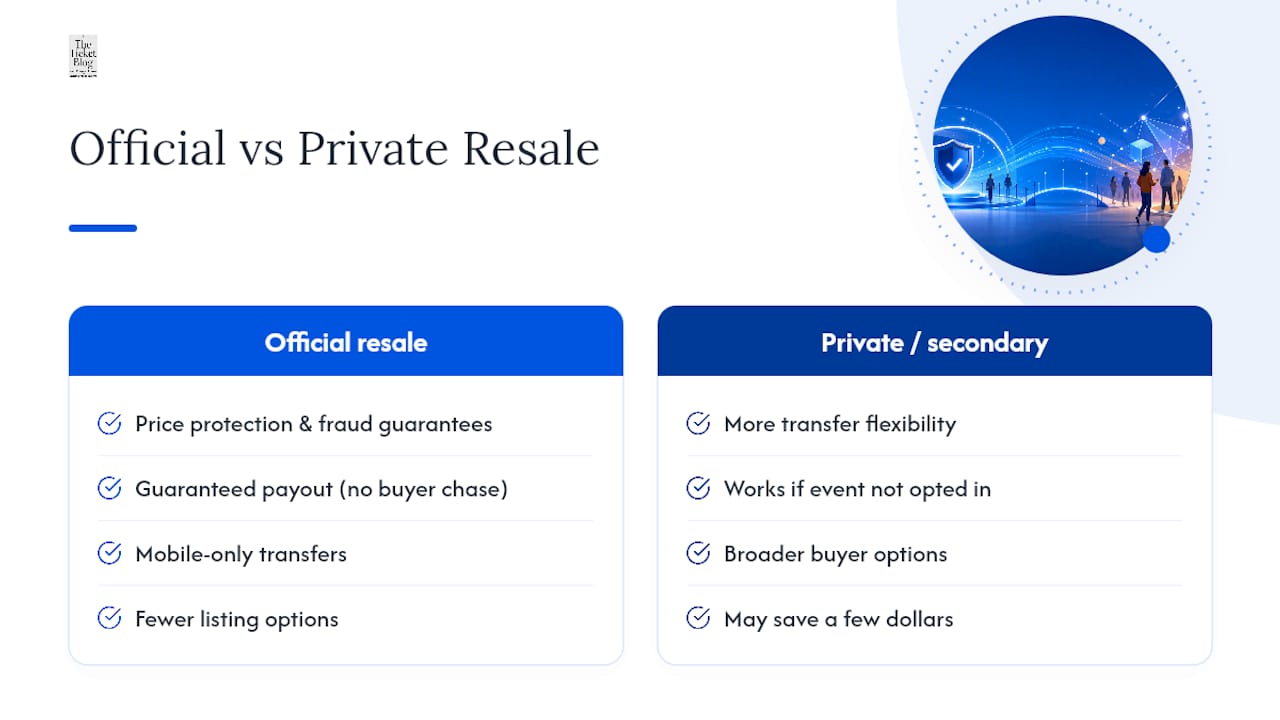
The tradeoff here is straightforward once you see it laid out: official resale gets you price protection and fraud guarantees, but it costs you flexibility. Fewer listing options, mobile-only restrictions, and organizer opt-in requirements all limit what you can do compared to a private sale between friends.
Official platforms make the most sense when you’re a seller who needs a guaranteed payout without chasing down a buyer, or a buyer who cares more about walking into the venue with a valid ticket than shaving a few dollars off the price. If your event isn’t opted in, or you need more flexibility than a mobile-only transfer allows, a private sale or a broader secondary market might serve you better.
— The Ticket Blog
Get More Resale Guidance From The Ticket Blog
Comparing five official platforms is a good start, but every event has its own quirks, and figuring out which resale program actually applies to your ticket can eat up more time than it should. The Ticket Blog breaks down exactly that: specific venues, specific tours, and which resale route actually saves fans money instead of just capping it.

If you’re heading into a mobile-only venue for the first time, our guide on entering without paper tickets walks through exactly what to expect at the gate. For a broader look at how ticket trading works outside official channels, check our full guide to ticket trades. Head to The Ticket Blog for deal alerts, promo codes, and step-by-step resale guides built around specific artists and venues.
FAQ
Can You Resell a Fan-to-Fan Ticket?
Yes. Platforms like Ticketmaster Resale, AXS Official Resale, CashorTrade, and Twickets all let fans list tickets for other fans to buy, though price caps and eligibility depend on the specific event and platform.
Is Fan-to-Fan Resale Legit?
It’s legitimate when you use an official or verified platform. Verified labels, void-and-reissue systems, and guarantees like AXS’s 100% validity promise exist specifically to keep these transactions safe.
How Does Fan-to-Fan Resale Work on Ticketmaster?
Ticketmaster offers two paths: Face Value Exchange, which caps resale at the total price the seller originally paid, and standard Verified Resale, where sellers set their own price within a verified, fraud-protected system.
What Is Ticketmaster’s Official Fan-to-Fan Resale Platform?
Face Value Exchange is Ticketmaster’s dedicated face-value resale program, available only on events where the artist or organizer has opted in. Its broader Verified Resale marketplace covers a wider range of events without the price cap.
What Should I Do If My Resale Ticket Doesn’t Work?
Contact the platform’s dispute or help-center system right away. Both Ticketmaster and AXS back verified listings with refund or replacement guarantees, and The Ticket Blog recommends keeping your confirmation email on hand in case you need it.
Recommended


Comments