Oregon Ducks History Traditions Legendary Players and Fan Culture Guide

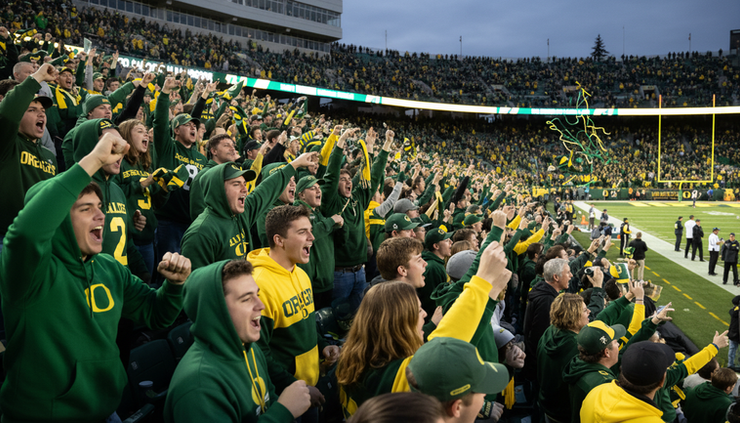
Autzen Stadium does not need the largest crowd in college football to feel loud. On a fall Saturday in Eugene, 50,000-plus fans can make the place shake, the Duck can turn a touchdown into a miniature workout, and one chant, “Go Ducks,” can tell you exactly where you are.
The Oregon Ducks are known today for flash, speed, Nike-connected style, and one of the most recognizable mascots in sports. That identity took more than a century to build. It includes early Rose Bowl glory, long stretches of patience, a breakthrough in the 1990s, national title runs, and a fan culture that mixes Pacific Northwest pride with big-stage ambition.

The Ducks grew from Webfoots into a national football name
Oregon football dates back to the late 1800s, when the program was still far from the national brand it would become. For decades, Oregon teams were often called the Webfoots, a nickname tied to the rainy Northwest and used broadly for Oregonians.
The “Ducks” name gradually took hold, helped by student usage, newspaper coverage, and the growing popularity of duck imagery. By the mid-20th century, the Duck identity had become central to Oregon athletics.
One of the program’s earliest landmark moments came after the 1916 season, when Oregon played Penn in the 1917 Rose Bowl. The Ducks won 14-0, giving the school one of its most important early victories and a proud place in West Coast football history.
The program had strong seasons and standout players across the decades, but Oregon did not become a steady national presence overnight. The Ducks spent much of the 20th century building, rebuilding, and fighting for attention in a region often dominated by other powers.
That changed in the 1990s.
A few milestones shaped the modern era:
Year | Milestone | Why it mattered |
1917 | Oregon beat Penn in the Rose Bowl | It gave the program early national credibility |
1967 | Autzen Stadium opened | The Ducks gained a compact, loud home built for atmosphere |
1994 | Oregon beat Washington on “The Pick” | The win helped send Oregon to the Rose Bowl |
2001 | Oregon won the Fiesta Bowl after the 2001 season | The Ducks finished among the nation’s elite |
2010 | Oregon reached the BCS National Championship Game | The program became a true national title contender |
2014 | Marcus Mariota won the Heisman Trophy | Oregon produced its first Heisman winner |
2024 | Oregon joined the Big Ten Conference | The Ducks entered a new national chapter |
The turning point most fans circle is 1994. Washington had long been a bitter rival and a measuring stick. With Oregon leading late in Eugene, cornerback Kenny Wheaton intercepted a pass and returned it for a touchdown. The play became known simply as “The Pick.”
It did more than seal a game. It marked a change in belief. Oregon went to the Rose Bowl after that season, and a new era started to feel possible.
Legendary players made Oregon more than a uniform brand
Oregon’s modern image often starts with uniforms, speed, and bright colors. The deeper story starts with players who gave the program its backbone.
Norm Van Brocklin starred at Oregon before becoming one of football’s great quarterbacks. Mel Renfro brought elite athleticism to Eugene before his Hall of Fame NFL career. Dan Fouts became one of the school’s signature quarterbacks and later a Pro Football Hall of Famer.
Ahmad Rashad, known at Oregon as Bobby Moore, was another major figure. His talent and versatility made him one of the top players of his era.
The late 1990s and early 2000s brought a new wave. Joey Harrington became the face of Oregon’s rise under head coach Mike Bellotti. His confidence, leadership, and success helped the Ducks move from respected program to national contender.
Then came the speed years.
LaMichael James was electric in Chip Kelly’s offense. He ran with vision, balance, and burst, and he helped define one of the most entertaining attacks college football had seen. De’Anthony Thomas, Kenjon Barner, and other playmakers turned open grass into instant danger.
Marcus Mariota stands in a category of his own. Calm, accurate, fast, and efficient, he won the 2014 Heisman Trophy and led Oregon to the first College Football Playoff National Championship Game. His legacy remains one of the cleanest examples of Oregon’s best football values: speed, humility, preparation, and poise.
Recent stars such as Justin Herbert, Penei Sewell, Kayvon Thibodeaux, Bo Nix, and others kept Oregon visible on national broadcasts and NFL draft boards. Each helped carry the program into a new era where Oregon expects to recruit and compete with the best programs in the country.
Games that shaped the Ducks’ identity
Some games become part of a program’s permanent vocabulary. Oregon has several.
The 1917 Rose Bowl win over Penn gave Oregon its first major national moment. It still matters because it shows that Oregon’s football story did not begin with modern uniforms or television exposure.
The 1994 win over Washington changed the emotional direction of the program. “The Pick” is replayed because it captured a shift in one snap. Oregon was no longer just chasing rivals. Oregon was starting to pass them.
The 2002 Fiesta Bowl, played after the 2001 season, remains one of the program’s great high points. Oregon beat Colorado and finished the season with a strong claim as one of the best teams in the country. Harrington and that team helped prove the Ducks could belong near the top.
The 2011 BCS National Championship Game, played after the 2010 season, ended in a narrow loss to Auburn. Even in defeat, it confirmed Oregon had become a national title threat. Chip Kelly’s tempo offense forced the sport to adjust.
The 2012 Rose Bowl win over Wisconsin gave Oregon its first Rose Bowl victory since the 1917 game. It was fast, dramatic, and full of the offensive fireworks associated with that era.
The 2015 Rose Bowl win over Florida State in the first College Football Playoff semifinal was another program-defining moment. Oregon beat the defending national champions and advanced to the CFP title game. Mariota was at the center of it, and the Ducks looked like a fully formed national power.
The 2020 Rose Bowl, played after the 2019 season, added another chapter. Oregon beat Wisconsin in a close game behind a tough, physical performance. It showed that Oregon could win with more than speed.
These games shaped the way fans see the Ducks: creative, bold, resilient, and always capable of turning one play into a memory that lasts for decades.
The Duck mascot gives Oregon its playful edge
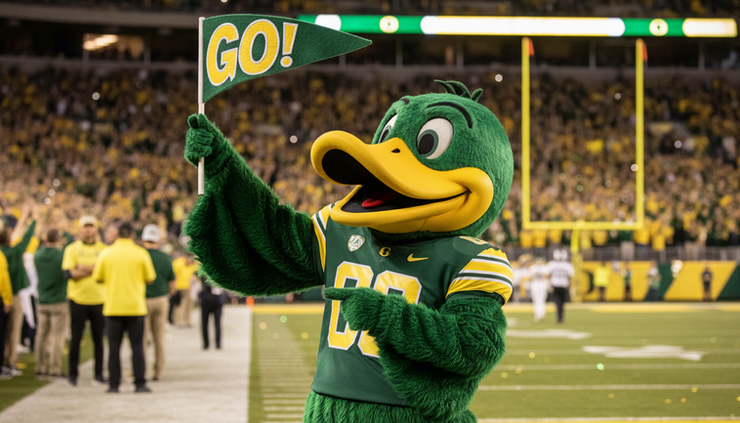
The Oregon Duck is one of the most beloved mascots in college sports. The character’s look has long been linked to Disney’s Donald Duck through a historic permission arrangement, and that connection helped make Oregon’s mascot instantly recognizable.
What makes the Duck work is personality. The mascot is not just a sideline figure. The Duck dances, jokes, interacts with fans, and famously does pushups after Oregon scores. If the Ducks put up a big number, the Duck gets a workout.
That playfulness fits Oregon. The program takes winning seriously, but the culture leaves room for humor and spectacle. The mascot gives kids, students, alumni, and casual viewers a shared point of connection.
Autzen’s game day rituals add to that feeling:
“Mighty Oregon”
The fight song ties current fans to generations of Oregon supporters.
“Shout”
The song, connected to the movie Animal House, has become a favorite stadium moment.
“It never rains in Autzen Stadium”
The famous line from longtime public address announcer Don Essig captures Oregon’s mix of optimism and local wit.
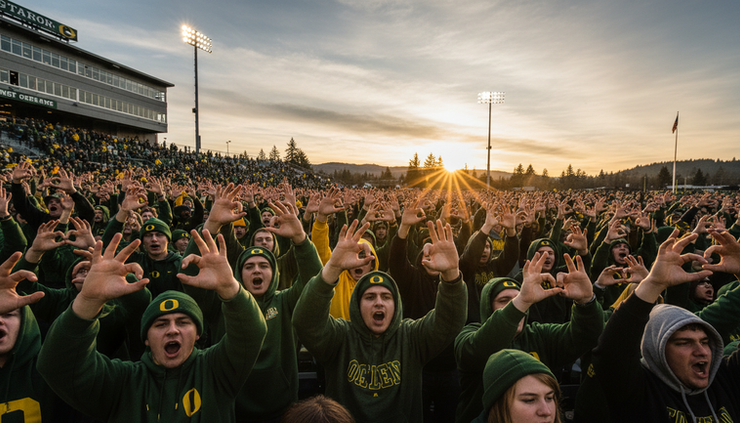
The “O” hand sign
Fans use it as a simple symbol of Oregon pride.
The walk, tailgate, and river setting
Autzen sits north of the University of Oregon’s main campus, near the Willamette River. The trip to the stadium is part of the ritual.
Oregon’s fan culture blends tradition with modern style
Oregon fans cherish history, but they also expect change. That mix makes the Ducks unusual.
The program became closely linked with Nike co-founder Phil Knight, a University of Oregon alumnus, and the school’s uniforms became part of its national identity. Oregon helped turn college football uniforms into a weekly conversation. Green, yellow, black, white, silver, chrome, throwbacks, and new combinations all became part of the show.
At some schools, tradition means wearing the same thing every week. At Oregon, tradition often means asking, “What are they wearing this week?”
That modern style pairs with older forms of loyalty. Fans still care about rivalry games, fight songs, bowl history, and the shared memory of breakthrough seasons. The result is a culture that feels both rooted and restless.
Oregon’s move to the Big Ten in 2024 added another layer. Longtime West Coast matchups still matter, especially Oregon State and Washington, but the Ducks now face a broader national schedule. For fans, that means new road trips, new rivalries, and a bigger stage for traditions that started in Eugene.

Further reading for Oregon Ducks fans
For official schedules, rosters, tickets, and team news, start with GoDucks.com, the official home of Oregon athletics.
For football-specific updates, the Oregon football page on GoDucks is the best official resource.
For historical records and season-by-season results, Sports Reference College Football has a useful Oregon archive.
For fan conversation and analysis, Addicted to Quack has long been one of the better-known independent Oregon fan sites.
For campus history, photos, and archival material, explore University of Oregon Libraries and Oregon Digital.
For player honors and broader college football history, the National Football Foundation Hall of Fame search is a good place to look up major figures from the sport’s past.
FAQ about Oregon Ducks history and traditions
Why are Oregon teams called the Ducks?
Oregon teams were once widely known as the Webfoots. Over time, “Ducks” became the more popular nickname, helped by student use, media coverage, and the mascot’s growing role in school identity.
Is the Oregon Duck based on Donald Duck?
Yes, the Oregon Duck’s look has a historic connection to Disney’s Donald Duck through a permission arrangement. That relationship helped create one of the most recognizable mascots in college sports.
What is the most famous play in Oregon football history?
Kenny Wheaton’s interception return against Washington in 1994, known as “The Pick,” is the program’s most famous play. It helped send Oregon to the Rose Bowl and symbolized the start of a new era.
What makes Autzen Stadium special?
Autzen is known for being extremely loud despite not being one of the largest stadiums in the country. Its design, passionate fans, and game day rituals make it one of college football’s toughest road environments.
Who is the greatest Oregon Ducks football player?
There is no single answer, but Marcus Mariota has the strongest modern case. He won the 2014 Heisman Trophy, led Oregon to the College Football Playoff title game, and remains one of the program’s most admired figures.
The Ducks keep adding new chapters
Oregon’s story is not just about one coach, one uniform era, or one famous play. It stretches from Webfoots history to Rose Bowl memories, from “The Pick” to Mariota’s Heisman, from Autzen rituals to a new Big Ten future.
That is what makes the Ducks compelling. They honor the past without freezing themselves in it. Every season brings a chance to add another uniform combination, another stadium moment, another star, and maybe another game that fans will talk about for the next 30 years.
For new fans, the best place to start is simple: learn “The Pick,” watch a few Autzen game day clips, know the Duck, and remember that Oregon football has always been more than flash. The shine gets attention, but the history gives it meaning.


Comments