Regional Theater vs. Broadway: What Theatergoers Pay


Regional theater is significantly cheaper than Broadway across every ticket tier. A typical lowest-tier seat at a professional regional theater averages around $34.75, according to the 2024 State of the Field report from TYA/American Theatre, while Broadway’s average paid admission runs close to $128. Premium regional seats can push past $90, but Broadway’s premium and resale tickets routinely clear $300. The total trip cost gap is even wider once you add NYC hotel rates, service fees, and transportation.
Ticket-only verdict: Regional theater is generally 50%–75% cheaper per seat than a comparable Broadway show.
Main reason: Broadway operates on a commercial investor model with mounting costs that can exceed $17 million for a major musical; regional theaters are mostly nonprofits subsidized by donations and grants.
Immediate saving tip: Check lottery and rush programs before buying at face value for either option.
$34.75 vs. ~$128 — that’s the gap between the average regional theater lowest-tier ticket and the average Broadway paid admission, a spread that shapes every budget decision in this comparison.
Key Takeaways
Regional theater tickets average around $34.75 at the lowest tier versus Broadway’s average paid admission near $128, and the full trip cost gap widens further once NYC hotel and meal expenses are factored in.
Point | Details |
Ticket price gap | Regional lowest-tier averages ~$34.75; Broadway average paid admission runs ~$128. |
Main cost driver | Broadway’s commercial investor model requires $17M–$23M+ to mount a major musical, pushing ticket prices up structurally. |
Personnel dominates budgets | Personnel costs make up ~55% of nonprofit theater expenses, explaining why ticket revenue alone rarely covers costs. |
Biggest non-ticket expense | A NYC hotel for a Broadway trip can add $150+ per person per night, often exceeding the ticket price itself. |
Top ways to save | Lotteries, rush tickets ($27–$50), TKTS (20%–50% off), and weeknight performances cut costs at both levels. |
The Ticket Blog | Use The Ticket Blog’s guides on rush tickets, promo codes, and weeknight deals to close the Broadway price gap. |
Table of Contents
How does the regional theater vs. Broadway cost comparison look side by side?
How do regional theaters fund operations and keep tickets affordable?
How can you pay less for Broadway or regional theater tickets?
What Theatre Horizon’s pricing experiment reveals about production costs
The Ticket Blog’s take on choosing between regional and Broadway
How does the regional theater vs. Broadway cost comparison look side by side?
The numbers below reflect typical U.S. market conditions. Broadway figures apply to New York City; regional figures vary by market size, with major nonprofit theaters in cities like Washington, D.C. (Arena Stage), Minneapolis (Guthrie Theater), and Cleveland (Cleveland Play House) often sitting at the higher end of the regional range.
Category | Regional Theater | Broadway |
Typical ticket (low tier) | $25–$40 | $70–$120 |
Typical ticket (average) | $35–$75 | $120–$150 |
Typical ticket (premium) | $90–$150 | $200–$400+ |
Resale / secondary market | $50–$200 | $300 and up |
What the ticket usually includes | Seat only | Seat only |
Funding model | Nonprofit (donations, grants, earned income) | Commercial (investor-backed) |
Typical additional trip costs | Parking, local transit, concessions | NYC hotel, subway/rideshare, service fees, meals |
Discount options | Subscriptions, student/senior rates, rush | TKTS, lotteries, rush, standing room |
Currency is USD throughout. Geographic variance is real: a regional theater in a smaller market like Norristown, Pennsylvania (Theatre Horizon) prices tickets lower than a flagship nonprofit in a major metro, while a Broadway touring production at a regional venue can approach Broadway-level pricing.
What do ticket prices actually look like at each level?
The TYA/American Theatre 2024 State of the Field report puts the professional regional theater lowest-tier average at $34.75. That figure covers a wide range of nonprofit houses; a mid-size regional theater in a competitive market might price its lowest seats at $30–$40, while a premium regional house can charge $60–$90 for orchestra seating on a weekend.
Broadway’s average paid admission near $128 is a blended figure that includes discounted tickets sold through TKTS and lotteries alongside full-price orchestra seats. The real spread is wider. A weeknight mezzanine seat for a mid-run Broadway play might cost $89–$110 at face value, while a Saturday orchestra seat for a hit musical can exceed $200 before fees. Resale prices for a blockbuster like a major new musical can push well past $400 per ticket.
Broadway’s average paid admission of ~$128 is nearly four times the regional theater lowest-tier average of $34.75 — a gap driven by production scale, not just geography.
Seat location and show popularity drive most of the spread within each category. A front-row orchestra seat at a regional theater on opening night can cost as much as a mid-house Broadway mezzanine seat. Understanding how theater ticket pricing works — including dynamic pricing and seat-tier logic — helps you find the best value within either market.
Why does Broadway cost so much more to produce?
The price gap between Broadway and regional theater isn’t arbitrary. It reflects a structural difference in how productions are financed and operated. As a 2025 analysis in the Emory Economics Review explains, Broadway runs on a commercial investor model where a majority of productions historically fail to recoup their initial investment — meaning ticket prices must cover enormous upfront and ongoing costs.
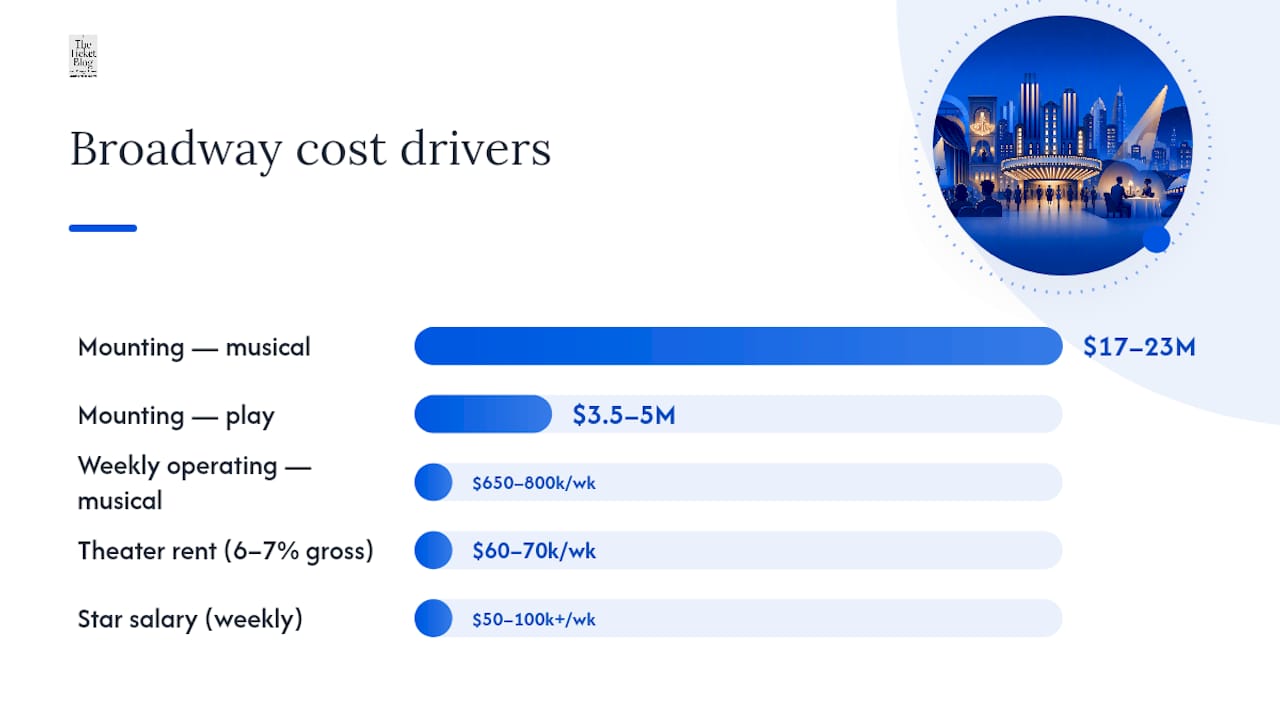
According to Loeb & Loeb’s Broadway investment primer, the key cost drivers look like this:
Mounting costs: New major musicals typically cost $17M–$23M to open; plays run $3.5M–$5M. These are sunk costs before a single ticket is sold.
Weekly operating costs: Large musicals commonly run $650,000–$800,000 per week, excluding theater rent.
Theater rent: Typically charged at 6%–7% of gross weekly box office receipts, which on a $1M+ gross week adds $60,000–$70,000 in rent alone.
Union contracts: Broadway productions operate under agreements with multiple unions (Actors’ Equity, IATSE, Local One stagehands, AFM musicians), each with minimum pay scales, benefit contributions, and staffing minimums.
Star salaries: A marquee name can command $50,000–$100,000+ per week, a cost regional theaters almost never carry.
Marketing: Broadway shows spend heavily on advertising in a competitive NYC market; regional theaters often rely more on subscriptions and word of mouth.
Pro Tip: If a regional theater is mounting a large-cast musical with a touring star, check whether it’s a co-production with other regional houses or a licensed production — those shows can carry higher ticket prices that approach the lower end of Broadway pricing.
For a deeper look at what pushes Broadway prices up, The Ticket Blog’s guide on why Broadway tickets are so expensive breaks down each cost layer in detail.
How do regional theaters fund operations and keep tickets affordable?
Regional theaters rely on a mixed funding model that Broadway simply doesn’t use. Earned income (ticket sales, concessions, facility rentals) covers part of the budget, but contributed income — individual donations, foundation grants, government arts funding, and corporate sponsorships — fills the gap. TCG’s Theatre Facts 2023 report shows that this contributed income is what allows many nonprofit theaters to hold ticket prices below their true cost of production.
Personnel costs made up roughly 55% of total expenses for U.S. not-for-profit theaters in 2023, with other non-personnel costs comprising nearly 36%, according to Statista’s compilation of sector expense data. That leaves very little margin for ticket revenue to cover everything on its own.
The TCG data also reveals a fragility problem: many reporting theaters showed negative changes in unrestricted net assets through 2023, meaning they spent more than they brought in. Rising personnel costs, energy bills, and post-pandemic recovery pressures have squeezed budgets at theaters of all sizes. Arena Stage in Washington, D.C., the Guthrie Theater in Minneapolis, and Cleveland Play House — all large regional institutions — face the same fixed-cost pressures as smaller houses, just at greater scale. A sector analysis published in Taylor & Francis documents how reduced public funding and rising operating costs have pushed some regional venues to experiment with new pricing and partnership models.
The practical result for theatergoers: regional ticket prices are intentionally subsidized by donors and grantors, which is why they stay accessible. But that subsidy is not guaranteed, and some theaters have begun raising prices or introducing dynamic pricing to close budget gaps.
What does a night at the theater actually cost you, all in?
The headline ticket price is only part of what you spend. Here’s how the full out-of-pocket cost stacks up:
Service and delivery fees: Online ticket purchases typically add 10%–25% in fees on top of face value, at both regional and Broadway levels.
Parking: Regional theaters in suburban or mid-size markets often have free or low-cost parking ($5–$15). NYC parking near a Broadway theater can run $30–$60 for an evening.
Public transit / rideshare: A subway ride in NYC costs $2.90 each way; a rideshare from midtown to a Brooklyn hotel can add $20–$40 round trip.
Meals: A pre-show dinner near a Broadway theater in Midtown Manhattan averages $50–$100 per person. Near a regional theater in a smaller city, the same meal runs $25–$50.
Hotel: This is where the Broadway trip cost explodes. A mid-range Manhattan hotel averages $250–$400 per night; a hotel near a regional theater in most U.S. cities runs $100–$180.
Concessions: Programs, drinks, and snacks add $10–$30 per person at most venues.
Run length and frequency also matter for your budget. Broadway shows run for months or years with eight performances per week, so a return visit is always possible. Regional productions typically run four to eight weeks with fewer weekly performances — if you miss the run, you miss the show. That limited window can push some theatergoers to pay premium prices rather than wait for a discount. Checking weeknight theater ticket deals is one of the fastest ways to cut costs at either level.
How can you pay less for Broadway or regional theater tickets?
Many of the best discount strategies work for both Broadway and regional theater, though availability varies by market. Here’s what actually moves the needle:
Lotteries: Broadway shows including Hamilton, The Lion King, and others run digital lotteries through apps like TodayTix and official show websites. Winning tickets typically cost $30–$50 per seat. Some regional theaters run their own lotteries for opening-night or closing-weekend performances.
Rush tickets: Day-of rush tickets are available at the box office for many Broadway and regional shows, often at $30–$50. The Ticket Blog’s guide on how to get Broadway rush tickets walks through the process step by step.
Standing room: Broadway standing-room tickets, when available, typically sell for $27–$35 and are released the day of the performance after the house sells out. Details on availability and strategy are in The Ticket Blog’s standing room Broadway guide.
TKTS booths: The TKTS booth in Times Square and online at tdf.org offers same-day Broadway and off-Broadway tickets at 20%–50% off face value. No lottery required.
Student and senior discounts: Most regional theaters offer 20%–50% off for students and seniors; Broadway productions vary, but many offer student rush programs through TDF or directly through the show’s website.
Season subscriptions: Subscribing to a regional theater’s season package typically saves 15%–30% per ticket compared to single-ticket prices, and often includes priority seating and exchange privileges.
Pro Tip: Weeknight performances (Tuesday through Thursday) are consistently cheaper than weekend shows at both Broadway and regional theaters — sometimes by $20–$40 per ticket at face value, before any discount is applied. Buying directly from the box office also avoids third-party service fees.
What Theatre Horizon’s pricing experiment reveals about production costs
Theatre Horizon, a nonprofit theater in Norristown, Pennsylvania, made its production budgets public as part of a transparent pricing pilot — and the numbers are instructive. As reported by The Philadelphia Inquirer, one production carried a total production cost exceeding two hundred thousand dollars. With Theatre Horizon’s annual operating budget running around $1.4 million, a single production represents a significant portion of the organization’s entire yearly expenses. This illustrates that even a modestly scaled regional production costs far more than ticket revenue alone can cover at typical regional pricing.
If that production sold out every performance at an average ticket price of $40, it would need more than 5,500 tickets sold just to break even on production costs alone, before any overhead. That math explains why donations and grants aren’t optional for regional theaters — they’re structural. The experiment also shows why some regional theaters are moving toward dynamic pricing: charging more for high-demand performances and less for slower ones, rather than holding a flat price that leaves money on the table during peak demand.
Pro Tip: When a regional theater publishes its production budget or runs a “pay what you can” performance, that’s a signal the organization values access over margin. Those performances are worth seeking out if budget is your primary concern.
How geography shapes what you actually spend
Where a theater sits on the map changes the cost equation significantly. A Broadway theatergoer traveling from outside New York City faces hotel, transit, and meal costs that can easily double or triple the ticket price. A theatergoer attending a regional production in their own city pays only for the ticket, parking, and dinner.
Within the regional theater world, geography also drives price variation. A large regional theater in a high cost-of-living city — think Arena Stage in Washington, D.C., or the Guthrie Theater in Minneapolis — operates with higher personnel costs and facility expenses than a smaller theater in a mid-size market. Those costs flow through to ticket prices. A top-tier seat at Arena Stage or the Guthrie can reach $100–$150, overlapping with the lower end of Broadway pricing.
Smaller regional markets offer the most affordable theater options in the country. Community and semi-professional theaters in mid-size cities regularly price tickets at $15–$35, with student and senior rates below $20. The trade-off is production scale: smaller budgets mean smaller casts, simpler sets, and fewer orchestra musicians.
For theatergoers willing to travel, some regional productions in mid-size cities offer a compelling value: a $60 ticket, a $120 hotel room, and a $40 dinner adds up to roughly $220 per person — still well below the cost of a comparable Broadway trip. The key is choosing a theater with a strong artistic reputation, which organizations like Theatre Communications Group track through their annual reporting.
The Ticket Blog’s take on choosing between regional and Broadway
The conventional wisdom is that Broadway is always the premium experience and regional theater is the budget fallback. That framing undersells regional theater and overstates what Broadway’s price premium actually buys.
A well-funded regional theater — Arena Stage, the Guthrie, Cleveland Play House — can deliver productions that match Broadway in artistic ambition, design quality, and performance caliber. The difference is often star power and scale, not craft. For most theatergoers, the decision should come down to three practical questions:
What’s your per-person budget? Under $150 all-in, regional theater is the clear choice. Over $300, a Broadway trip becomes viable if you’re combining it with other NYC activities.
Is this a special occasion? Broadway’s scale and energy are genuinely different — the size of the houses, the production values on a major musical, the cultural moment of seeing a show everyone is talking about. For a milestone celebration, that experience has real value.
How far do you need to travel? If you live within an hour of a strong regional theater, the local option almost always wins on value. If you’re already planning a New York trip, adding a Broadway show to the itinerary is far more cost-efficient than making a dedicated theater trip.
The Ticket Blog’s guides on rush tickets and weeknight deals can close the price gap on Broadway significantly. A lottery win or a TKTS purchase can bring a Broadway ticket down to regional pricing — which changes the calculus entirely.
Save more on your next theater trip with The Ticket Blog
Knowing the price gap is one thing. Closing it is where The Ticket Blog comes in. Whether you’re planning a Broadway weekend or looking for the best seats at your local regional theater, The Ticket Blog’s guides give you the specific tactics — lotteries, rush windows, promo codes, and timing strategies — that translate directly into dollars saved.

The site covers everything from theater promo codes and standing room strategies to weeknight deal windows and subscription packages. Affiliate links appear on some pages, which helps keep the guides free. Start with the Broadway cost breakdown or the rush ticket guide, then check The Ticket Blog’s theater news section for current discount windows and limited-run regional productions worth your attention. Visit The Ticket Blog to find the guide that fits your next night out.
Sources
Recommended
Comments