San Jose Sharks 2026-27 Season Preview, History, Key Players, Coaching, and Outlook

The San Jose Sharks enter 2026-27 with the kind of season that can change how a rebuild feels. The question is no longer only whether the future is bright. It is whether the future starts showing up on the scoreboard every week.
This preview looks at where the franchise has been, which traditions still define hockey in San Jose, which players should shape the season, how the coaching staff can get more from a young roster, and what a fair performance target looks like. For live numbers during the season, the best reference points are the NHL’s official Sharks statistics page, Hockey Reference’s San Jose Sharks history page, and the team’s own official roster.

The Sharks’ history still shapes the 2026-27 season
The Sharks joined the NHL in 1991 and quickly built an identity that did not feel like an expansion novelty. Teal became one of hockey’s signature colors. The shark logo became instantly recognizable. The entrance through the giant shark head gave home games a theatrical edge without losing the sport’s grit.
The franchise’s best years were built on star power, steady defense, and a home crowd that made SAP Center, widely known as the Shark Tank, feel like a hard place to play. Names like Patrick Marleau, Joe Thornton, Evgeni Nabokov, Owen Nolan, Joe Pavelski, Brent Burns, Marc-Édouard Vlasic, Logan Couture, and Erik Karlsson all left marks on different eras.
The most important milestone remains the 2016 run to the Stanley Cup Final, when San Jose beat Los Angeles, Nashville, and St. Louis before falling to Pittsburgh. The NHL’s archive of 2016 Stanley Cup Playoffs results is a useful starting point for newer fans who want to understand that era.
Another essential piece of franchise memory is the 2019 first-round series against Vegas, especially Game 7. San Jose’s third-period comeback became one of the wildest playoff swings of the modern NHL. It still feeds the rivalry and remains a shorthand moment for what Sharks fans mean when they talk about belief inside the building.
The 2026-27 season does not need to copy those teams. It needs to connect back to them. The best Sharks seasons have shared a few traits:
A strong center-ice spine
Defensemen who can move the puck under pressure
A power play that makes opponents nervous
A crowd that senses momentum before the scoreboard does
That is the historical standard for this new group.
The key players who can define the season
The Sharks’ next step depends on whether their young core can move from promise to production. The front office has spent recent seasons turning the page, stocking the roster and system with high-end skill, and creating room for younger players to take over larger roles.
Because NHL rosters can change quickly through trades, injuries, and training camp decisions, the key names below are best understood as the main types of players San Jose needs to drive the 2026-27 season.
Macklin Celebrini can become the face of the rebuild
Macklin Celebrini arrived with the pressure that follows a top-tier prospect. His value is not only in highlight plays. It is in the way a high-end center can change every matchup.
A true No. 1 center gives a team structure. He can carry the puck through the neutral zone, support the defense low in the zone, create offense off the rush, and make wingers better by drawing coverage. If Celebrini takes a clear step in 2026-27, San Jose’s entire offense becomes harder to defend.
Fans tracking his development should keep an eye on his official player information through the NHL player database and game-by-game production through the Sharks’ official stats page.
The big questions for Celebrini are simple:
Can he handle matchups against top defensive pairs?
Can he drive play at five-on-five, not just on the power play?
Can he stay efficient over a full 82-game grind?
If the answer is yes, the Sharks’ ceiling rises fast.
Will Smith brings creativity that San Jose has needed
Will Smith gives the Sharks a different kind of offensive threat. His game has been known for skill, deception, and playmaking touch. Players like that matter on rebuilding teams because they can create chances before the system looks perfect.
Smith’s 2026-27 role should show how much trust the coaching staff has in him. A sheltered scoring role can help a young player build confidence. A larger role against tougher competition can speed up development, but it also brings more mistakes.
The ideal path is balance. Smith should get chances with skilled linemates, power-play time, and enough five-on-five responsibility to grow into a complete NHL forward. His longer-term profile can be followed through resources like Elite Prospects and the NHL player database.

William Eklund can be the connector on the wing
William Eklund’s value comes from linking plays. He can support in transition, help entries, and make smart touches in tight spaces. On a young team, that kind of winger matters because not every chance comes from a clean rush or a perfect setup.
Eklund’s season will be judged less by flashes and more by repeatable impact. Can he win enough puck battles? Can he make the right play at speed? Can he help a line spend more time attacking than defending?
If Eklund becomes a steady top-six option, the Sharks can spread skill across more than one line. That would make them much less predictable.
The blue line needs a clear leader
Every rebuild reaches a point where the defense must stop being only a development project. San Jose’s forwards can take major steps, but the team will remain limited if the defense cannot move pucks cleanly and protect the middle of the ice.
The Sharks need a defense group that can do three things well:
Break pucks out without constant glass-and-out clears
Defend rush chances before they become slot chances
Support the offense without giving up odd-man rushes
That does not require one defenseman to become a Norris Trophy candidate. It does require a group identity. A reliable top pair, a puck-moving second pair, and a third pair that can start shifts in tough spots would give the Sharks a much firmer base.
Goaltending can decide whether the rebuild feels ahead or behind
Young teams often make life difficult for goaltenders. Missed assignments, failed clears, and long defensive-zone shifts can turn average chances into chaos. That makes goaltending one of the hardest areas to project.
For San Jose, the goal should be stability. The Sharks do not need a miracle every night. They need enough saves at key times to give the young core room to grow. A rebuilding team can live with mistakes when the goalie stops the kind of second chance that crushes momentum.
For season-long tracking, save percentage, goals saved above expected, and workload splits will tell a more complete story than wins alone. Public stat sites such as Natural Stat Trick and MoneyPuck are useful for deeper context.
Coaching strategy should focus on pace, habits, and matchups
Ryan Warsofsky’s coaching challenge is clear. He needs to help talented young players play fast without turning the game into a track meet they cannot control.
The 2026-27 Sharks should aim for structured aggression. That means pressure with support, not pressure for its own sake. Wingers can attack opposing defensemen on the forecheck, but the third forward has to stay high enough to prevent easy counterattacks. Defensemen can pinch, but only when a forward covers behind them.
The forecheck has to create offense without feeding rush chances
San Jose should be at its best when it forces hurried exits. Young forwards with speed can win races and turn loose pucks into quick chances. The risk is spacing. If all three forwards get caught below the circles, one missed puck can become a two-on-one the other way.
A good Sharks forecheck in 2026-27 should look like this:
First forward pressures the puck carrier
Second forward closes the nearest outlet
Third forward reads the play and protects the middle
Defensemen hold the blue line only when support is clear
That kind of detail is not glamorous, but it keeps a young team from chasing games.
The power play needs a true plan around its best hands
The Sharks’ power play should become one of the clearest signs of progress. With skilled young forwards, the team should not settle for slow perimeter passing.
The top unit needs movement, rotation, and quick decisions. Celebrini can be used as a central bumper or half-wall driver depending on matchups. Smith can attack seams with his passing. Eklund can help connect plays below the dots or on the flank. The point shot still matters, but only if it creates rebounds or opens lanes.
A dangerous power play does more than score. It changes how opponents defend at five-on-five. If a team fears taking penalties, San Jose’s skilled players get a little more room.
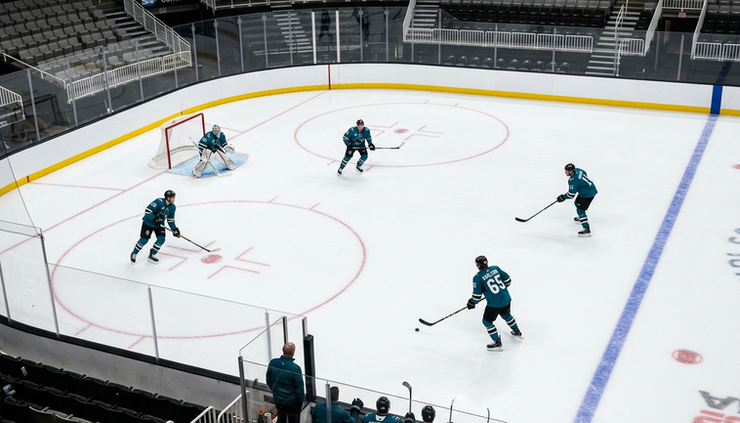
Defensive-zone exits will be the quiet key
Many fans notice goals. Coaches often notice exits. A team that cannot leave its own zone spends too much time tired, late, and reaching.
The Sharks need cleaner first passes, stronger wall support, and centers who come low enough to help. This is where young players learn NHL details. A simple five-foot pass under pressure can matter as much as a flashy rush.
If San Jose improves its exits, it will look faster overnight. The team will not actually become faster. It will just stop wasting energy defending failed clears.
Expected performance for the 2026-27 Sharks
The honest outlook is that San Jose should be judged by progress more than by a single standings spot. The Pacific Division has often been unforgiving, with heavy teams, elite skill, and long road trips that can punish inconsistency.
A successful 2026-27 season does not have to mean a deep playoff run. It should mean the Sharks are clearly harder to play against by spring than they were in October.
Fair expectations include:
Area | What progress should look like |
Young core | Celebrini, Smith, and Eklund drive real offense, not only flashes |
Team defense | Fewer odd-man rushes and cleaner coverage in the slot |
Special teams | A power play with identity and a penalty kill that limits seam passes |
Home ice | SAP Center becomes a place where opponents expect a hard game |
Standings | The Sharks stay relevant deeper into the season and close the gap in the Pacific |
A best-case season would put San Jose near the playoff conversation, especially if the young stars mature quickly and goaltending holds steady. A more realistic target is meaningful improvement in goal differential, five-on-five play, and close-game confidence.
The danger signs are also clear. If the Sharks rely too much on rush offense, struggle to exit the defensive zone, or ask inexperienced players to fix every problem, the season could feel uneven. Growth rarely moves in a straight line.
Still, the ingredients are more exciting than they have been in years. A franchise center candidate changes the mood. A skilled supporting cast gives the lineup imagination. A coaching staff focused on habits can turn raw talent into repeatable hockey.
This is the heart of the San Jose Sharks 2026-27 season preview: the team does not need to pretend the rebuild is finished. It needs to prove the foundation is real.

Why this season matters to new fans and longtime supporters
For new fans, the 2026-27 Sharks offer a clean entry point. The team is not defined only by past heartbreak or old playoff memories. It is being rebuilt around young talent, fresh roles, and the hope that a new core can grow together.
For longtime supporters, the season carries a different pull. The best years of Sharks hockey were not only about stars. They were about identity. San Jose teams at their peak played with pace, skill, bite, and confidence at home. The next group has to earn that same trust.
Three themes should guide the season:
Patience
Young players will make mistakes. The key is whether they repeat them.
Standards
Rebuilding cannot excuse poor habits forever. Details must improve.
Belief
A young team becomes dangerous when talent and structure meet.
The Sharks’ history gives the franchise a clear target. The 2026-27 roster gives fans a reason to watch the climb. If the young core takes charge, the power play becomes a weapon, and the defensive structure improves, San Jose can turn this season into a major step toward contention.
The most meaningful sign may not be a single win streak or one breakout month. It will be the feeling that opponents can no longer treat the Sharks as a rebuilding stop on the schedule. That is when a future-looking season starts to feel like the beginning of something real.


Comments