Secondary Market Timing: When to Buy Resale Tickets


The best time to buy resale tickets is usually two to four weeks before the event for average-demand shows and games, and early for the events everyone wants. Prices on the secondary market, where fans and brokers resell tickets that were first sold elsewhere, follow demand, not the calendar. Your job is to work out which kind of event you are shopping for, then compare the total price, fees included, on a few days of your own checks. This guide shows how to read that demand, what the data says about waiting, and how to avoid the mistakes that make last-minute shopping expensive.
This article is about resale tickets for concerts, sports and theater. If you landed here looking for stock-market trading hours, that is a different kind of secondary market.
TL;DR
Resale prices tend to ease as an event approaches, but the drop is far smaller for high-demand events and can reverse in the final week.
For average-demand events, the window from about three weeks out to the final 10 days is where prices often soften as supply rises.
For hot tickets, such as a major tour, a rivalry game or a hit show, buy early. Waiting is a bet that can lose.
Judge every listing by the all-in price at checkout. Since May 2025, U.S. rules require the total price to be shown for live-event tickets.
Track a few listings for a week or two before you buy, and use a seller with a buyer guarantee.
Table of Contents
Why resale prices move the way they do
A resale price is set by the seller, not by the venue. Sellers watch what similar seats are listed for, and they adjust. Two forces matter most: how many tickets are available, and how badly buyers want them.
Supply starts small. Tickets reach the secondary market only after someone buys them on the primary market, the first sale by the venue, team or ticket agency. A 2018 U.S. Government Accountability Office report said industry representatives estimated that presales typically offered 10% to 30% of tickets for major concerts, and sometimes about 65% for major artists in large venues. Those are estimates, not a market-wide count, but they show why early resale supply for a big tour can be thin and expensive.
Supply then grows. The same report said promoters commonly release unused ticket holds before an event, often offering them to the public at face value. Face value is the price printed on the ticket. When extra tickets appear at face value, resale sellers have to compete with them, which can pull listings down.
The GAO also found that resale tickets can be significantly more expensive than primary tickets, especially when the primary tickets were initially priced below what buyers were willing to pay. That is the situation in which waiting for a bargain is least likely to work: demand already exceeds supply, and sellers know it.
What the timing data shows
No single study covers every event, so read the evidence as a set of patterns.
Prices usually soften, with exceptions. A data-driven look at resale concert prices reports that, more often than not, prices come down as an event approaches. It also notes that for the most in-demand events, the day-of median price can be nearly as high as the peak, so the idea of a reliable day-of fire sale is mostly a myth. Weaker events, in the bottom quartile of demand, saw drops of as much as 30%.
There may be a dip around three weeks out. The same report says the price index for tickets fell to roughly 0.82 of its peak about 20 days before showtime, then climbed again. It also found Wednesdays were around 6% cheaper than Fridays and Mondays. These are averages across many events, so treat them as a reason to start checking, not a promise.
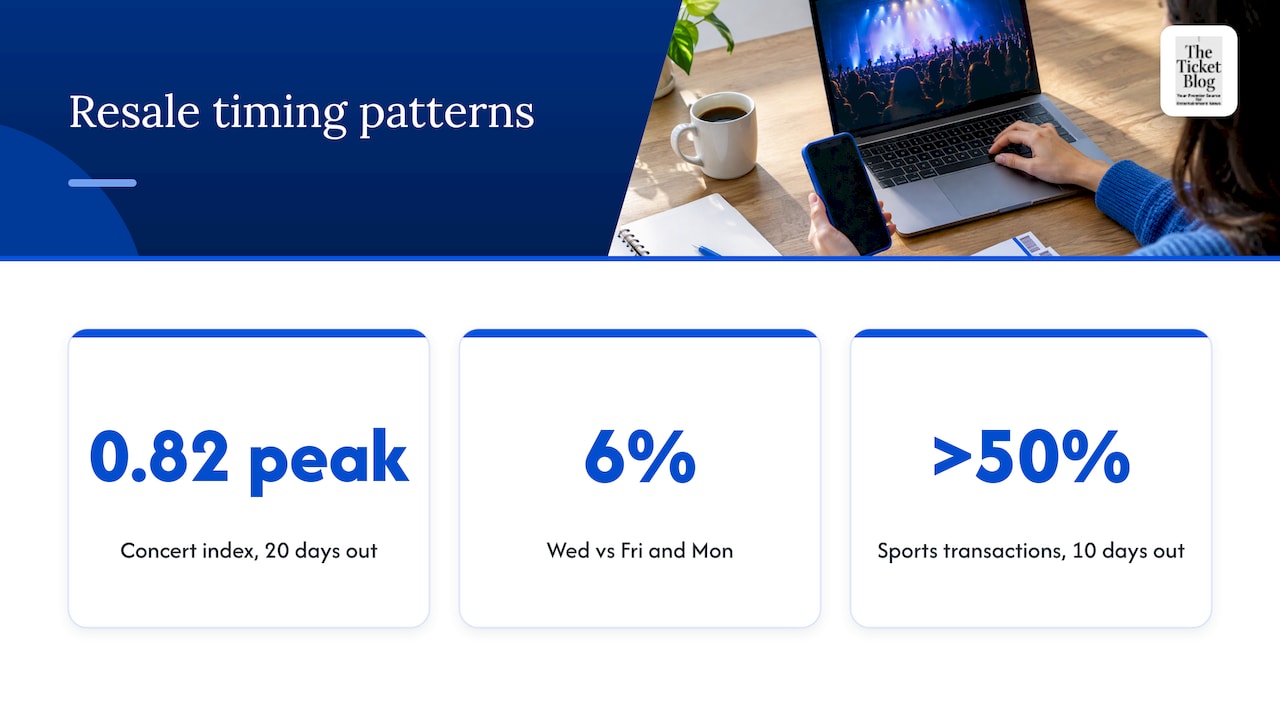
Sports sellers unload about 10 days out. A Forbes analysis of sports ticket transactions found more than half of transactions happened about 10 days before games, when supply rose and prices began sliding. The author cautioned that hot tickets may behave differently. The data is from 2018, so use it as a pattern, not a rule.
Waiting can backfire. The Better Business Bureau says buying within a week of the event, rather than more than a month ahead, will likely get you a lower price. It adds that the tactic can backfire if the event proves popular enough.
Match your timing to the event type
The right moment depends on the kind of event. Use this table as a starting point, then confirm with live listings.
Event type | Demand pattern | Suggested approach |
Major arena tour, superstar artist | Thin supply, high demand through show day | Buy early, once you find a total price you accept |
Mid-level concert or club show | Supply grows as the date nears | Start tracking a month out, buy in the 2 to 3 week window or the final 10 days |
Regular-season sports game | Sellers unload as game day nears | Watch for softening in the last 10 days |
Rivalry, playoff or opening day | Demand can rise in the final week | Buy early, do not gamble on a late drop |
Theater, long-running show | Steady supply, midweek seats often easier | Compare dates, check midweek performances, watch the week before |
Theater, hit or limited run | Thin supply near the date | Buy early |
Concerts
For concerts, the first question is whether the tour is a must-see. If tickets sold out in minutes on the primary market, resale prices tend to stay high through the show date. If the venue still has primary tickets on sale, resale prices have a ceiling, because buyers can simply buy from the venue. For a deeper look at how the pattern plays out, see our guide on whether concert tickets decrease in price as the date approaches, and our best time to buy concert tickets guide.
Sports
Sports seasons have many games, so supply is large and sellers have more reason to cut prices as game day nears. The 10-day mark in the Forbes analysis is a useful point to begin checking. Opening day, rivalry games and playoff games break the pattern, because demand builds with the stakes. A team’s record and weather forecast can move prices too, so check again a day or two before you commit.
Theater
Theater tickets are tied to specific performances, and each performance is its own small market. Weeknight shows are often easier to price than Friday and Saturday evenings, in line with the weekday pattern in the data above. A show that just won awards or has a celebrity in the cast is a hot ticket. Treat it like a major tour and buy early.
When waiting costs you
Waiting is a trade. You might save money, but you also give up choice, and you accept a few risks.
Seat selection shrinks. The best seats and adjoining seats for a group go first. If you need four seats together, waiting often costs more than the price drop saves.
Prices can jump in the final week. The Yahoo report points to a World Cup example in which prices fell about 25% in the month before the tournament, then demand surged in the final week.
Delivery gets tight. Some tickets are transferred digitally and others need time to arrive. A last-minute purchase leaves less room to fix a problem.
Fees hide the savings. A listing that looks cheaper may not be once fees are added, which brings us to the next section.
A useful rule: wait only if you would be fine skipping the event or paying a bit more. If missing it would ruin the plan, buy when you find a price you can accept.
Compare the all-in price, not the listing price
Timing means little if you misread the price. The FTC’s rule on unfair or deceptive fees, 16 CFR Part 464, took effect May 12, 2025. It makes it an unfair and deceptive practice to display a live-event ticket price without clearly disclosing the total price. Optional fees you choose, plus government charges and shipping, can be listed separately.
The agency described the problem as drip pricing, where mandatory fees can raise the price by as much as 30% and the first price you see is not what you pay. A Congressional Research Service report, updated March 20, 2026, says all-in pricing helps consumers compare primary and secondary ticketers before investing time in checkout.
In practice, that means you can compare options earlier than you could before. Our guide on how U.S. buyers can use the FTC all-in price rule on resale tickets walks through it. The BBB also advises going to checkout to see fees, because some resellers disclose them only near payment.
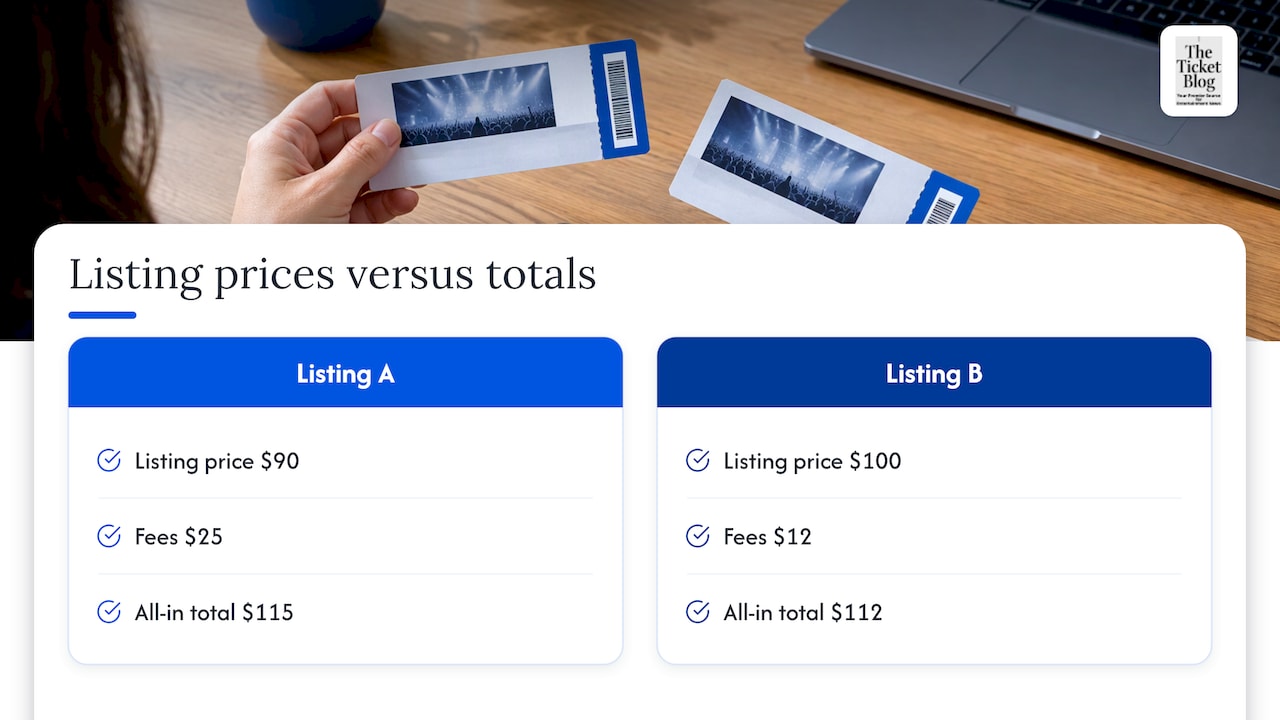
Here is a worked example of why the total matters. Say you see Listing A at $90 and Listing B at $100 for the same section. If A adds $25 in fees and B adds $12, A costs $115 and B costs $112. The cheaper-looking ticket is the more expensive one. When you watch prices over time, track the all-in number for the same seats on each visit, or you will be comparing apples to oranges.
How to track prices and spot a real deal
A simple routine beats guessing. This one takes a few minutes per check.
Set a budget and a seat standard. Decide your maximum all-in price per ticket and the sections or rows you would accept. A deal outside that standard is not a deal.
Note the face value. Find the original price on the primary seller’s page. Resale at or below face value is a clear win. Resale far above it needs a reason, such as strong demand.
Start tracking early. Look at listings three to four weeks out and write down the all-in price for two or three seat options. Check again every few days.
Read the direction. If prices are falling and the number of listings is growing, supply is outrunning demand. If prices rise, the Yahoo report notes that such increases usually happen over a few weeks, not overnight, so you will see the trend coming.
Compare on more than one marketplace. Different platforms show different sellers. Our concert ticket marketplaces comparison helps you pick where to look.
Go to checkout before you decide. Confirm the final total, the delivery method and the refund terms.
Buy when the price meets your standard. Do not chase the last extra few dollars. A ticket that fits your budget in your preferred section is the deal.
If you are down to the final days, our guide to finding cheap concert tickets last minute covers the tactics that work when time is short. For a broader walk through the hunt, see how to master resale ticket hunting.
Protect yourself whatever the timing
A low price on a ticket that does not work saves nothing. The BBB advises buying from resellers with a consumer protection policy or National Association of Ticket Brokers registration, and notes that most major resellers typically provide a full refund if a ticket is forged. It also says that when Live Nation or Ticketmaster resells primary tickets, it invalidates the original ticket and creates a new barcode, which adds protection.
Before you pay, check:
The refund or guarantee policy, in writing
How the ticket will be delivered and when
The seat location, matched against the venue map
The payment method, ideally a credit card, which gives you dispute options
If you want to see how an officially guaranteed resale works, our guides cover verifying AXS Resale tickets, AXS Resale fees and payout timing and fan-to-fan resale platforms.
We write about ticket buying every day, and our advice comes down to one idea: timing is a tool, not a trick. Most readers who go wrong are not unlucky. They apply a single rule, such as always wait until the last minute, to every event. We think a better habit is to sort the event first. Is this a show with thin supply and strong demand, or one with plenty of seats? Then follow the price for a couple of weeks, compare the all-in total, and buy when it meets your standard. That approach turns resale from a gamble into a plan. This is why our guides pair price analysis with seating recommendations, promo codes and marketplace comparisons. Savings come from several small choices, and we aim to put them in one place so you can act with confidence, whether you are a first-time buyer or a seasoned ticket hunter. The Ticket Blog
Our view on resale timing
Put the plan to work
If you are ready to start, our ticket-buying hub collects guides, deal listings and promo postings for concerts, sports and theater in one place. Use it to find the event you want, then apply the tracking routine above.
You can browse our guide to buying tickets for events for the current deals and codes we feature.
If you shop more than one event a season, bookmark our summer concert ticket buying checklist so the routine becomes automatic.
FAQ
What is the best time to buy resale tickets?
For most average-demand events, the range from about three weeks out to roughly 10 days before is when prices often ease as supply grows. For high-demand events, buy early, because prices can stay near their peak up to the day of the event. Check the all-in price each time you look.
Are resale tickets cheaper on the day of the event?
Sometimes, but not reliably. The data suggests that day-of drops show up mainly for lower-demand events, and the most in-demand events often hold their prices. The BBB notes that buying within a week can get a lower price but may backfire if the event is popular enough.
Does the day of the week matter when buying?
One data set found Wednesdays were about 6% cheaper than Fridays and Mondays. That is an average across many events, so use it as a reason to check midweek, not as a rule that decides your purchase.
How do I avoid hidden fees on resale tickets?
Look at the total price. Under the FTC’s rule effective May 12, 2025, live-event ticket sellers must clearly show the total price, though optional fees, government charges and shipping may be listed separately. Compare the all-in number across listings, and go to checkout to confirm it before you pay.
Should I buy resale tickets for a sold-out show right away?
If the event is in high demand and you have found a price and seats you accept, yes. Thin supply and strong demand are the conditions where waiting is most likely to cost you. Verify the seller’s guarantee, then buy.
Sources
GAO-18-347, Event Ticket Sales: Market Characteristics and Consumer Protection Issues
BBB Tip: What to know about buying tickets from an online reseller
Federal Register: Rule on Unfair or Deceptive Fees, January 10, 2025
Congressional Research Service: Tickets for Live Entertainment Events
The Best Time to Buy Resale Concert Tickets, According to Data
Recommended

Comments