What Is a Ticket Lottery? How It Works and Your Odds


A ticket lottery is a controlled system where fans register for the chance to buy event tickets selected through a random draw, rather than competing in a first-come, first-served sale. This method separates registration from purchase, which prevents website crashes, reduces scalping, and gives every fan an equal shot regardless of how fast they can click. Major markets like Japan have built entire legal frameworks around lotteries, and Broadway has run both digital and in-person draws for years. Understanding ticket lotteries is the first step toward actually winning one.
What is a ticket lottery and how does it work?
A ticket lottery is a two-phase process: a registration window followed by a randomized selection. The two phases are distinct by design, and that separation is what makes the system fair.
Here is how the process works from start to finish:
Registration window opens. The event organizer announces a window, typically lasting several days to a couple of weeks, during which fans submit entries. You provide your name, contact details, and sometimes payment information.
Entry submission. You submit one entry per lottery, though some events allow you to request multiple tickets in a single entry. Fan club lotteries often open before general public lotteries, giving members early access.
Random selection. After the window closes, the system selects winners at random. Timing does not affect your odds. Entering on day one gives you the exact same statistical chance as entering on the last day.
Notification. Winners receive an email or app notification, usually within a few days of the window closing. Non-winners are also notified so they can pursue other options.
Purchase window. Winners get a limited time, typically 48–72 hours, to complete their purchase. Miss that window and the ticket goes back into the pool.
Identity verification. In markets like Japan, your ticket is linked to your government-issued ID. Your name on the entry must match your ID at the venue door. This step blocks resale and scalping at the point of entry.
Pro Tip: Set a calendar reminder the moment you enter a lottery. The purchase window is short, and missing it means losing your spot even after winning.
The registration-then-draw structure is what separates lotteries from traditional sales. Traditional on-sale events reward whoever has the fastest internet connection or the most browser tabs open. Lotteries reward patience and preparation instead.
Why are ticket lotteries used?
Ticket lotteries exist because first-come, first-served sales consistently fail fans and organizers alike. When a major artist goes on sale, thousands of fans hit the same server at the same second. Sites crash, bots buy in bulk, and scalpers list tickets at three times face value within minutes. Lotteries eliminate that chaos by creating a level playing field where no single fan has a technical advantage over another.

The anti-scalping benefit is especially significant. Japan passed legislation in 2019 making reselling above face value illegal, and lotteries with name-based ID verification became the enforcement mechanism. A scalper cannot profit from a ticket that is locked to the original buyer’s identity. That legal and operational combination has made Japan one of the most fan-friendly concert markets in the world.
Beyond anti-scalping, lotteries build trust between organizers and fans. Consider this core principle:
“Lotteries promote audience fairness by mitigating technical failures and allowing equal access regardless of purchase speed or capital. Every fan who enters has the same chance, whether they are a casual listener or a lifelong devotee.”
Other ticket distribution methods each carry trade-offs. Presales reward credit card holders or fan club members but still create a rush. Dynamic pricing adjusts ticket costs based on demand, which prices out fans with limited budgets. Standing-room-only and rush tickets offer last-minute access but require physical presence or real-time monitoring. The lottery system, by contrast, asks only that you register and wait. That accessibility is its defining strength.
What types of ticket lotteries exist around the world?
Ticket lottery systems vary widely by region, event type, and organizer. The table below shows how the main formats differ.
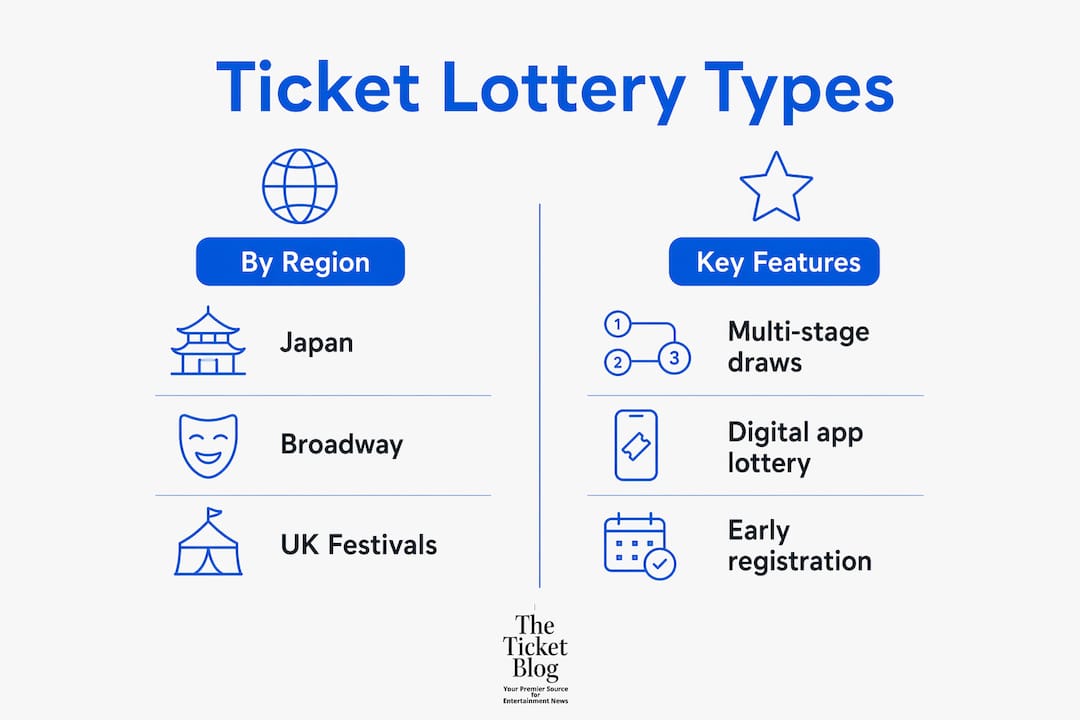
Lottery type | Where it’s common | Key features |
Fan club lottery | Japan (concerts) | Opens before general public; requires paid membership |
General public lottery | Japan, South Korea | Name-based ID verification; multi-stage draws |
Digital Broadway lottery | United States | App or website entry; discounted seats; same-day results |
In-person Broadway lottery | United States | Physical entry at the box office; cash or card payment |
Festival ballot | UK, Europe, US | Registration weeks in advance; full weekend passes |
Japan’s system is the most structured. Major concerts run multi-stage lotteries, starting with fan club members, then moving to credit card presales, and finally opening to the general public. Each stage is a separate draw. If you lose the fan club lottery, you can still enter the general public lottery. This layered approach maximizes access while protecting against scalping at every stage.
Broadway lotteries work differently. Productions like Hamilton and Hadestown have run digital lotteries through dedicated apps, offering two discounted seats per entry at prices well below face value. Broadway lotteries coexist with rush and standing-room-only tickets, giving fans multiple low-cost entry points to the same show. Winners are notified the same day and must purchase within a few hours.
Festival lotteries, common at events like Glastonbury in the UK, open registration months before the event. Demand far exceeds supply, so odds are low. However, the process is transparent and fair, which is why fans accept it year after year.
Pro Tip: For Broadway shows, check whether the production runs a digital lottery through its official app. These draws often offer the best seat-to-price ratio of any discount method, including rush and standing room.
What are your odds in a ticket lottery, and how can you improve them?
Lottery odds depend entirely on how many people enter versus how many tickets are available. There is no published formula that applies universally. What is certain is that entry timing has zero effect on your chances. Selection happens after the window closes, not as entries come in.
That said, you can take steps to put yourself in the best position:
Enter every available stage. For multi-stage lotteries, enter the fan club draw, the presale draw, and the general public draw separately. Each is an independent chance.
Prepare your ID and payment details in advance. Many lotteries require exact name matching between your entry and your government-issued ID. A typo can disqualify your entry or block you at the venue.
Act immediately when you win. The purchase window is short. Winners typically have 48–72 hours to complete payment. Missing that deadline forfeits the ticket.
Combine lotteries with other access methods. Winning a ticket lottery is rare, so treat it as one option among several. Rush tickets, standing-room-only, and Broadway rush strategies can all serve as backups.
Avoid unofficial “lottery entry services.” No third-party service can improve your odds. Any site claiming otherwise is taking your money without delivering results.
Track multiple lotteries simultaneously. For high-demand tours, the same artist may run separate lotteries for each city. Entering several dates increases your overall probability of winning at least one.
Understanding concert ticket discount types helps you see where lotteries fit within the broader access picture. They are not the only path to affordable tickets, but they are often the fairest one available for sold-out events.
Key Takeaways
A ticket lottery is the fairest method for distributing high-demand event tickets, using random selection after registration closes to give every fan an equal chance regardless of speed or resources.
Point | Details |
Core definition | A ticket lottery selects winners randomly from a registration pool, not by purchase speed. |
Entry timing is irrelevant | Submitting early or late in the window does not change your odds of winning. |
Identity verification matters | Many lotteries, especially in Japan, require your entry name to match your government ID. |
Purchase windows are short | Winners typically have 48–72 hours to pay before forfeiting their ticket. |
Use multiple strategies | Combine lotteries with rush tickets and standing-room-only access to maximize your chances. |
The Ticket Blog’s take on where ticket lotteries are headed
Ticket lotteries have done more for fan access than any other single change in event ticketing over the past decade. I have watched the shift from chaotic on-sale free-for-alls, where bots and scalpers cleaned out inventory in seconds, to structured draws where a fan in a small town has the same shot as someone with a fiber connection in a major city. That shift matters.
The challenges are real, though. Identity verification systems are inconsistent across markets. Japan enforces name matching strictly and it works. Many Western lotteries still allow ticket transfers, which creates a backdoor for scalping even after a fair draw. The technology is there to close that gap. Blockchain-based ticketing, which ties each ticket to a verified wallet, could make transfers traceable and resale above face value practically impossible. A few smaller festivals have already piloted this approach.
The legal side is catching up too. Japan’s 2019 anti-scalping law showed that legislation and lottery systems work best together. Other markets are watching. The United States has seen state-level discussions around resale caps, and the UK’s secondary market has faced increasing regulatory pressure. Lotteries will likely become more common as those laws tighten.
The honest truth is that lotteries are not perfect. Odds can be brutal for blockbuster events. But they are fairer than anything that came before. For fans who want the best shot at a ticket without paying inflated resale prices, understanding how lotteries work is a genuine advantage. The Ticket Blog covers these systems precisely because knowing the rules is half the battle.
— The Ticket Blog
The Ticket Blog’s resources for ticket lottery fans
The Ticket Blog tracks ticket lotteries, rush sales, and ticketing strategies across concerts, Broadway, and sports events so you always know your options before an on-sale date hits.

Whether you are trying to win a Broadway draw or navigate a multi-stage concert lottery, The Ticket Blog’s guides give you the practical detail you need. Check out the full breakdown of online ticketing platforms to understand where lotteries fit within the broader ticketing ecosystem. For theater fans, the guide on theater ticket pricing explains how lotteries interact with face value, dynamic pricing, and rush sales. Bookmark The Ticket Blog to stay current on lottery announcements, promo codes, and fan-first ticketing news.
FAQ
What is a ticket lottery in simple terms?
A ticket lottery is a system where fans register during a set window and winners are chosen at random to purchase tickets. It replaces first-come, first-served sales with a fair draw open to everyone who enters.
Are ticket lotteries legal?
Ticket lotteries are legal in all major markets and are actively encouraged by regulators in countries like Japan, where anti-scalping laws passed in 2019 made lotteries the standard distribution method for concerts.
Does entering a lottery early improve your odds?
No. Selection is randomized after the registration window closes, so the timing of your entry has no effect on your chances of winning.
How long do you have to buy tickets after winning a lottery?
Most lottery systems give winners 48–72 hours to complete their purchase. Missing that deadline forfeits the ticket, so act immediately after receiving your winning notification.
Can you enter the same lottery multiple times?
Most lotteries allow only one entry per person per draw. However, multi-stage lotteries, common in Japan, run separate draws for fan club members and the general public, so you can enter each stage independently.
Recommended


Comments