2026-27 Los Angeles Lakers Preview, Key Players, History, and Iconic Traditions

The Los Angeles Lakers never enter a season quietly. The expectations are too loud, the history is too heavy, and the spotlight is too bright. For 2026-27, that familiar pressure sets the stage for another fascinating year in purple and gold.
This season preview has two jobs. First, it looks ahead at what the Lakers will need on the court, from star production to coaching choices and the challenges waiting in a deep Western Conference. Second, it connects the coming season to the larger Lakers story, one built by George Mikan, Jerry West, Elgin Baylor, Wilt Chamberlain, Kareem Abdul-Jabbar, Magic Johnson, Shaquille O’Neal, Kobe Bryant, Pau Gasol, LeBron James, Anthony Davis, and so many more.
A Lakers season is never just a standings chase. It is a test of identity.

The 2026-27 season will hinge on star power and balance
The Lakers’ clearest path to contention still starts with elite talent. That has been true for decades. The franchise has almost always been at its best when a dominant star sets the tone and the rest of the roster fits around that player with purpose.
For the 2026-27 Los Angeles Lakers, the first big question is how the team’s top-end talent shapes the roster. If LeBron James remains part of the picture, his role would be one of the central storylines of the league. Few players in NBA history have adjusted their game across eras as well as LeBron. He has gone from explosive wing to power playmaker to late-career offensive organizer, using strength, passing, and basketball IQ to control games without needing to dominate every possession.
That version of LeBron would still give the Lakers answers in late-clock situations. He can punish switches, find corner shooters, organize transition attacks, and settle the team when possessions get messy. The challenge would be managing his workload across 82 games. The Lakers would need to protect his legs without giving away too many regular-season wins.
Anthony Davis, if still anchoring the roster, remains the most important two-way piece. At his best, Davis changes the geometry of the court. On defense, he covers mistakes before they become layups. He can guard in space, protect the rim, rebound in traffic, and make opponents think twice near the basket. On offense, his best use depends on spacing. When the floor is open, Davis can roll hard, slip screens, attack mismatches, and work from the elbows.
The Lakers’ ceiling may come down to whether Davis is used as a pure center, a power forward next to another big, or a mix of both. Each version has value.
Davis at center
More spacing, faster lineups, better switching options, clearer driving lanes.
Davis next to another big
More size, better rebounding support, less physical wear, stronger paint presence.
Austin Reaves, if retained as a core guard, profiles as the kind of player every high-level Lakers group needs. He can shoot, handle enough to run second-side actions, draw fouls, and make quick decisions. He does not need the offense built around him to matter. That matters next to stars.
Around those names, the Lakers will need role players with narrow, dependable jobs. The modern NBA punishes teams that carry non-shooters, poor decision-makers, or defenders who cannot survive switches. Los Angeles must have wings who can hit open threes, guards who can stay in front of the ball, and bigs who understand positioning.
The roster does not need to be perfect. It needs to make sense.
The coaching plan must fit both the roster and the calendar
A Lakers coach has to manage more than rotations. The job includes star relationships, media pressure, fan expectations, playoff math, and the daily tension between winning now and staying fresh for later.
The best version of the Lakers’ 2026-27 strategy should begin with a simple idea: reduce stress on the stars without shrinking their impact.
That means cleaner offense. The Lakers cannot rely on late-clock isolations for months and expect to look sharp in April. They need early actions that create advantages before the defense gets set. A steady diet could include:
High pick-and-rolls with Davis as a screener and short-roll passer
Elbow touches that let Davis face up or hand off to guards
Weak-side movement that keeps help defenders occupied
Corner spacing to punish teams that load up on the stars
Early offense after defensive rebounds, especially when LeBron or Reaves can attack a defense before matchups settle
The Lakers have often been dangerous when they play with pace, but pace does not only mean sprinting after makes. It also means getting into sets quickly. Walking the ball up, calling a play late, and forcing a star to solve everything is a losing habit over time.
On defense, the plan should flow from Davis. If he is the back-line anchor, the perimeter defenders must guide opponents toward help rather than giving up straight-line drives. That takes discipline. Gambling for steals looks good when it works, but it can expose the rim when it fails.
A strong defensive identity would include:
Better transition defense after missed threes
Cleaner communication on switches
Stronger defensive rebounding from guards and wings
More selective help from the corners
Fewer fouls against teams that live at the free throw line
The coaching staff also has to handle lineups with common sense. The Lakers should avoid bench groups that lack both spacing and shot creation. At least one real organizer should be on the floor as often as possible. In playoff-style games, the closing lineup may change by matchup, but the regular season is where trust gets built.

The biggest challenges are health, depth, and the West
Every Lakers preview eventually reaches the same word: health.
No matter how good the top of the roster looks, the Lakers cannot build a serious season if the most important players miss too much time or spend months playing through limitations. That does not mean the team needs perfect injury luck. No team gets that. It means Los Angeles needs enough depth to survive normal wear and enough discipline to avoid turning every January game into a seven-man playoff rotation.
The Western Conference makes that harder. The West usually offers little patience. Young teams run, veteran teams execute, and several rivals can punish a weak bench or a poor shooting night. The Lakers cannot assume their name will carry them. They have to earn wins in places where energy, shooting, and defensive focus decide the night.
The second challenge is three-point math. Lakers basketball has often been built around size, stars, and paint pressure. That can still work, but only if the supporting cast hits enough open threes. In the modern NBA, a team can defend well and still lose if it cannot keep up from deep.
The answer is not simply taking more threes. The answer is taking better ones. Good threes come from paint touches, ball reversals, offensive rebounds kicked back out, and stars drawing extra defenders. Bad threes come from stalled possessions and tired legs.
The third concern is depth. A strong Lakers bench should have at least three reliable types of players.
A guard who can run offense without turning the ball over
A wing who can defend top scorers for short stretches
A big who can protect the rim or rebound without needing plays called
If the bench can hold leads instead of losing them, everything changes. Stars rest more. The coaching staff gains options. Role players feel less pressure. The regular season becomes more manageable.
The final challenge is identity. Some Lakers teams know exactly who they are. Others spend too long searching. The 2026-27 group needs clarity early. Is it a defense-first team? A half-court execution team? A big, physical team? A pace team? The best answer may be a blend, but the team still needs a foundation to return to when the schedule gets rough.
Lakers history keeps raising the standard
The reason Lakers expectations feel different is simple. Few franchises in American sports carry a record this rich.
The Lakers began as a dynasty in Minneapolis, led by George Mikan, the NBA’s first true superstar big man. Mikan made size a central part of basketball strategy and helped form the early idea of a dominant center as a title foundation. That thread runs through the entire franchise.
After the move to Los Angeles, the team became a national basketball symbol. Jerry West brought skill, competitiveness, and one of the most elegant jump shots the sport has known. Elgin Baylor lifted the game with creativity and athletic scoring. Wilt Chamberlain added unmatched physical force, and the 1971-72 Lakers produced one of the most famous seasons in NBA history, including a 33-game winning streak that still stands as the league record.
Then came Showtime.
Magic Johnson and Kareem Abdul-Jabbar turned the 1980s Lakers into basketball theater. Magic’s passing made fast breaks feel like art. Kareem’s skyhook gave the team a half-court answer that almost no defense could solve. James Worthy, Byron Scott, Michael Cooper, Pat Riley, and a deep supporting cast helped make the Lakers the defining team of that decade.
The Shaq and Kobe era brought a different kind of dominance. Shaquille O’Neal overwhelmed teams with power, touch, and presence. Kobe Bryant attacked the game with footwork, shot-making, and relentless ambition. Together, they led the Lakers to three straight championships from 2000 to 2002.
Kobe later added another chapter with Pau Gasol. The 2009 and 2010 title teams blended skill, size, toughness, and trust. Those runs remain central to modern Lakers memory, especially the 2010 Finals win in Los Angeles.
The LeBron James and Anthony Davis era added the 2020 championship, a title earned under unusual and difficult conditions. That banner matters. It connected a new generation to the franchise’s championship standard.
The Lakers do not just chase wins. They chase seasons that can stand beside the banners.

The traditions make the Lakers feel larger than one season
The Lakers’ identity is not only built by championships. It lives in rituals, images, sounds, and shared memories.
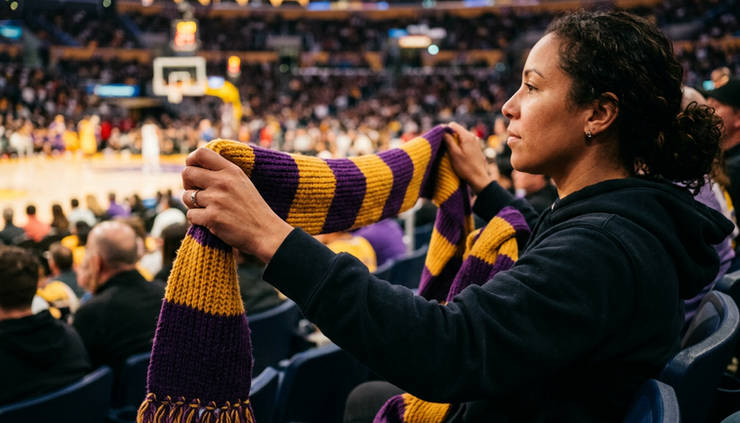
The purple and gold color scheme is one of the most recognizable in sports. Even without a logo, those colors signal glamour, pressure, and star power. The home crowd has its own rhythm too. Lakers fans can be demanding because they have seen greatness up close. They expect effort, style, and results.
That fan culture has layers. There are celebrity courtside images that travel across broadcasts. There are families who inherited Lakers loyalty from parents and grandparents. There are fans who came through Kobe, others through Magic, others through LeBron, and others who know the Minneapolis years by heart. The building can feel like both an event and a test.
Certain moments live almost outside time.
Magic starting at center as a rookie in the 1980 Finals. Kareem’s skyhook. Jerry West’s long-range Finals shot before the three-point line era could fully reward it. Kobe’s 81-point game. Kobe’s final 60-point night. Derek Fisher’s 0.4-second shot. Robert Horry’s playoff daggers. LeBron and Davis standing at the center of the 2020 title run.
These memories shape how every new season gets judged. A normal good year can feel incomplete in Los Angeles. A promising roster can still draw concern if it does not look title-ready. That pressure can be unfair, but it is also part of the franchise’s power.
For the 2026-27 team, tradition should not become a burden. It should become a guide. The best Lakers teams share common traits across eras.
They have a clear star structure.
They defend when the game slows down.
They rebound with force.
They turn role players into trusted specialists.
They create moments that fans remember years later.
The modern NBA has changed, but those traits still travel.
What would make 2026-27 a successful Lakers season
A successful season depends on the standard. For some teams, a playoff berth is enough. For the Lakers, the bar usually sits higher.
The 2026-27 Lakers will be judged by whether their best players stay healthy, whether the roster pieces fit, and whether the coaching staff builds habits that survive playoff pressure. Regular-season wins matter, but the larger question is whether the team can close games against elite opponents when every weakness gets targeted.
The path is clear enough.
Davis must play like a defensive anchor and offensive force. LeBron, if still part of the roster, must be used wisely and not asked to carry every possession. Guards must create without being hunted on defense. Wings must shoot and compete. The bench must keep games stable. The coach must choose an identity and stick with it long enough for the group to grow.
The Lakers’ past will always make the present feel bigger. That is the price of all those banners. It is also the privilege.
The 2026-27 season offers another chance to add a new chapter to a story that already includes dynasties, legends, heartbreak, reinvention, and unforgettable nights under bright lights. For the Lakers, the mission never really changes: build a team worthy of the jersey, then prove it when the season is on the line.


Comments