2026 Illinois Fighting Illini Football Team History Traditions and Key Players Guide

Illinois football carries a different kind of weight. It is not only about fall Saturdays in Champaign. It is about Red Grange running through Michigan, Dick Butkus setting the standard for linebackers, the Block I filling Memorial Stadium, and generations of fans measuring time by Big Ten games.
The 2026 Illinois Fighting Illini football team will step into that long story. Some roster details, depth chart battles, and schedule results will only become clear as the season gets closer. Still, the identity of the program is already rooted in more than a century of history, tradition, and unforgettable players.
This guide gives new fans a clear starting point and gives long-time supporters a fresh look at the moments that shaped Illini football.

The 2026 Illini enter a program with deep Big Ten roots
Illinois has played football since the late 19th century and has been part of the Big Ten story for generations. The program’s highs have often arrived in memorable bursts: dominant national stretches, Rose Bowl trips, elite defensive stars, and seasons when Champaign became one of the toughest stops in the conference.
For fans looking ahead to 2026, the most useful lens is continuity. Illinois football has usually been at its best when it has combined three traits:
Physical line play
Reliable defense
A clear offensive identity
That formula has mattered across eras. It was true when the Illini built early national power. It was true during Rose Bowl seasons. It still matters in the modern Big Ten, where travel, depth, recruiting, player development, and transfer portal management shape every season.
The official home for schedules, rosters, staff updates, and tickets is the Fighting Illini football page. For historical results and season-by-season records, Sports Reference’s Illinois football archive is one of the easiest places to browse.
A short history of Illinois football
Illinois football history stretches across several distinct eras. Each one added something to the program’s identity.
The early rise and the Red Grange era
The name most associated with early Illinois football is Harold “Red” Grange. Known as “The Galloping Ghost,” Grange became one of the most famous athletes in America during the 1920s. His legendary performance against Michigan in 1924, when he scored multiple touchdowns in stunning fashion, remains one of college football’s defining moments.
Grange did more than win games. He helped turn football into a national spectacle. His fame carried from Illinois to the professional game, and his legacy still lives in Champaign.
Fans who want more background can start with the College Football Hall of Fame profile for Red Grange.
Memorial Stadium and the World War I legacy
Memorial Stadium opened in the 1920s and stands as one of college football’s most meaningful venues. It was built as a memorial to University of Illinois students and alumni who died in World War I. The stadium’s name is not a branding flourish. It is a reminder of sacrifice and public memory.
That gives Illinois home games a layer of history beyond football. The stadium has changed over time, with renovations and improvements, but its central meaning remains.
A useful overview of the venue is available through the university’s Memorial Stadium information page.
Mid-century success and national respect
Illinois claimed major success in the first half of the 20th century, including national championship recognition in select seasons and several conference titles. The program also built a reputation for producing elite players who could succeed beyond college.
The Illini reached the Rose Bowl multiple times across their history, giving the program a national stage against top competition. Those Pasadena trips still carry emotional power because the Rose Bowl has long represented the Big Ten’s grandest postseason tradition.
The Dick Butkus standard
If Grange gave Illinois its enduring offensive icon, Dick Butkus gave it a defensive one. Butkus played center and linebacker at Illinois in the early 1960s, then became one of the most feared defensive players in football history.
His name has become shorthand for toughness, instincts, and relentless pursuit. The Butkus Award, given to top linebackers at multiple levels of football, extends that legacy.
For more on his career, visit the Pro Football Hall of Fame profile for Dick Butkus.
Traditions that define Illini football Saturdays
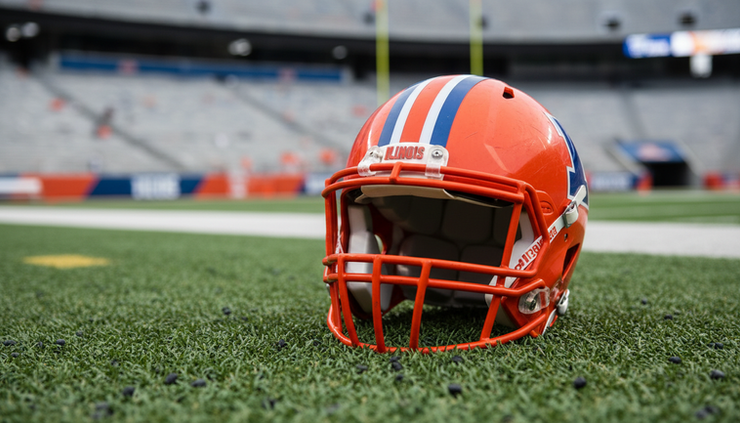
A football program becomes meaningful through rituals. Illinois has plenty of them, from the student section to the sounds that roll across Memorial Stadium.
The Block I
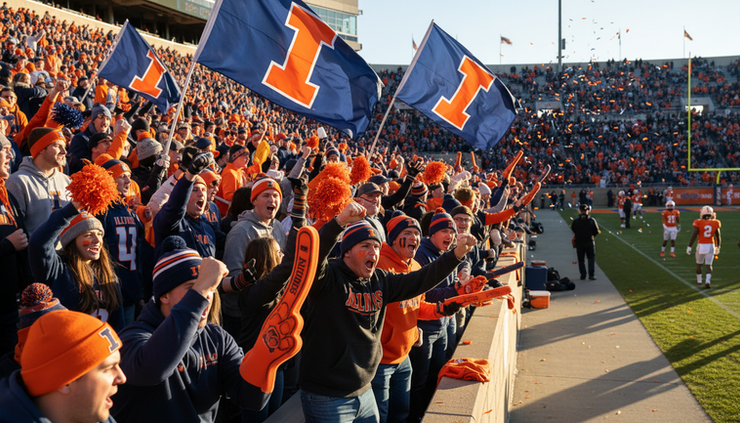
The Block I is one of Illinois’ most recognizable student traditions. It brings students together in coordinated orange and blue, giving the stadium a visual identity that feels distinctly Illini.
For new fans, this is one of the easiest traditions to understand right away. When the student section is full and loud, Memorial Stadium has a different energy.
Oskee Wow-Wow
“Oskee Wow-Wow” is the Illinois fight song, and it has been part of the school’s athletic culture for generations. Its title alone makes it memorable, but the real effect comes when the band plays it after big moments.
Fight songs matter because they connect eras. A fan in 2026 can hear the same tune that past generations heard after touchdowns, defensive stands, and rivalry wins.
The Marching Illini
The Marching Illini are a central part of the game-day experience. The band adds rhythm, pageantry, and school identity to Saturdays in Champaign. For many fans, the sound of the band is tied as closely to Illinois football as the first snap of the game.
The band has its own long history, which fans can explore through the Marching Illini website.
Orange and blue pride
Illinois’ colors, orange and blue, are simple but powerful. They show up in the stands, on helmets, in campus gear, and across alumni gatherings nationwide. For a program that has seen both peaks and rebuilding years, the colors are a steady thread.
Key moments every Illini fan should know
Illinois football history includes many games and seasons worth revisiting. These moments stand out because they still help explain the program’s personality.
Era or moment | Why it matters |
Red Grange against Michigan in 1924 | One of the most famous individual performances in college football history |
Rose Bowl appearances | Proof that Illinois has reached the sport’s biggest traditional Big Ten stage |
Dick Butkus’ college career | Set a defensive standard that still shapes how linebackers are judged |
Big Ten title seasons | Show the program’s ceiling when talent, coaching, and identity align |
Modern ranked wins and bowl seasons | Remind fans that Illinois can still create national noise |
One modern moment that many fans remember came in the 2007 season, when Illinois defeated Ohio State in Columbus and later reached the Rose Bowl. That team, led by a dynamic offense and key defensive playmakers, gave a new generation a taste of high-level Illini football.
For context on the Big Ten as a whole, the conference’s official football page offers current standings, awards, and news at BigTen.org.
Notable Illinois players across generations
Any guide to Illinois football must spend time with the players. The Illini have produced stars who changed college football, won major honors, and made long professional careers.
Red Grange
Grange remains the program’s most iconic name. His combination of speed, vision, and national fame made him one of the first true football superstars. Even fans who know little about early college football often know “The Galloping Ghost.”
Dick Butkus
Butkus represents the hardest edge of Illinois football. His linebacker play became the model for future generations. He later became an NFL legend, but his Illinois years remain central to his story.
Ray Nitschke
Ray Nitschke, another Illini great, became one of the most famous defensive players in Green Bay Packers history. His Illinois career helped lead him toward a professional path defined by toughness and championship success.
Hugh Green, Simeon Rice, and defensive tradition
Illinois has had several standout defenders across different eras, including pass rushers and linebackers who gave the program national credibility. Simeon Rice, in particular, became one of the most feared edge players in college football before a highly productive NFL career.
Modern Illini standouts
Recent Illinois teams have produced NFL talent on both sides of the ball. Defensive backs, linemen, running backs, and specialists have all helped restore attention to the program. Players such as Devon Witherspoon, Chase Brown, Kerby Joseph, and others showed that Illinois can develop athletes capable of thriving at the next level.
That matters for the 2026 Illinois Fighting Illini Football Team History Traditions and Key Players Guide because modern player development will shape how fans judge the next era. The tradition is not locked in old photos. It continues every time a player grows into an All-Big Ten performer or hears their name called in the NFL Draft.
What to watch as the 2026 team takes shape
Because rosters now change quickly, any responsible preview of the 2026 team should avoid pretending every detail is settled. The transfer portal, NFL Draft decisions, recruiting classes, injuries, and staff changes can reshape a team in months.
Still, several areas will define the Illini’s 2026 outlook.
Quarterback stability
Every Big Ten team needs steady quarterback play. Illinois does not always need a record-setting passer to win, but it needs smart decisions, protection of the football, and enough downfield threat to keep defenses honest.
A strong 2026 Illini season will likely require a quarterback who can handle pressure, read Big Ten defenses, and make late-game throws.
Offensive line growth
Illinois football has often been strongest when the offensive line sets the tone. In a conference known for physical fronts, the line affects everything: rushing success, quarterback comfort, red-zone efficiency, and fourth-quarter control.
Fans should watch returning starters, young linemen moving into larger roles, and portal additions who can compete right away.
Defensive identity
Illinois has a proud defensive past, and recent teams have reminded fans how much a strong defense can lift the whole program. The 2026 team will need speed in the secondary, discipline at linebacker, and consistent pressure up front.
The strongest Illini defenses do not only create sacks. They limit explosive plays, tackle in space, and give the offense short fields.
Special teams details
Special teams do not always get much attention until something goes wrong. Field position, reliable kicking, clean punt coverage, and return decisions can decide close Big Ten games. Illinois fans know how thin the margins can be.

Significant achievements that still shape the program
Illinois’ achievements deserve context. The program has claimed national championship recognition in selected historical seasons, won Big Ten titles, reached the Rose Bowl, and produced College Football Hall of Fame and Pro Football Hall of Fame talent.
Those achievements matter for three reasons.
They prove the ceiling is real. Illinois is not a program without history. It has stood at or near the top before.
They give recruits and fans a shared story. Players want to join programs with identity. Illinois can point to legends, major games, and NFL success.
They raise expectations. History does not win in 2026, but it can shape standards. Fans remember what the program can look like when it is strong.
For deeper historical browsing, the College Football Hall of Fame and the Pro Football Hall of Fame are useful starting points for Illini greats who reached the sport’s highest levels.
How new fans can follow the 2026 season
Following Illinois football is easier if you know where to look and what to track.
Start with the official team site for confirmed news. Use the Big Ten site for conference context. Check reputable local and national sports coverage for analysis, especially once fall camp begins. Historical databases can help compare the 2026 team with past Illini seasons.
A simple weekly checklist works well:
Review the opponent’s recent form and style of play.
Check Illinois’ injury and depth chart updates from reliable sources.
Watch line-of-scrimmage matchups on both sides.
Track turnovers, explosive plays, and red-zone results.
Revisit postgame notes to see which young players are earning more time.
That approach helps new fans understand more than the final score. It also gives long-time supporters a sharper way to evaluate progress.
The takeaway for 2026
The 2026 Illinois Fighting Illini will not be judged only against the present. Every Illini team carries echoes of Grange, Butkus, Memorial Stadium, the Marching Illini, the Block I, and the Rose Bowl dream that never fully leaves Big Ten football.
That history should not feel like pressure alone. It should feel like fuel.
For new fans, Illinois offers a program with real tradition, famous names, and a game-day culture worth learning. For long-time supporters, 2026 brings another chance to see how the next group adds to a story that has been growing for well over a century. Watch the line play, watch the defense, watch the young players, and listen when “Oskee Wow-Wow” rings out after a big Illini moment. That is where the past and future meet.


Comments