How Auction-Style Ticket Sales Work: A Buyer's Guide


Auction-style ticket sales are a competitive bidding process where tickets go to the highest bidder, letting market demand set the final price rather than a fixed face value. This model has grown significantly across concerts, sports events, and theater productions as promoters look for fairer ways to allocate high-demand seats. Understanding how auction-style ticket sales work gives you a real edge, whether you are chasing front-row seats at a sold-out show or trying to score a premium upgrade without overpaying. The Ticket Blog breaks down every step so you can bid with confidence.
How do auction-style ticket sales operate in online event ticketing?
Auction-style ticketing, also called competitive bid ticketing, works by opening a window during which buyers submit their maximum price for a specific seat or seat tier. The platform then ranks all bids and awards tickets to the highest bidders when the window closes. Payment is only charged if your bid wins, which means you are not tying up cash during the bidding period.
Most platforms use proxy bidding, a system where the platform automatically increases your bid in small increments on your behalf, up to the maximum you set. Proxy bidding protects you from manually overbidding and lets you participate without watching the auction in real time. Think of it like setting a ceiling: the system does the work, and you only pay what it takes to win, up to your limit.

Timing matters more than most buyers realize. Bidding windows typically range from a few hours to several weeks before the event, with seat upgrade auctions commonly opening 14–21 days after the original ticket purchase. The closer the event gets, the more competitive bids tend to become as urgency builds.
Key steps in the auction ticket sales process:
Register and verify: Create an account on the ticketing platform and confirm your payment method before the auction opens.
Review available seats: Check which seat tiers or upgrades are available for bidding, along with any listed minimum bid.
Submit your maximum bid: Enter the highest amount you are willing to pay. The proxy system handles incremental increases automatically.
Wait for the auction to close: The platform evaluates all bids at the end of the window and notifies winners.
Payment and delivery: Winning bidders are charged and receive their tickets digitally or by mail, depending on the platform.
Pro Tip: Submit your bid early in the auction window. Late bids can trigger competitive surges, and early entry gives the proxy system more room to work in your favor.
What are the different auction formats used for tickets?
Not all ticket auctions follow the same rules. The format determines how bids are placed, how winners are chosen, and how transparent the pricing is.
Auction format | How bids work | Winner selection | Pricing transparency |
Competitive open auction | Buyers bid openly and can see current high bid | Highest bidder wins | High |
Sealed proxy auction | Buyers submit max bid privately | System awards to top bidder | Moderate |
Dynamic pricing algorithm | No active bidding; price adjusts to demand | First buyer at current price wins | Low |
Charity Chinese auction | Buyers purchase tickets for chances | Random draw from prize container | Low |
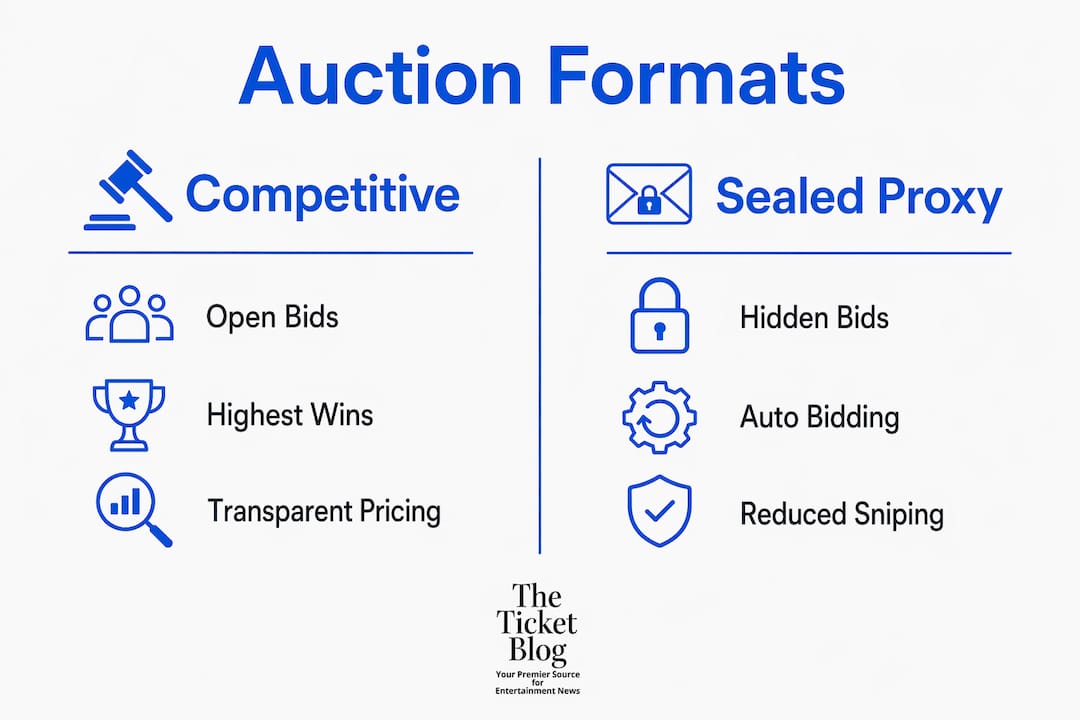
The most common format in event ticketing is the sealed proxy auction. Buyers never see each other’s bids, which reduces emotional overbidding. The platform reveals the outcome only after the window closes.
Not all online bidding platforms operate as true auctions. Many use dynamic pricing algorithms that simulate auction behavior but involve no competitive bidding at all. Prices rise and fall based on a pricing model, not on what other buyers are actually offering. This distinction matters because true auctions give you a real chance to win at a price you set, while dynamic pricing simply charges whatever the algorithm decides.
Charity events sometimes use the Chinese auction format, where bidders buy tickets representing chances and winners are drawn randomly from a container for each prize. Participants can place unlimited tickets in a single container to improve their odds. This format differs fundamentally from competitive auctions because skill and strategy play no role; it is purely a game of probability.
What are the benefits and challenges of auction-style ticketing?
Auction ticketing solves a problem that has frustrated fans for decades: scalpers buying tickets at face value and reselling them at a massive markup. Auction and dynamic pricing have grown as promoters try to recapture ticket value lost to the secondary market by setting prices closer to what the market will actually bear. When the artist or venue captures that premium directly, the money stays with the people who created the event.
Benefits for buyers:
Price discovery: You see what a seat is actually worth based on real demand, not an arbitrary face value.
Fairer allocation: High-demand tickets go to the buyers who value them most, not to whoever has the fastest internet connection at the moment of sale.
No immediate payment risk: You only pay if you win, so your money is never at risk during the bidding period.
Upgrade access: Seat upgrade auctions let you access premium sections at prices often well below the listed VIP rate.
Challenges to watch for:
Unpredictable final price: You may not know your total cost until the auction closes, which makes budgeting harder.
Platform trust: Not every platform running “auctions” operates transparently. Verify that the site is official or affiliated with the venue or artist.
Complexity for casual buyers: The proxy bidding system confuses first-time participants who expect a simple checkout process.
Pro Tip: Bid about 20% below the official VIP price for seat upgrades. Platforms cap bids at around 80–90% of listed prices, so bidding higher does not improve your odds and only increases your cost if you win.
How can you effectively participate in auction-style ticket sales?
Preparation separates buyers who win at good prices from those who overpay or miss out entirely. Follow these steps to participate with confidence.
Register before the auction opens. Most platforms require account verification and a saved payment method before you can place a bid. Complete this step at least 24 hours in advance to avoid technical delays.
Research the seat tier you want. Compare the auction’s minimum bid against the face value of the seat and the current secondary market price for the same event. This gives you a realistic ceiling before you commit.
Set your maximum bid based on value, not emotion. Decide the most you would pay for that seat before the auction opens. Changing your bid upward mid-auction is a common mistake that leads to overpaying.
Place your bid early in the window. Early bids give the proxy system more time to work and reduce the chance of a last-minute bidding surge pushing prices above your limit.
Use official channels only. Bid through platforms directly linked to the artist, venue, or authorized ticketing partner. Unofficial auction sites carry a real risk of fake listings and no buyer protection.
Understand what you win. Winning a seat upgrade auction typically improves your seating location, but original ticket terms such as refund policies remain unchanged. Only the seat class improves, not the underlying ticket contract.
Check delivery details. Confirm whether winning tickets arrive digitally, by mail, or at will-call. Digital delivery is standard for most event platforms and arrives within 24–48 hours of the auction closing.
How do auction-style sales differ from fixed-price and secondary market sales?
Understanding where auction ticketing fits in the broader ticket ecosystem helps you choose the right buying method for each event.
Sales model | Price set by | Buyer risk | Scalping exposure |
Fixed-price primary sale | Promoter or venue | Low | High (bots buy fast) |
Auction-style sale | Market demand via bidding | Moderate | Low |
Secondary market resale | Individual reseller | Variable | High |
Fixed-price primary sales set one price for all buyers in a tier, regardless of demand. This creates the conditions scalpers exploit: they buy at face value and resell at a premium. Auction ticketing removes that gap by letting the market set the price from the start.
Secondary market prices fluctuate widely based on popularity, venue size, and timing. Buyers can sometimes find tickets below face value on the secondary market when demand drops or sellers need to offload seats quickly. Auctions, by contrast, reflect demand at a specific moment in time and offer more predictable pricing than the secondary market’s constant fluctuation. For a deeper look at how private sales compare to auction models, The Ticket Blog covers the key differences in detail.
Fees also differ across models. Fixed-price tickets carry standard service fees set by the platform. Auction winners typically pay the winning bid plus a platform fee, while secondary market buyers often face the highest fees of all three models. Understanding the full cost before bidding is the clearest way to avoid surprises.
Key Takeaways
Auction-style ticket sales give buyers direct access to market-driven pricing, but winning at a fair price requires preparation, a firm maximum bid, and a clear understanding of the format being used.
Point | Details |
Proxy bidding is standard | The system bids incrementally on your behalf up to your maximum, so set it carefully before the window opens. |
Bid 20% below VIP price | Platforms cap competitive bids near 80–90% of listed prices, making higher bids costly but not more effective. |
True auctions vs. algorithms | Many platforms use dynamic pricing, not real competitive bidding. Verify the format before you participate. |
Original ticket terms persist | Winning a seat upgrade improves your location but does not change refund policies or other ticket conditions. |
Early bids outperform late ones | Submitting early gives the proxy system more room to work and reduces exposure to last-minute price surges. |
The Ticket Blog’s take on auction ticketing
Auction ticketing is genuinely better for informed buyers than most people realize. The problem is that most buyers walk in without a ceiling price and let urgency make the decision for them. That is how you end up paying more for a seat upgrade than you would have spent on a VIP ticket bought outright.
The most underappreciated part of this model is the proxy system. Buyers who understand it treat the auction like a negotiation with a clear walk-away point. Buyers who do not understand it treat it like a race, which is exactly the wrong mindset. Patience and a firm number win more auctions at better prices than aggressive last-minute bidding.
The shift toward auction and dynamic pricing is not going away. Promoters have watched secondary markets extract enormous value from their events for years, and auctions are the most direct tool to recapture it. For buyers, that means the skill of reading an auction format and setting a disciplined bid is becoming as useful as knowing where to find discounted ticket options before an event sells out.
The technology will keep improving. Expect more real-time bidding interfaces, better transparency on competing bid ranges, and tighter integration between artist fan clubs and auction access. Buyers who learn the mechanics now will be well positioned as these tools become the norm rather than the exception.
— The Ticket Blog
The Ticket Blog’s resources for auction ticket buyers
Auction-style ticketing rewards buyers who come prepared. The Ticket Blog publishes detailed guides on every major ticket buying model, including how to spot the difference between a true auction and a dynamic pricing tool, and how to find the best value across primary and secondary markets.
Whether you are new to bidding or looking to sharpen your strategy, The Ticket Blog’s event ticket guides cover the full picture: auction mechanics, fee structures, promo codes, and insider tips for concerts, sports, and theater. For buyers who want to understand every cost before committing, the hidden fee breakdown is a practical starting point. Verified information and trusted platform guidance are what The Ticket Blog delivers, every time.
FAQ
What is auction-style ticket sales in simple terms?
Auction-style ticket sales let buyers place competitive bids for event seats, with tickets going to the highest bidder when the auction window closes. The final price reflects real market demand rather than a fixed face value set by the promoter.
How does proxy bidding work in ticket auctions?
Proxy bidding means the platform automatically increases your bid in small steps on your behalf, up to the maximum you set, so you do not need to monitor the auction manually. You only pay the amount needed to beat the next highest bidder, not necessarily your full maximum.
How much should I bid for a seat upgrade?
Bid approximately 20% below the official VIP or premium seat price, since most platforms cap competitive bids at around 80–90% of the listed rate. Bidding higher than that threshold does not increase your chances of winning but does raise your cost if you succeed.
Are auction-style ticket platforms safe to use?
Platforms directly affiliated with artists, venues, or authorized ticketing partners are safe and offer buyer protections. Avoid unofficial sites running “auctions” without clear verification, as these carry a higher risk of fraudulent listings and no recourse if something goes wrong.
Do auction ticket wins come with the same guarantees as regular tickets?
Winning an auction-style upgrade improves your seat location, but the original ticket’s terms, including refund policies, remain in place. Only the seating class changes; the underlying ticket contract does not.
Recommended
Comments